
Bloomington council votes 5–4 to codify permanent seasonal Kirkwood closure
Bloomington’s city council voted 5–4 Wednesday to codify an annual Kirkwood Avenue closure from April 1 to Nov. 15 starting in 2027. Mayor Kerry Thomson now has 10 days after it's presented to her to sign or veto the measure, which drew significant public comment.
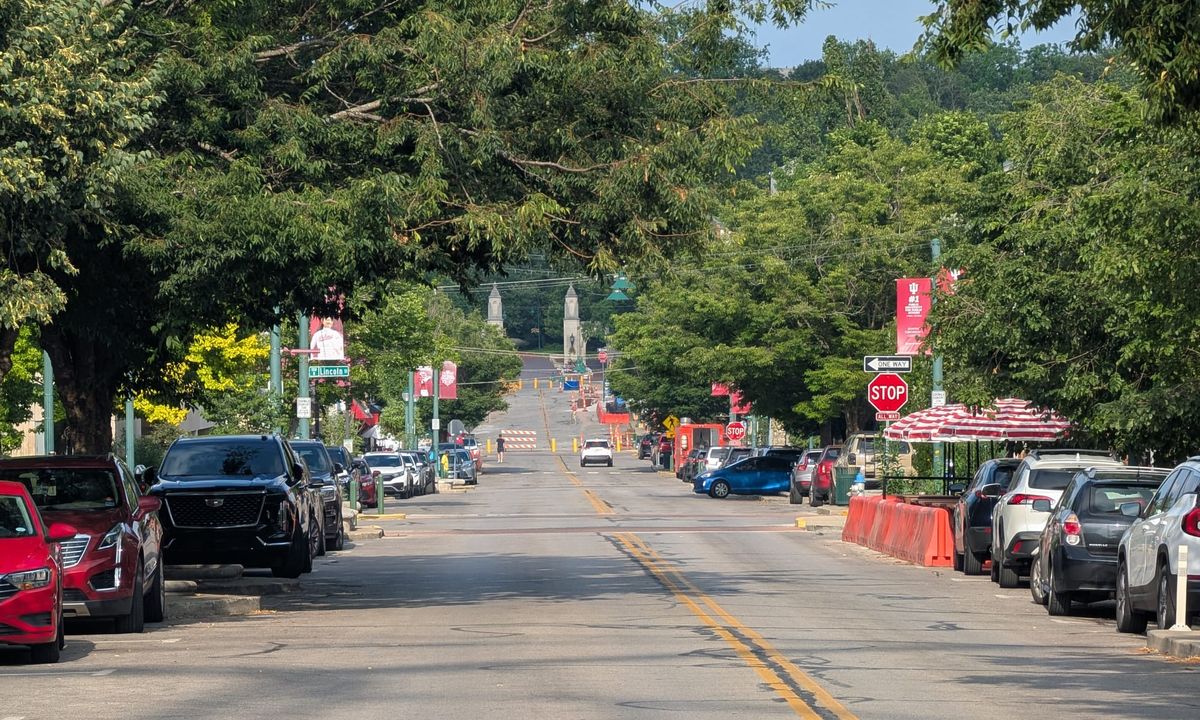
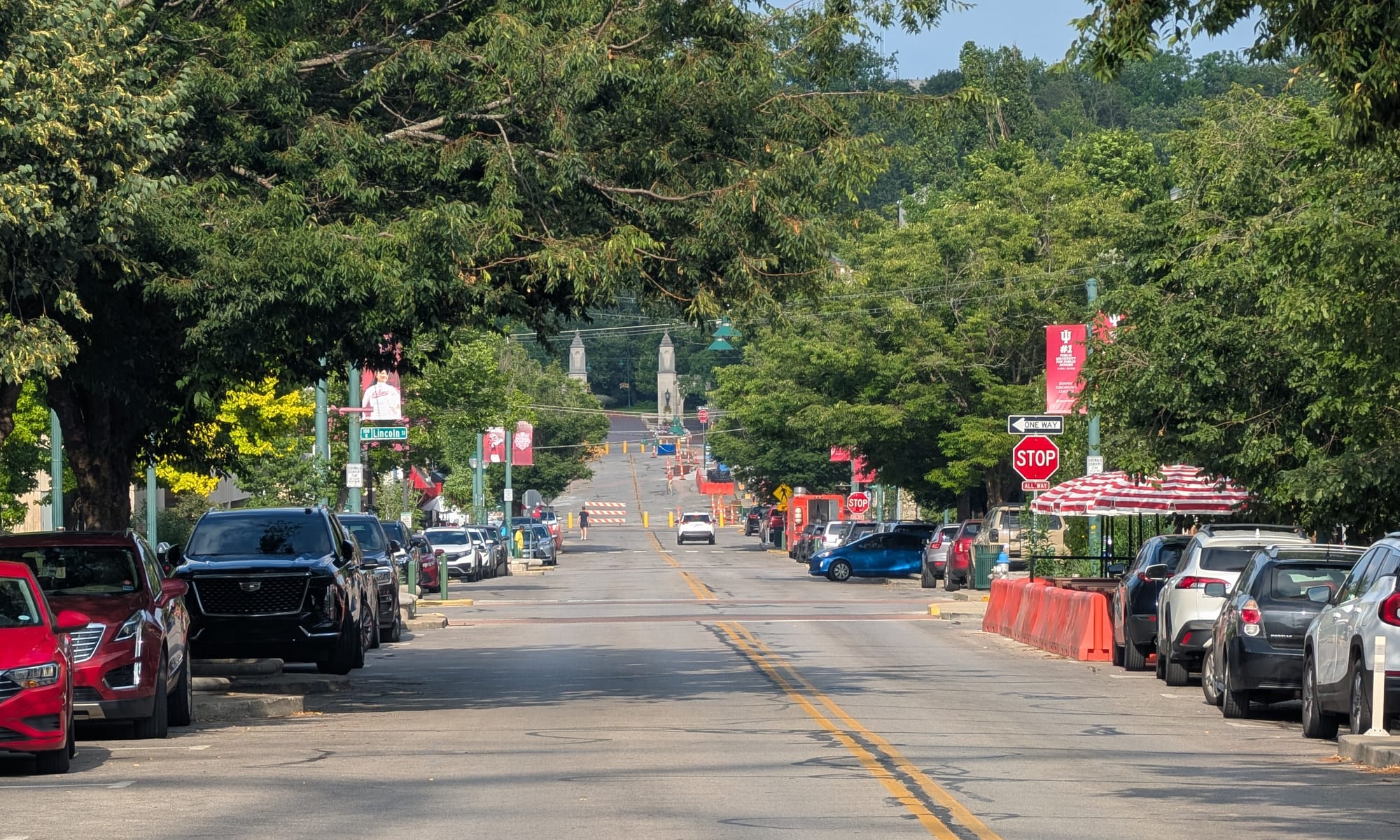
The closure of Kirkwood Avenue to automobile traffic from April to November every year starting in 2027 has been codified by Bloomington’s city council. At its regular meeting on Wednesday (June 10) the council voted 5–4 in favor of the ordinance mandating the closure.
The roll call on the vote came close to 10 p.m. after lengthy discussions between council members and numerous public comments.
Under state law, Bloomington mayor Kerry Thomson will now have to either sign the ordinance or veto it within 10 days of its presentation to her. Presentation of an ordinance to the mayor generally takes a few days.
However, the city council has the power to override a veto with a two-thirds majority, which is six votes on the nine-member council. The override vote has to take place at the next meeting of the council after the 10-day window for the mayor’s action.
Council president Isak Asare voted in favor of the ordinance, along with councilmembers Matt Flaherty, Courtney Daily, Dave Rollo, and Kate Rosenbarger. Councilmembers Sydney Zulich, Isabel Piedmont-Smith, Hopi Stosberg, and Andy Ruff dissented.
Kirkwood Avenue has been seasonally closed to traffic for five of the six years between 2020 and 2025. The city administration opted to keep the street open to vehicular traffic in summer 2026 while continuing to allow individual “parklet” installations for restaurants.
The ordinance now requires that the first five blocks of Kirkwood, from Indiana Avenue to Walnut Street, remain closed to vehicular traffic from April 1 to November 15 each year. The ordinance has an effective date of April 21, 2027, so for next year, the closure is slated to begin on that date.
This particular ordinance has been in front of the council since May 27. The council postponed its vote during the second reading on June 3 to allow the transportation commission to review the ordinance during a special hearing on June 8.
The commission was presented with staff findings that said the ordinance was not consistent with a set of criteria set forth in the city code. However, commissioners rejected those findings and forwarded the ordinance with a positive recommendation.
Before the council took its vote, it heard from councilmembers Daily and Rosenbarger, the ordinance’s co-sponsors, as well as transportation commission chair Steve Volan. This was followed by a period of public comments, from downtown business owners and residents, who represented a mix of opinions for and against the proposal to close Kirkwood Avenue to vehicular traffic.
Daily and Rosenbarger presented their views on how the ordinance can begin the process of converting Kirkwood Avenue into a public space that aligns with the goals and plans of the city and its residents. “Right now feels like a first step to me, and that is codification of this, and then the next step would be design charrettes, as called for in the transportation plan, and then deliberation sessions from city council,” said Rosenbarger.
“I think there’s a lot more hunger for being in outdoor spaces since the pandemic and people really appreciate having that space and that air around them,” said Daily.
During public comments, Hillary Martell, co-owner of Hartzell’s Ice Cream on Dunn Street, spoke against the ordinance. “As a downtown business owner, I am in full support of creating a more pedestrian-friendly. Kirkwood. My opinion, though, is that creating a carless Kirkwood and a pedestrian mall [on] Kirkwood, are two totally separate things,” said Martell.
Carole Canfield, who introduced herself as a lifelong resident of Bloomington, spoke against it as well. “I’m now at the point in my life where I can’t get around like I once did and I’m against closing Kirkwood permanently because it will cut me off from being able to use things such as the Bus-Chum [Buskirk-Chumley Theater]. I can’t walk the distance, and I’d like to be able to continue to use things in my hometown,” she said.
John Santos, a downtown business owner, brought up concerns about parking and the timing of the closure. “People are forgetting it takes vehicles to bring pedestrians,” he said. “Bloomington actually does have a lot of pedestrian residents, but those are students, and they’re actually gone during this period that you’re looking at closing Kirkwood, so your closing Kirkwood during the time Bloomington has the least amount of pedestrians and the least amount of traffic, and the least amount of people.”
There was also a series of comments in support of the ordinance. Zach Ammerman, vice-chair of the city’s commission on sustainability and resilience, said, “Bloomington has every structural advantage research identifies for implementing a successful pedestrian program, the one ingredient we are missing is political will and vision.”
Claire Woods, a resident, said, “As someone who was born and raised in Bloomington and used to spend an immense amount of time specifically on Kirkwood as a young child, who had two older sisters who worked at the library and loved that part of Bloomington, it’s drastically changed. And to see the potential ideas for third space are really neat.”
Dave Huber, who went to college and grad school in Bloomington and lives on the west side, said, “I am in favor of exploring options for making downtown more pedestrian friendly. I think the framing of whether or not to close Kirkwood to cars is hindering the conversation to some extent. I think the question might better be asked, how might we make downtown more friendly to pedestrians and I think that introduces a lot of ideas.”
Paul Rousseau, a city resident, focused on the pattern of discourse that has been taking place on this issue. “It seems that most of the people who look or sound like they’re under 40 are in support of it, and those who look or sound like they’re more my age are against it. And I don’t think that’s a coincidence,” he said. “I sympathize with my friends who have spoken against this tonight. I think the key will be—how do you get older people access?”
Katie Yoder, a city resident with two children, said, “While cars are a necessary part of our community, not every space needs to be designed around them. A pedestrian-focused Kirkwood gives families a place where people, not vehicles, are the priority. We understand that there are concerns about costs, implementation, and other areas of Bloomington that also need investment. Those are important conversations to have. However, we do not believe those priorities are mutually exclusive.”
Before the vote, during final deliberations, councilmember Rollo laid out the reasoning behind his vote. “My view is to bookmark this for the future and to revisit it through a series of deliberation sessions so that we can really dive deep into these particulars and make sure that whatever trade-offs are made makes sense, and that success is assured. I’ll be supporting this for now tentatively with the expectation that we will visit this again,” he said.
Councilmember Zulich said the current state of Kirkwood is not the version she would like to see closed. “If this passes, I promise not to bite my nose to spite my face, and I will do my best to support further activation efforts and investments that bring the city to life. That said, given our current financial situation, I cannot support this tonight,” she said.
Councilmember Stosberg provided an analysis of the issue based on personal experience and her own research. “The pro-con list is relatively balanced for this issue, and public sentiment doesn’t strongly lean to either direction. There is not an argument or a vote that will work for everyone,” she said. “I don’t think what we have right now on Kirkwood spells success for a closure to vehicular traffic, especially one that requires closure, as this ordinance does, of five complete blocks for only part of the year.”
Councilmember Piedmont-Smith brought up fiscal concerns facing the city in the near future. “I think there’s not an urgency to put this in our code now. Especially if we are seeing that our revenue sources are going to be limited in the coming years because of what the state legislature has done,” she said. “I just don’t think it’s fiscally wise to put this in our ordinance and then say, we’ll figure out the funding later before we’ve had any deliberation sessions.”
Councilmember Flaherty expressed skepticism about what the future would look like without a strong commitment from the council. “I generally have held the view for a long time, since before I served on council, that we can do great things in Bloomington, and that we have a unique and really special opportunity between the courthouse square and the Sample Gates to design a shared street, and to have that street be pedestrian-focused for much of the year,” he said.
According to councilmember Ruff, the city is not ready to make that commitment at this time. “Kirkwood to me, it’s bikeable, and it’s walkable and it’s drivable and parkable. I see a big vision that, yeah, this could come, but not without, as one of my council colleagues said a minute ago, without a real commitment to make this happen. And I just don’t think we’re in a position to make that commitment,” he said.
With this vote, the council has now put the ball in the court of an administration that wrote a memo in late May asserting that it does not support the ordinance. The next step in the saga of carless Kirkwood is to wait to see if Thomson signs the ordinance or chooses to exercise her veto powers.
After the 5–4 was taken around 10 p.m., the mayor did not immediately respond to a texted question from The B Square about a possible veto.

Comments ()