
Bloomington transportation commission backs car-free Kirkwood ordinance, despite staff findings
Bloomington’s Transportation Commission voted 5–1 to recommend a seasonal car-free Kirkwood ordinance, rejecting staff findings that the proposal conflicts with parts of city plans, and lacked targeted public engagement. The council is expected to decide the question Wednesday (June 10).
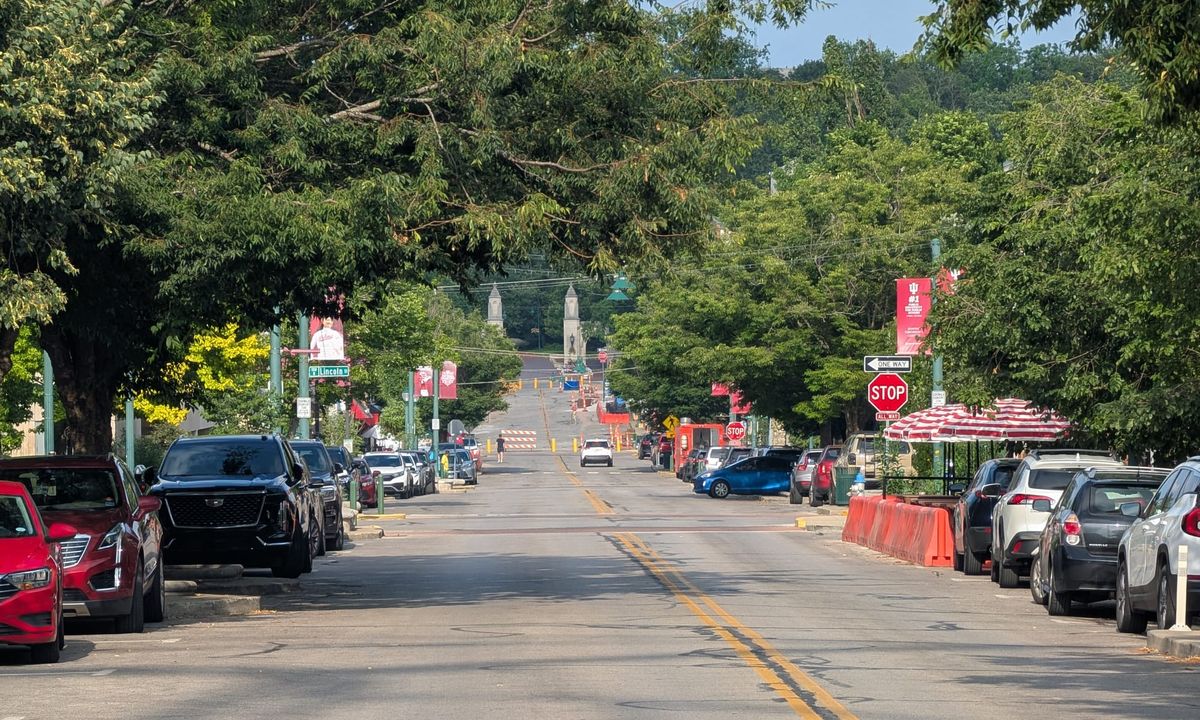
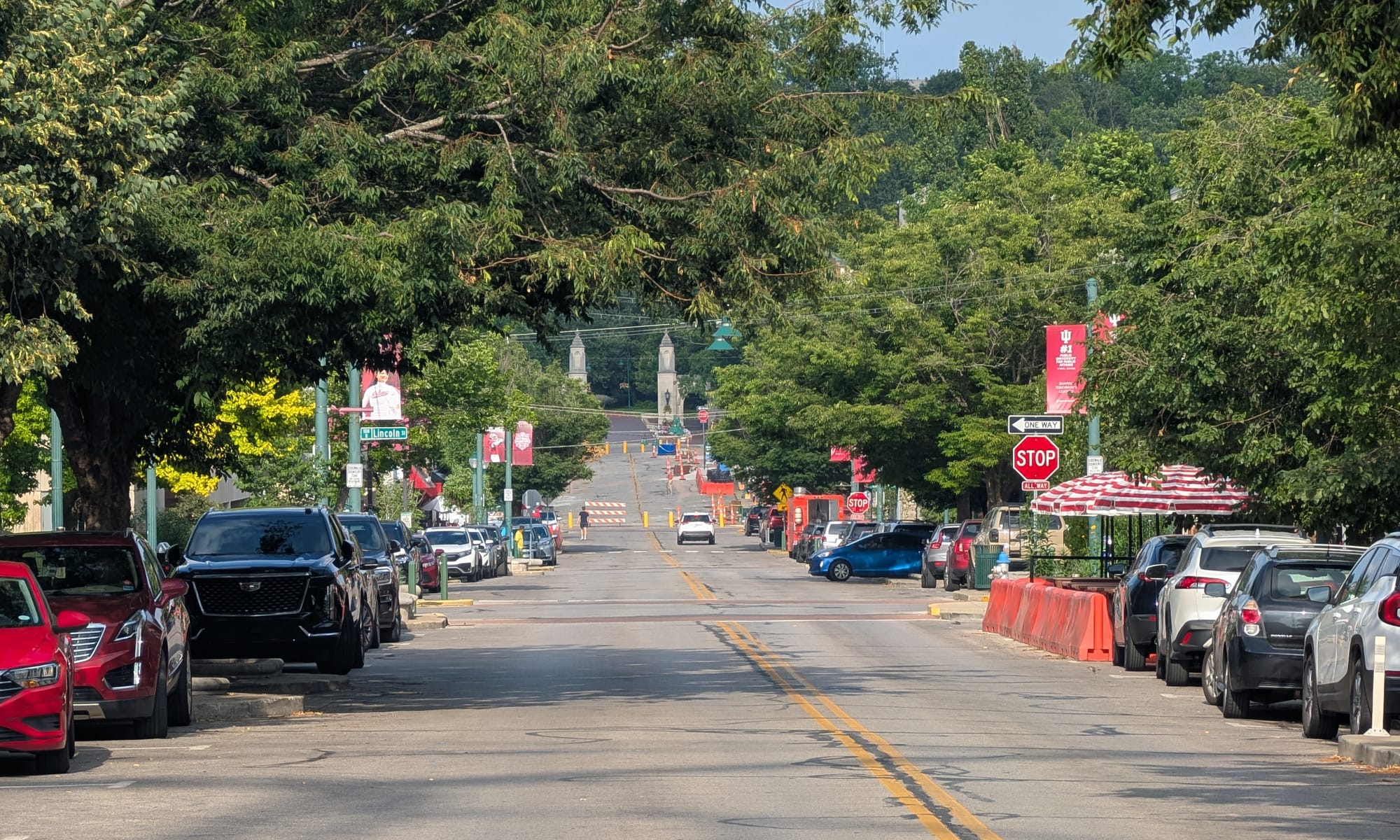
A proposed new city ordinance that would codify seasonally closing Kirkwood Avenue to vehicular traffic was reviewed by Bloomington’s transportation commission at a special meeting on Monday night (June 9), ahead of an expected city council vote on Wednesday.
After nearly two and a half hours of deliberation, the commission voted 5–1 to forward a positive recommendation on the ordinance to the city council. Dissenting was John Connell, who represents Bloomington Transit on the nine-member group. Absent from the meeting were Rick Coppock, Brian Drummy, and Oleksandra Sukhoruchko.
The ordinance would close Kirkwood Avenue to car traffic, from Indiana Avenue to Walnut Street, from April through mid-November every year.
The positive recommendation of the transportation commission was made despite a staff recommendation against the ordinance. The findings presented by city engineer Andrew Cibor supported a negative recommendation. That’s why the motion to forward a positive recommendation also included a rejection of the staff findings, and the adoption of new findings that the ordinance is “broadly consistent with the commission’s criteria for analysis.”
The city council did not vote on approval of the ordinance during its regular meeting on June 3, because a section of city code was interpreted to mean the city’s transportation commission first had to review the proposal, because it proposed to change Bloomington’s Title 15, on vehicles and traffic. Monday’s proceedings were meant to provide that review.
What this means for the ordinance now is that two days ahead of a possible city council vote, the transportation commission has officially said the ordinance meets the criteria against which the commission is required to review all transportation projects and proposed changes to Title 15 of the municipal code.
The criteria, as detailed in Bloomington’s municipal code, require the commission to determine if the changes to Title 15 proposed by the ordinance on Kirkwood are: (a) consistent with the comprehensive plan and other applicable city adopted plans, (b) consistent with the best practices for eliminating all transportation-related fatalities and serious injuries within the city, (c) consistent with advancing a sustainable transportation system and equitable access to all transportation facility users while prioritizing non-automotive modes, and (d) has adequately conducted public engagement and considered community-centric design tied to targeted outcomes.
The ordinance is being sponsored by councilmembers Kate Rosenbarger and Courtney Daily, who both attended Monday’s transportation commission meeting, along with councilmember Matt Flaherty, who is the council’s appointee to the commission.
Between Cibor’s presentation of staff findings and commission’s vote to reject those findings and forward a positive recommendation anyway, came lengthy deliberations and discussion of the ordinance.
According to the staff report, the ordinance is inconsistent with the vision of the Bloomington’s transportation plan, because it eliminates vehicles and parking from Kirkwood Avenue and has not followed the public engagement process specifically called for in the plan. That process says: “In order to implement the shared street recommendation on Kirkwood Avenue, from Indiana Avenue to Walnut Street, the City should first pursue a design charrette to gather input and ideas of business owners, residents, Indiana University, and other stakeholders.”
Cibor said during the hearing, “The transportation plan specifically identifies Kirkwood, a very specific project on Kirkwood, trying to focus it on improving it for pedestrians, but it calls it a shared street. A shared street is a street, per the transportation plan, that accommodates automobile traffic, it accommodates on-street parking.”
Cibor continued by pointing out that the transportation plan describes specifically for the Indiana-to-Walnut segment of Kirkwood Avenue a detailed public engagement process involving a design charrette. Cibor concluded, “This ordinance essentially is taking us further from [the transportation plan], it’s not moving us in the direction of the transportation plan.”
The staff report also found that closing Kirkwood Avenue to vehicular traffic “is not expected to significantly alter the risk of transportation-related fatalities and serious injuries.”
Cibor explained the finding about fatalities and injuries, saying, “Kirkwood is a high priority corridor from a safety lens. Closing the road segment likely could decrease crashes on that road segment, but it likely could impact other things. And whenever you’re changing patterns block by block or seasonally, there are additional other risks.”
In judging the third criterion, the staff report found that the proposal is consistent with some city transportation goals and inconsistent with others. For the final criteria, the staff found that adequate public engagement has not been conducted for this proposal, and it does not reflect a community-centric design or articulate targeted outcomes.
“As far as I am aware, there has not been specific public engagement tied to this ordinance,” said Cibor. “I want to also recognize, though, that there has been significant public dialog about Kirkwood, about the seasonal program, but there has not been something targeted to this proposal specifically.”
Following the presentation of staff findings, councilmembers Rosenbarger and Daily made a presentation of their own, rebutting some of the points made in the staff report.
“I went through Director Cibor’s criteria and put in a little bit from our perspective,” said Rosenbarger. “This ordinance is consistent with a lot of city goals and plans.”
She put special emphasis on Goal 6.1.5 of the Bloomington’s comprehensive plan: “6.1.5 really gives me some goosebumps,” she said, before quoting from the plan: “Encourage the concept of streets as not merely for transportation, but as important public spaces where community thrives.”
She also said she see’s the design charrette as “the second step to the process of disallowing cars on Kirkwood”.
Daily drew comparisons to other communities across the country. “We don’t have to copy what they did, but they were able to solve the criteria, these problems that we have identified as concerns,” she said, speaking about Iowa City.
She described how a fire lane down the middle of the road in Iowa City was used to address safety concerns. She also used examples from State College, Pennsylvania, and Burlington, Vermont to discuss strategies such as a pilot program to study the impact and engaging micro-retail to keep the space vibrant and dynamic.
During discussions, commissioners raised several concerns for both the council sponsors and the staff.
Commissioner Lesley Davis, who serves on Bloomington’s council for community accessibility, posed a question about people who are blind, and how this ordinance might affect them.
“We [the council for community accessibility] have members who take BT Access Transportation, and BT Access allows someone who is blind to travel alone independently and be dropped off exactly in front of where they want to go. So with Kirkwood closed, the closest you can get is the intersection,” Davis said. “I want to know what you’re thinking about in terms of these accessibility concerns.”
Flaherty asked the staff to clarify whether the city administration’s previous decisions to convert Kirkwood to a car-free street was also a violation of the comprehensive plan. “I’m having trouble squaring that, like the current recommendation [from the administration] is this doesn’t meet city plans, yet it’s what this administration recommended last year,” he said.
He also asked if staff considered the city’s climate action plan and its relevance to the proposed findings, to which city engineer Cibor and economic and sustainable development director Jane Kupersmith said that they did not.
Commissioner Steve Volan questioned the staff’s conclusion that risk to traffic injuries would not be altered by the ordinance. “You talked about how it’s not expected to significantly alter injuries, but if [Kirkwood Avenue] is a high priority [street], I don’t understand. There seems to be a disconnect,” he said.
Commissioner Eoban Binder asked for the staff’s perspective on what the administration’s efforts have been to engage with the city council on this issue. “I’d be interested in understanding, like your characterization of what the administration’s efforts have been, like concrete efforts towards council so far, and engaging them, because I’m sort of interpreting this as like the council doesn’t feel like they have a lot of options left to kind of keep this process moving forward,” Binder said.
Volan also asked staff whether, in case the ordinance did not pass, the administration still intended to implement any kind of carless Kirkwood plan in 2027 or some later year. Kupersmith said that there would be a corridor study of Kirkwood in 2027, but as for a closure, “I don’t think that we can speak to that at this time.”
Volan indicated that according to the bylaws of the transportation commission, a majority of the full commission is required to pass a motion.
At the end of the discussion, the commission first voted on a motion to adopt no findings and forward a neutral recommendation. That motion failed 3–3, with commissioners Davis, John Connell, and Mark Stosberg for it and Flaherty, Volan, and Binder against it. (Transportation commissioner Mark Stosberg is married to city councilmember Hopi Stosberg, who will have one of the nine votes on Wednesday to decide whether the ordinance gets enacted.)
Following the 3–3 tie, the commission voted on a motion to adopt the staff findings and negative recommendations. That motion also failed, this time 2–4, with commissioners Connell and Davis for the motion and the other four against it.
Finally, the commission voted on a motion to reject the staff findings, adopt new findings that the ordinance is “broadly consistent with the commission’s criteria for analysis”, and forward a positive recommendation on the ordinance to the city council.
That motion passed 5–1, with Connell the sole voice of consent.
The city council will decide the future of the ordinance at its meeting on Wednesday (June 10).
If it is adopted, it could test whether Daily’s framing of the proposal as a way to “light a fire under this” is accurate, and it actually becomes a catalyst for mayor Kerry Thomson’s administration to act in the way that advocates on the council hope.


Comments ()