
Bloomington mayor vetoes AI superintelligence ban, citing research, enforcement and surveillance concerns
Bloomington mayor Kerry Thomson declined to sign a city council ordinance banning artificial superintelligence, citing concerns about enforcement, legal authority, privacy and the local innovation economy. The council could override her veto on Dec. 2, if there are at least six votes in support.
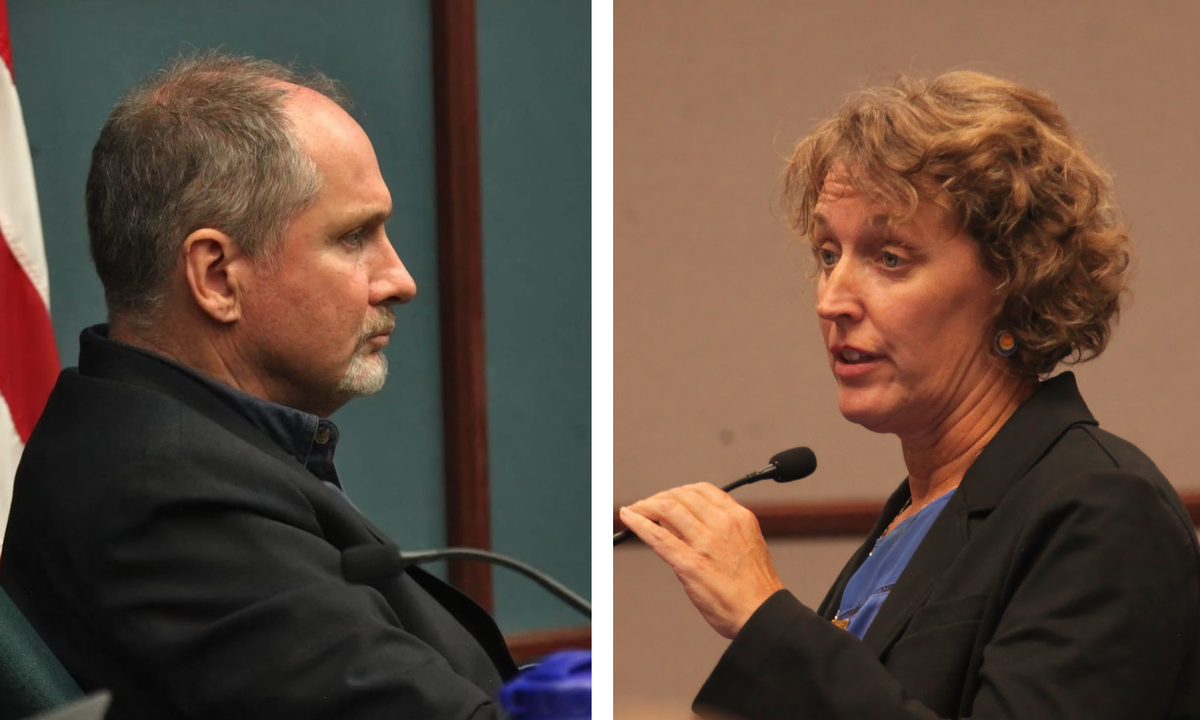
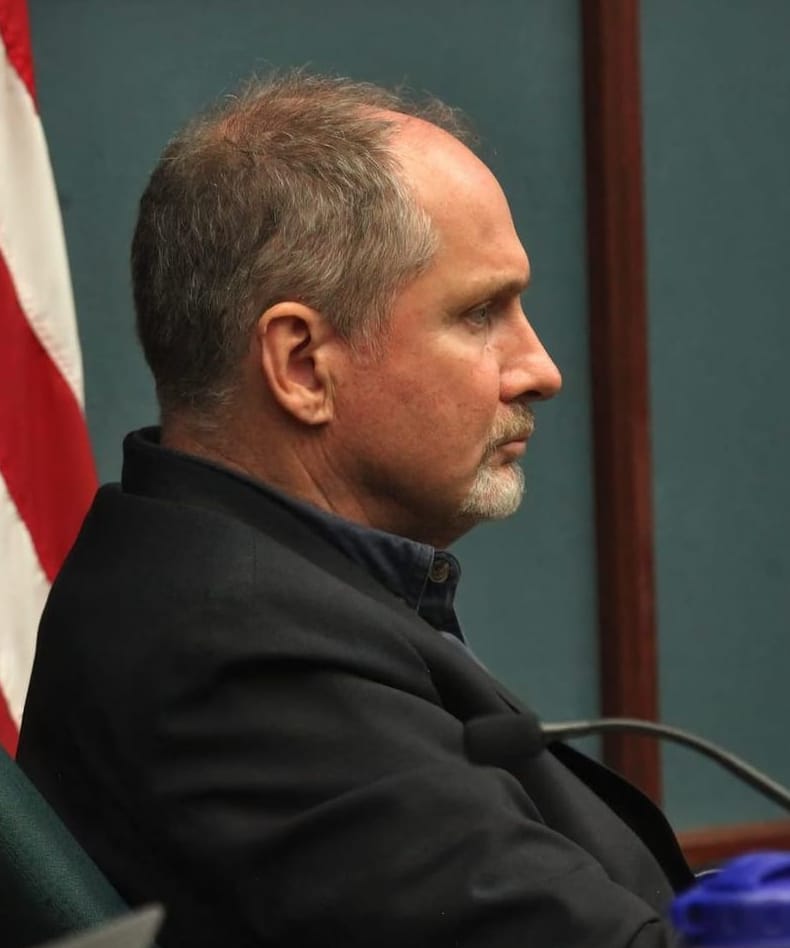
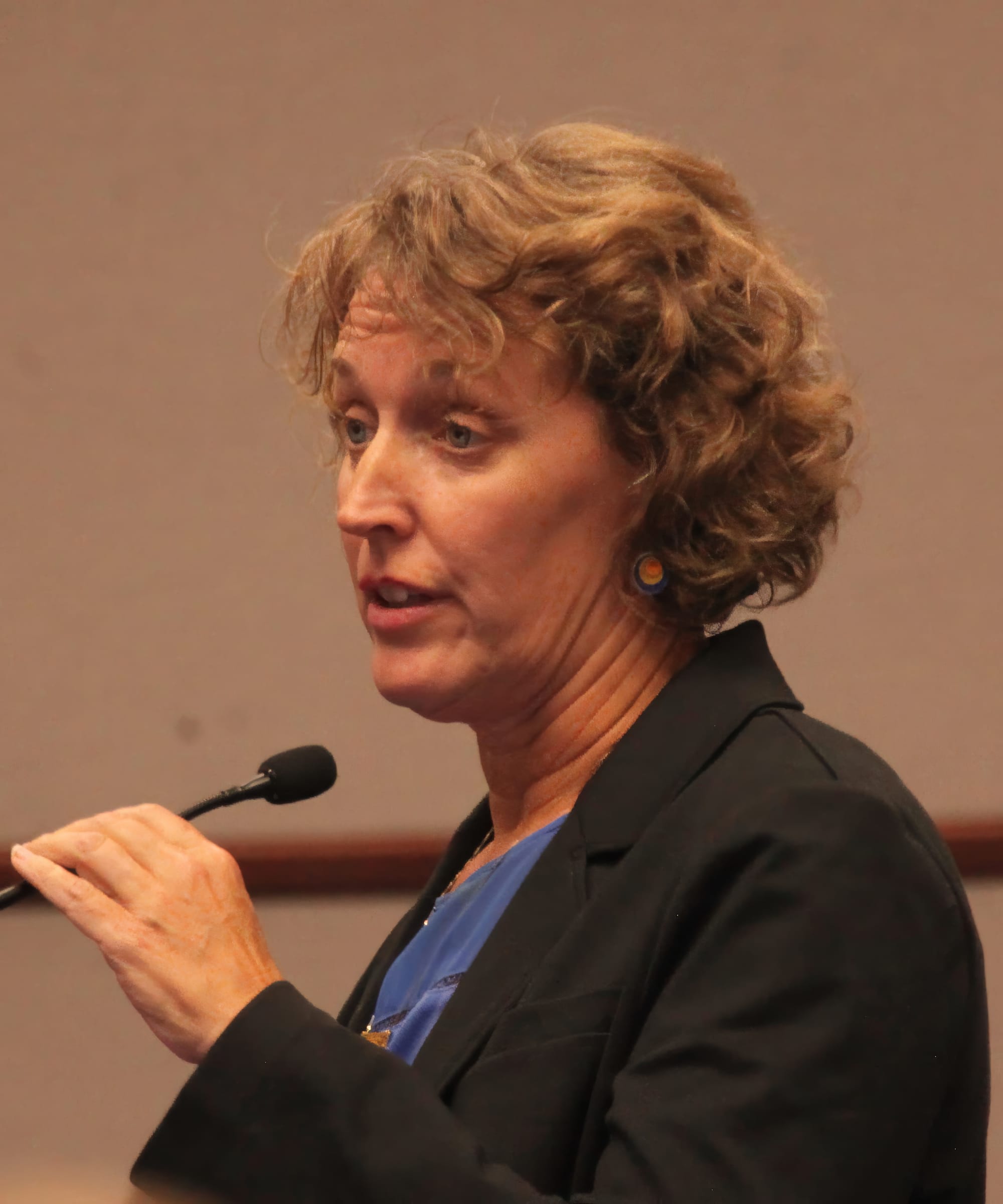
Left: B Square file photo of Bloomington councilmember Dave Rollo. Right: B Square file photo of Bloomington mayor Kerry Thomson.
Bloomington mayor Kerry Thomson will not sign an ordinance approved 7–0 by the city council earlier this month that would prohibit the distribution and deployment of artificial superintelligence within city limits.
In a statement issued Thursday afternoon (Nov. 19), Thomson cited concerns about the ordinance’s potential impact on Bloomington’s research and innovation economy, as well as unanswered questions about the city’s legal authority to regulate the technology and how it could enforce such a prohibition without monitoring private digital activity.
“Bloomington is working hard to grow our innovation economy, and artificial intelligence plays an important role in that work,” Thomson said. “AI already contributes to advances in research, medicine, education and many other fields.”
She added: “We also need to be careful about creating unnecessary barriers that discourage those very people from investing in our community.”
According to the city clerk’s office, the ordinance was presented to the mayor on Nov. 9 at 5:13 p.m., giving her until 5:13 p.m. Thursday to sign it or return it to the council with a veto message. If she does neither, the ordinance is considered vetoed under Indiana law.
The council could attempt to override the veto at its next regular meeting, scheduled for Wednesday, Dec. 2, at 6:30 p.m. An override would require six votes in favor from the nine-member council. Seven councilmembers voted for the ordinance Nov. 4, when two members were absent. The two absent members were Sydney Zulich and Kate Rosenbarger.
The mayor’s objections to the ordinance come despite several amendments adopted by the council before its final vote. Those changes were intended in part to narrow the ordinance’s scope, address concerns that it could affect ordinary users of AI technology, and other issues identified soon after councilmember Dave Rollo introduced it.
Reached by phone on Thursday after the mayor released her statement, Rollo told The B Square he is still optimistic about working with the mayor on a version of the ordinance she might eventually be willing to sign.
He wants to collaborate with her because, he says, superintelligent AI is “a deadly risk for everyone.” He added the fact that it’s not just dangerous, but has an urgent timeline: “Obviously, we’re racing forward as the horizon is racing at us. I mean, this is madness. And there are huge consequences.”
Rollo responds to concerns about research
Rollo appeared to anticipate concerns about Bloomington’s research community when he made a statement at the start of Wednesday night’s (Nov. 18) council meeting.
His remarks came less than 24 hours before the mayor’s deadline and focused partly on the distinction between the hypothetical technology targeted by his ordinance and the AI applications already being developed and used locally. “[Bloomington’s ordinance] is emphatically not what tech businesses are using here or at IU,” Rollo said.
He described artificial superintelligence, or ASI, as a particular kind of autonomous AI system capable of outperforming humans across virtually all cognitive fields and improving its own underlying technology without continuous human supervision. “This particular AI, ASI, hasn’t yet arrived,” Rollo said. But he contended that developing such systems is the goal of leading AI companies and that the technology could arrive soon.
He contrasted that goal with the work underway at Indiana University, which he characterized as human-centered artificial intelligence, emphasizing ethical deployment, human oversight and beneficial social impacts. “Local tech applications and IU are to be lauded for their approach,” Rollo said.
The distinction is central to Rollo’s argument that the ordinance would protect Bloomington without undermining its technology industry. But the distinction between what Rollo intends to prohibit and how the ordinance could be interpreted or enforced is also central to Thomson’s objections.
Her statement raises the question of whether researchers, entrepreneurs and investors would be reassured by the Rollo’s explanation or concerned about the possible application of a local prohibition whose technical boundaries have yet to be established.
In her statement, Thomson acknowledged the risks Rollo is attempting to address. “I appreciate Council’s efforts to address the risks of increasingly autonomous AI systems and the national conversation this legislation has helped advance,” she said. “Those risks deserve serious consideration.”
But Thomson drew a distinction between acknowledging those risks and enacting an ordinance the city would be responsible for enforcing.
How would the city enforce a ban?
“As mayor, I have a responsibility to lead the team that implements and enforces our ordinances,” Thomson said. “This ordinance leaves significant questions about how the City would identify violations, what authority we have to regulate them and what enforcement would require.”
The ordinance would add a new chapter to Bloomington’s municipal code under Title 14, which governs peace and safety.
The challenge begins with determining what technology would be covered. The proposed chapter defines superintelligence in terms of agency, generality and intelligence. It describes autonomous systems capable of modifying their own algorithms, executing computer code outside restricted environments and undertaking complex tasks without continuous human oversight, combined with capabilities vastly exceeding human cognitive performance.
That is different from ordinary generative AI systems, including chatbots and software used to produce written material, computer code or images.
But the ordinance does not establish a testing procedure or designate an independent authority to determine when a particular AI system has crossed the threshold into superintelligence.
A second complication is geographic. The ordinance would prohibit distribution and deployment of ASI within Bloomington, including through websites, software and other electronic interfaces, even when the computers hosting those systems are physically located elsewhere.
In other words, an AI company could potentially violate Bloomington’s municipal code by making a prohibited system available to someone in the city, even if the company and its computers were located in another state.
The city would be attempting to regulate the delivery of a digital product across jurisdictional boundaries. The ordinance invokes the city’s powers under Indiana’s Home Rule Act and compares superintelligence to hazardous substances and industrial processes that local governments can regulate in the interest of public safety.
Whether those powers would support a prohibition extending to remotely operated digital systems is an unresolved legal question.
The ordinance would authorize the city’s legal and police departments to seek civil penalties and court orders against violators. Enforcement would be discretionary, rather than mandatory.
Thomson identified another concern in her Thursday statement: The potential consequences for a resident’s privacy if the city attempted to determine whether prohibited AI systems were being accessed or distributed. “The potential need to monitor private digital activity is especially troubling given our recent work to strengthen protections against government surveillance,” she said.
That concern comes just five weeks after the city council voted 7–0 to prohibit automated license plate readers and certain surveillance camera systems that allow outside entities to access recordings and data. The council took that action onOct. 14.
The superintelligence ordinance does not itself authorize new surveillance of internet activity. But Thomson’s concern is that enforcing its prohibition could create pressure for the city to investigate private digital communications.
“Passing a law carries responsibilities beyond stating a principle,” Thomson said. “We need to be confident that we can implement and enforce the laws we adopt.”
When reached by phone on Thursday by The B Square, Rollo rebutted Thomson’s concern that enforcement could require surveillance of private digital activity. “We don’t need to surveil anyone,” he said.
Rollo suggested that violations could be reported through complaints or investigated by testing whether a prohibited system was accessible from a city-operated computer.”
Council amendments narrow the ordinance
The council adopted four amendments before approving the ordinance on Nov. 4. It was Rollo himself who put all four amendments forward, including revisions intended to address objections to its original wording.
One amendment explicitly excluded end-user access from the prohibition. The revised language focuses on entities distributing or deploying superintelligence rather than individuals using technology made available to them. Under that provision, a Bloomington resident would not violate the ordinance merely by accessing an AI system through an electronic interface.
Another amendment removed an extraordinary restriction on repealing the prohibition. Rollo’s original proposal would have required approval from more than 95% of Bloomington’s registered voters, along with findings establishing an extremely high level of scientific certainty about the safety of superintelligence, before the ban could be lifted.
The amendment removed those conditions from the operative law. It retained a scientific-safety objective in the ordinance’s preamble, but no longer made the finding and referendum requirements for repeal.
The other two amendments revised terminology to distinguish artificial superintelligence from artificial general intelligence and added a reference to the council’s earlier resolution on the risks of advanced AI.
The amendments reduced the potential reach of the ordinance, but did not resolve the underlying question of how Bloomington would identify prohibited systems or determine whether companies outside its boundaries were distributing them within the city.
A local law intended to have national consequences
The ordinance vetoed by Thomson represents a third effort by Rollo to persuade Bloomington’s city government to address what he and others warn is the existential danger to the human species posed by increasingly powerful artificial intelligence.
In July 2023, Rollo proposed a resolution calling for a moratorium on developing artificial general intelligence until adequate safeguards could be established. He withdrew it after officials with Indiana University raised concerns about possible implications for research funding, and sufficient support from council colleagues appeared unlikely.
On June 10 of this year, the council unanimously adopted a resolution calling on governments at other levels to address the existential risks of artificial intelligence and urging a moratorium on developing advanced AI until the technology could be aligned with human values and well-being.
That resolution was nonbinding. It expressed the council’s position without establishing a local prohibition. The ordinance approved by the council in early November goes further by attempting to make distribution and deployment of superintelligence a violation of Bloomington law.
Rollo’s goals extend beyond Bloomington.
The ordinance is part of a strategy he envisions being replicated by hundreds of municipalities, with local prohibitions eventually generating enough pressure to prompt state, federal and international restrictions on advanced AI development. But he says that hundreds of cities adopting similar measures could create pressure for more comprehensive regulation.
That tension between the ordinance’s local enforceability and its broader political purpose runs through Thomson’s decision not to sign it.
The mayor’s statement does not reject the premise that advanced AI carries serious risks. It questions whether the proposed Bloomington ordinance is an appropriate and workable way to address them.
Rollo, by contrast, maintains that local action is necessary precisely because higher levels of government have not moved quickly enough.
At Wednesday’s (Nov. 18) meeting, he cited new research and warnings from AI experts to support his view that technological progress is accelerating and that the opportunity to prevent the development of dangerous systems could be closing.
He told councilmembers that AI-safety advocate Nate Soares had contacted him after the Nov. 4 vote to congratulate Bloomington and express hope that other cities would follow its example. Rollo said the resulting movement could eventually lead to national and international restrictions on developing artificial superintelligence.
What happens next?
The immediate question is whether the city council will attempt to override Thomson’s veto.
Under Indiana state law, a vetoed ordinance is defeated unless the council approves it again by a two-thirds vote at its first regular or special meeting after the mayor’s 10-day decision period. That makes the scheduled Dec. 2 meeting the council’s chance for an override, unless the council holds an earlier special meeting.
Six votes in favor or the ordinance would be required, regardless of how many councilmembers attend.
The council’s Nov. 4 7–0 vote demonstrated substantial support for Rollo’s ordinance. But it does not guarantee an override. Councilmembers could decide that the mayor’s objections warrant additional changes, even if they supported the original measure.
There is a recent precedent for that distinction. In June, the council voted 5–4 to approve an ordinance requiring seasonal vehicle closures on Kirkwood Avenue. Thomson vetoed it, citing concerns about public engagement, finances and implementation.
When the council attempted an override in July, Rollo was among those who declined to support it, despite having voted for the ordinance initially. The override failed 4–4.
In wrapping up Thursday’s statement, Thomson left open the possibility of a revised superintelligence ordinance. “I have discussed this ordinance at length with Councilmember Dave Rollo, its sponsor, and appreciate his openness to revisions,” she said.
She added, “I look forward to continuing that work to support Bloomington’s research and innovation economy while establishing clear, enforceable safeguards. I will not sign the ordinance as written.”
In that wording, Rollo told The B Square he sees an invitation to work collaboratively with the mayor and is leaning toward collaboration rather than trying for a veto override. “There is an avenue there, I think, for collaboration, and I certainly want to try to pursue that,” he said. “It goes further if we’re working as a team rather than ... as adversaries.”

Comments ()