
Bloomington council falls short of overriding Thomson veto of seasonal Kirkwood closure
Bloomington’s city council fell two votes short of overriding Mayor Kerry Thomson’s veto of a mandatory seasonal Kirkwood Avenue closure. The 4–4 vote left the ordinance defeated after Dave Rollo reversed his earlier support.
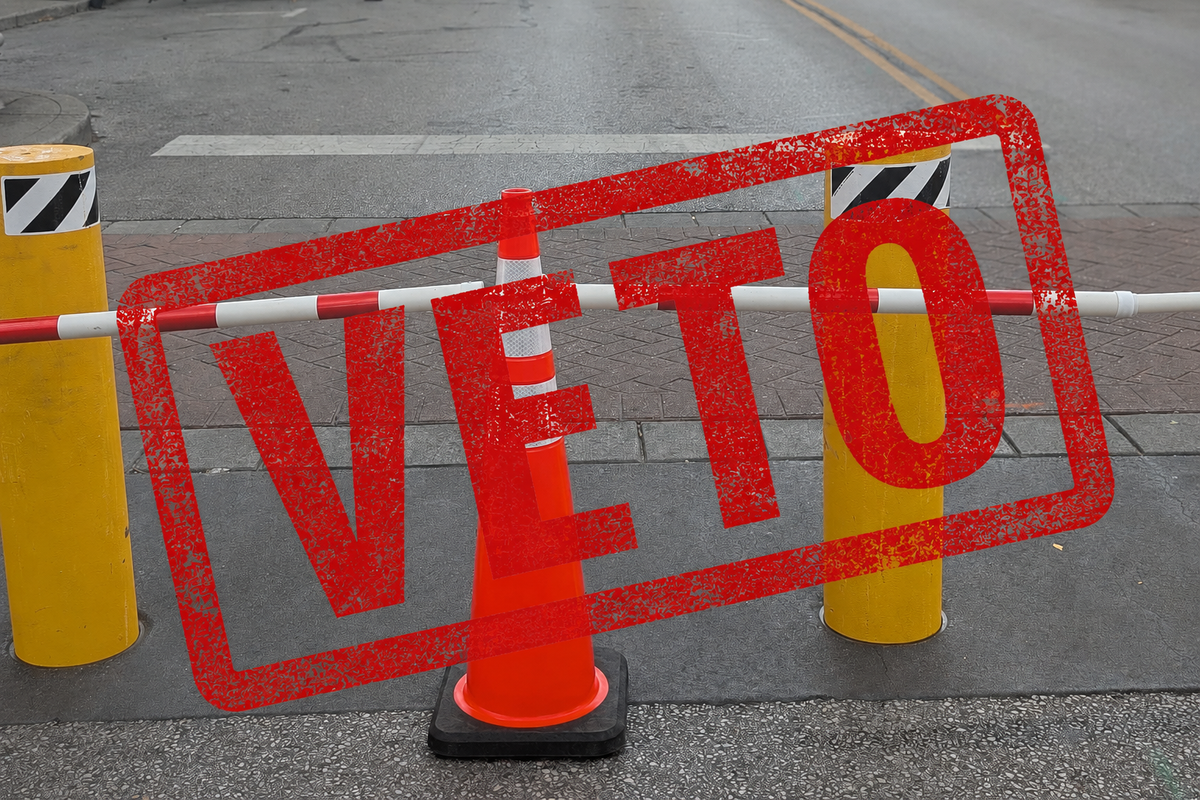
Bloomington’s city council failed Wednesday (July 22) to override mayor Kerry Thomson’s veto of an ordinance that would have required five blocks of Kirkwood Avenue to close to motor vehicles for more than seven months each year.
After voting 5–4 on June 10 to permanently enact a seasonal street closure as a part of city code, the council’s vote on the same ordinance Wednesday night was 4–4. That fell two votes short of the six required for a veto override under state law.
Voting for the override were: Isak Asare, Courtney Daily, Matt Flaherty and Kate Rosenbarger. Voting to sustain the veto were: Isabel Piedmont-Smith, Dave Rollo, Andy Ruff and Hopi Stosberg. The tally did not add to nine because Sydney Zulich was absent.
The result reflected a changed vote by Rollo, who supported the ordinance when the council originally approved it on June 10. The other seven councilmembers present on Wednesday voted the same way they had in June.
The failed override leaves the ordinance defeated, meaning the five-block closure from April 1 through Nov. 15 will not be placed in the city’s traffic code.
The vote does not repeal the separate outdoor-dining ordinance the council approved in 2025. That ordinance remains on the books, even if not a part of city code. It gives the city engineer authority to administer or suspend the outdoor-dining program based on emergencies, participation or other conditions that make it impractical. The Thomson administration could also continue authorizing shorter Kirkwood closures for festivals and other individual events.
Indiana state law requires a two-thirds vote to override a mayoral veto. It also requires the override vote to occur at the council’s first regular or special meeting after the mayor’s 10-day period for acting on the legislation. Because Bloomington has nine councilmembers, an override required six affirmative votes.
The ordinance would have required the five blocks of Kirkwood Avenue between Walnut Street and Indiana Avenue to close to motor vehicles annually through Nov. 15. Its April 21, 2027, effective date meant the first closure would have begun on that date, with an April 1 starting date in later years.
Rollo, who changed his position, said his original vote had been intended to force a broader discussion about Kirkwood, not to establish an inflexible outcome. On Wednesday, he said the street could become an “amazing space,” but that the council needed to work with the administration, businesses, churches, accessibility advocates and other stakeholders before committing to a long-term seasonal closure.
“I don’t want to just barrel through and say, ‘We’re going to close it, and you figure it out,’” Rollo said. He said he took Thomson at her word that she wanted the council and administration to work together on a long-term vision for Kirkwood. “I’m not going to attempt to override the veto,” Rollo said. “I’m going to actually reverse my vote this evening.”
He said he entered that process expecting the city ultimately to produce a better Kirkwood and remained open to proposals that would maximize pedestrian use of the street.
Supporters: Doubt prospects for mayoral collaboration
About an hour and 15 minutes ticked by between the motion to adopt the vetoed ordinance and the final roll call.
Rosenbarger made two sets of remarks totaling almost 20 minutes. Flaherty spoke for nearly 10 minutes. Both Flaherty and Rosenbarger participated in the meeting through a remote video connection.
Rosenbarger began by acknowledging that she and Daily already knew they did not have the six votes needed for an override. She nevertheless described the ordinance as one of the most rewarding measures she had worked on, because of the enthusiasm and ideas it had generated from residents.
She cited people with disabilities who said they felt safer on a street without moving vehicles, families who used the space with children and people who had experienced successful pedestrian streets in other cities.
Rosenbarger also described an Indiana Housing and Community Development Authority program called CreatINg Places, which provides matching money for community-funded improvements to public spaces. She said similar projects around Indiana showed that attractive public spaces could be created without relying entirely on city tax dollars.
Her sharper criticism came near the end of the debate, when she said that the central obstacle was not money or accessibility but Thomson’s willingness to work with the council. “The point of this was just to encourage and pressure the mayor to work with this city council,” Rosenbarger said.
She cited previous disputes over the Hopewell planned unit development (PUD) and a council deliberation session on sidewalk snow removal as examples of what she considered the administration’s failure to treat the council as a governing partner. “This ordinance was inspired by a lack of collaboration,” Rosenbarger said.
Rosenbarger said councilmembers could have amended the ordinance later to change the dates, reduce the number of blocks or postpone implementation if planning showed that changes were necessary. Defeating it, she said, eliminated the policy direction that would have required the work to move ahead.
For his part, Flaherty described the proposal not as a street closure but as a conversion of public space from motor-vehicle use to use by pedestrians, wheelchair users, bicyclists, shoppers, diners and others.
Kirkwood’s connection between the courthouse square and Indiana University’s Sample Gates made it the city’s most logical location for such a conversion, he said.
Flaherty said that the ordinance would have established the certainty needed for budgeting, design and accessibility work. Without a firm policy decision, he said, the city would remain caught in a recurring debate over whether the closure would happen at all.
Flaherty also rejected the suggestion that maintaining motor-vehicle access was inherently better for people with disabilities. A properly designed pedestrian zone, he said, could give greater independence to people who do not drive, while Kirkwood is already identified as part of Bloomington’s high-injury network for vulnerable road users.
Flaherty said previous promises of collaboration by Thomson had not produced results. He cited a council resolution involving the city’s UDO (Unified Development Ordinance) and a deliberation session he organized on sidewalk snow removal. Flaherty said Thomson prevented department heads from attending the snow-removal meeting.
“The track record there isn’t very good,” Flaherty said. “Again, I think the mayor has made it very clear that she is opposed to this. So I’m not putting a lot of faith in collaboration to follow. I think it’s up to the city council to lead here.”
Council president Isak Asare also urged his colleagues to assert their role as the legislative branch. The administration’s decision to cancel the 2026 closure after the council had unanimously approved the outdoor-dining program a year earlier, he said, demonstrated why the council needed to establish a clear direction.
“We, too, are elected officials who represent the city of Bloomington,” Asare said. “We, too, receive feedback. We too have a responsibility to our constituents.”
Asare said the ordinance would not have prevented later changes. Instead, it would have given the city a goal toward which planning, design and funding could proceed.
“I’d beg you, colleagues, please join us,” Asare said. “We have a whole year to design this right, to fund this right, to put all of the efforts into making this work. And if not, then we can take it back.”
Opponents: Cooperation necessary
Stosberg said the exercise of the council’s own authority was the strongest argument for changing her vote. But she ultimately concluded that a successful Kirkwood program would depend on cooperation from the mayor and city departments that did not currently exist.
“Without that buy-in from the administration and city departments, it won’t be successful,” Stosberg said.
She said she was not ready to try to force that cooperation through an override. Stosberg suggested that a future proposal might begin with one block rather than five, allowing the city to demonstrate how a smaller area could be designed and operated successfully.
Ruff said he had initially assumed there was broad community agreement about a seasonal closure, but comments from businesses and residents had caused him to reconsider. He said there was no clear evidence of either overwhelming support or overwhelming opposition.
Ruff also questioned assertions that closing Kirkwood would automatically produce significant sustainability or transportation benefits. A successful project, he said, would require collaboration with an administration that controls the employees and equipment needed to operate the space.
Piedmont-Smith said she had enjoyed pedestrian zones during a recent trip to Germany and would like to see a vibrant pedestrian space on Kirkwood. But the city was facing reduced revenues and would have to weigh Kirkwood against other needs, Piedmont-Smith said.
“We can’t keep adding more programs,” Piedmont-Smith said. “We’re going to struggle to keep up with funding the programs and projects we already have.”
Piedmont-Smith said neither the mayor’s listening session nor a city tabling exercise conducted on Kirkwood provided a scientifically representative measure of public opinion. People attending the mayor’s session might have been more likely to agree with Thomson, she said, while people visiting a car-free Kirkwood were more likely to support the closure.
Piedmont-Smith acknowledged that the Thomson administration had fallen short of collaboration on other issues, including Hopewell. But she said she had spoken with the mayor by telephone Tuesday and believed cooperation remained possible.
“I think that collaboration is possible and should be the route that we pursue,” Piedmont-Smith said.
Daily said she and Rosenbarger had initially agreed after the veto that they would not seek an override. Instead, they planned to pause and continue working through the fall and winter.
But Daily said the sponsors subsequently received substantial encouragement from residents and business owners who wanted them to keep the proposal moving. She said she would therefore vote for the ordinance she had helped develop, even though she did not expect the override to succeed.
Daily also said the city still had money in its current budget that could be used for Kirkwood improvements.
The outcome was consistent with statements made to a local media outlet soon after Thomson’s veto. Rollo said in late June that he did not plan to support an override, while Daily and Rosenbarger said at the time that they did not intend to pursue one. They instead pointed toward continued discussions among businesses, residents and city officials about a longer-term vision for Kirkwood.
Historical background
The city council’s action Wednesday came after a years-long and contentious history over whether Kirkwood Avenue should function primarily as a street for motor vehicles or as a pedestrian-oriented public space.
What became the seasonal Kirkwood closure began in June 2020 as a temporary response to the COVID-19 pandemic. City officials relaxed regulations governing signs, sidewalks and public rights-of-way and closed portions of Kirkwood on weekends so restaurants could spread tables farther apart and replace some of the indoor seating lost to pandemic occupancy restrictions.
The closures expanded later that year, and the city continued some version of the program in 2021, 2022 and 2023. The exact blocks, dates and operating rules changed from year to year. Restaurants paid fees to use the public right-of-way, while recurring debates focused on accessibility, lost parking, deliveries, alley access, emergency vehicles and whether the benefits were concentrated among a small number of restaurants.
The street remained open to regular vehicle traffic in 2024 because Kirkwood was needed as an alternate route during a utilities stormwater project affecting Indiana Avenue. Seasonal closures returned in 2025 under a standing outdoor-dining ordinance unanimously approved by the council in January of that year.
That ordinance was intended to replace an annual action with an ongoing program. It said the program would operate unless it was suspended. The right to suspend it was provided in a section giving the city engineer authority to halt all or part of the program in an emergency, because of a lack of participation or because of another condition that made it impractical.
For the 2025 season, the city closed three full blocks, from Indiana Avenue west to Lincoln Street, and the western half of the block between Washington and Walnut streets. The block between Washington and Lincoln remained open. The program ran from early April until November.
The dispute intensified in early 2026, when Thomson’s administration recommended keeping Kirkwood open to vehicles while allowing restaurants to continue operating parklets in parking spaces. Staff cited limited participation, competing demands on city resources, accessibility and safety concerns and mixed evidence about the program’s economic effect.
The administration also estimated that the seasonal closure produced about $80,000 in lost parking revenue while generating about $17,500 in program fees.
Several councilmembers said that the recommendation disregarded the intent of the ordinance they had adopted a year earlier. But on Feb. 12, city engineer Andrew Cibor suspended the closure component for the 2026 season, citing “lack of participation and impracticality (budget).”
The board of public works then approved a parklet-only plan on Feb. 24, leaving Kirkwood open to vehicles except during individual events such as Taste of Bloomington and Pridefest.
Daily and Rosenbarger responded by sponsoring Ordinance 2026-12, which would move the closure requirement into the city’s vehicles-and-traffic code instead of leaving it within an outdoor-dining program administered by the executive branch.
The measure covered every block of Kirkwood between Walnut and Indiana, a larger continuous area than the configuration used in 2025. It preserved the city engineer’s emergency authority but required council approval if the engineer wanted to restore motor-vehicle traffic for more than 90 days during a closure season.
The council postponed its first scheduled vote on June 3 after Asare and council attorney Larry Allen concluded that the proposal first had to go to the city’s transportation commission. That commission voted 5–1 on June 9 to give the ordinance a positive recommendation, rejecting a staff analysis that found the proposal did not satisfy the applicable city-code criteria.
On June 10, the council approved the ordinance 5–4 after hours of public comment and council deliberation. Asare, Daily, Flaherty, Rollo and Rosenbarger supported it. Ruff, Stosberg, Piedmont-Smith and Zulich opposed it.
Supporters described codification as the first step toward converting Kirkwood into a better-designed shared space and giving businesses and residents enough certainty to plan and invest. Opponents said the city had not developed the funding, physical improvements or operational plan necessary to make a long closure successful.
Speakers also raised concerns about access for older residents and people with disabilities, parking, deliveries and the possible effects on businesses.
Six days after the council vote, Thomson hosted a public listening session about Kirkwood. She announced her veto on June 22, saying the ordinance had arrived without a plan for implementation, a fiscal-impact analysis, an identified source of funding or the level of public consensus needed for a lasting change to one of the city’s most prominent streets.
Thomson said Bloomington should undertake a broader process addressing accessibility, public safety, deliveries, seating, shade, restrooms, lighting and the costs of operating and maintaining a pedestrian-oriented Kirkwood. Her administration has proposed preparing for a comprehensive Kirkwood corridor study in 2027.
The mayor characterized her veto not as a rejection of a pedestrian-oriented vision, but as an invitation to develop a funded plan with broader participation.
Council supporters of the ordinance continued to question how long that process would take and whether another study would merely postpone action on a street that had already operated without regular vehicle traffic during five of the previous six years.
Comments ()