
Bloomington RDC backs 714 South Rogers for police HQ, eyes up to $30M in financing
Bloomington’s RDC backed converting 714 S. Rogers St. into a new police headquarters, with up to $30 million in potential TIF-backed bonds. Residents raised concerns about arts uses and public engagement, while police and city officials supported the reuse plan

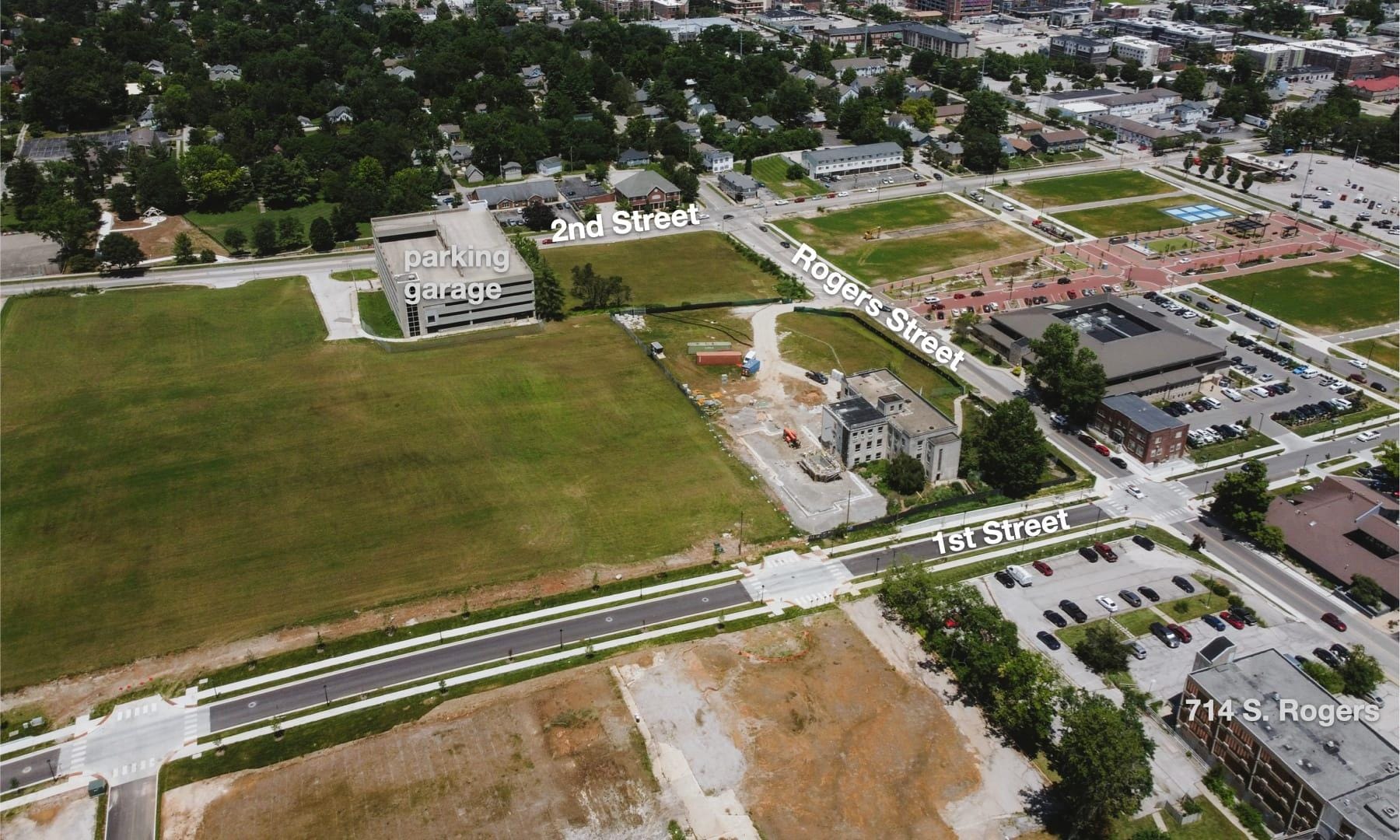
Bloomington’s redevelopment commission (RDC) has formally backed the reuse of the former Bloomington Convalescent Center at 714 S. Rogers St. as the city’s next police headquarters. The plan would renovate the existing building and add newly constructed space for other public safety functions.
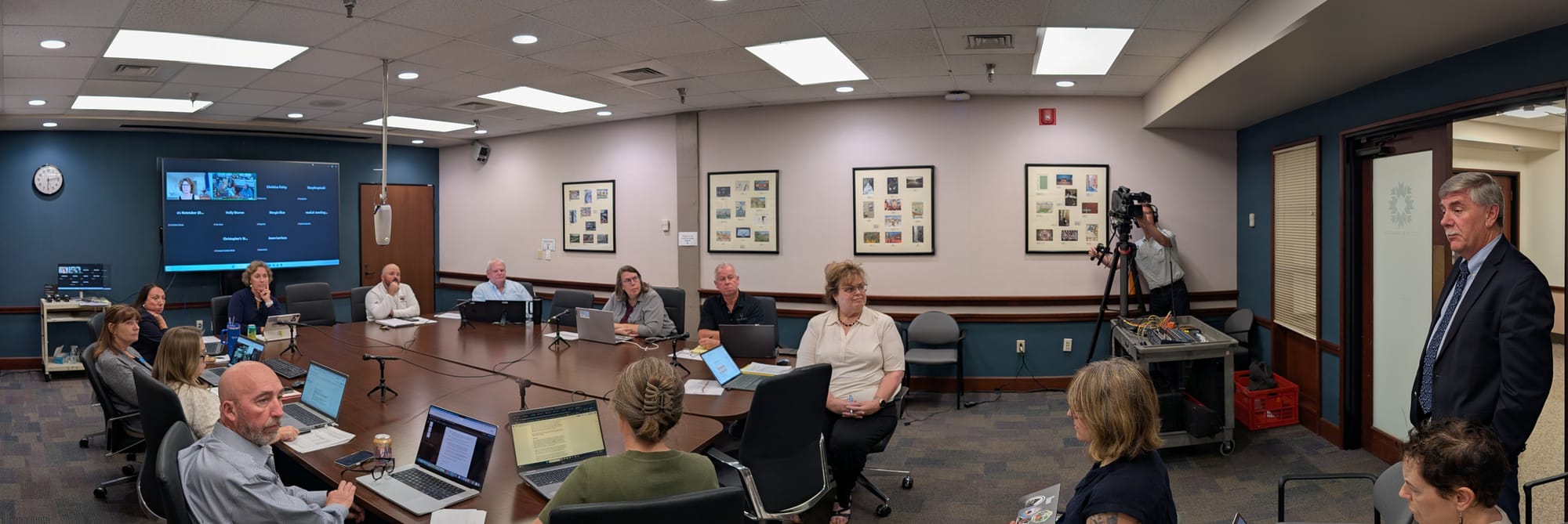
At its Monday meeting (Sept. 14), the RDC voted unanimously to approve a resolution that declares support for renovating and expanding the building for the Bloomington police department, central dispatch and potentially other uses.
The resolution also puts the commission on record as willing to investigate issuing bonds backed by tax increment financing (TIF) revenues, for up to $30 million. But the resolution does not itself authorize a bond issuance. City controller Geoff McKim stressed that distinction before Monday’s vote.
If the RDC decides to issue bonds, McKim said, a separate resolution would formally start that process and would then go to the Bloomington city council for approval. McKim told commissioners the $30-million figure was one the city believes could both accomplish the project and fit within the RDC’s potential bonding capacity. The $30-million figure would still leave room for other possible RDC commitments involving projects like the Hopewell neighborhood, McKim said.
Hopewell is the neighborhood that is being redevelopment by the RDC at and around the site of the former IU Health hospital at 2nd and Rogers streets.
The working concept is adaptive reuse rather than demolition and replacement. The existing 56,000-square-foot building would be renovated for police operations. But an addition is envisioned for central dispatch, an emergency operations center, and a sally port, along with parking and other site improvements. A sally port is a secure, enclosed vehicle entryway where someone in custody can be transferred between a transport vehicle and the holding facility inside a building.
Dispatch could be co-located at the site, but police chief Mike Diekhoff told the RDC in a memo that doing so would require further coordination with Monroe County. A final design and construction budget have not yet been established.
Bloomington mayor Kerry Thomson attended Monday’s meeting in person. Thomson said the Rogers Street site has two clear advantages. One is that the existing building appears reusable. Second, it sits within about a block of an area police had previously identified as their preferred location for a new headquarters. Tearing down the large concrete building would be a detriment from a climate standpoint and “frankly wasteful,” Thomson said. She called the proposed reuse a win and recommended approval.
Diekhoff told commissioners the existing 3rd Street headquarters has “basically outlived its life.”
“It leaks. We are making offices out of storage units. We just don’t have any room for growth in the current facility,” Diekhoff said. He said 714 S. Rogers offers a location and amount of space that the department thinks could meet its needs for as long as 50 years.
Questions about arts use, public engagement
The vote came after public comments questioning both the choice of a police use for the building and the city’s neighborhood engagement process.
From the audience, Leila Reichert described herself as a resident who lives about a quarter-mile from the building. Alluding to remarks by the mayor, Reichert said she did not recall public outreach about using the property for a police station. She pointed instead to an earlier arts feasibility study that concluded the building was suitable for uses other than a police station. The study was done in 2022 by Trahan Architects.
Reichert also disputed the idea that putting police headquarters there would not convey an increased police presence. The building “does loom on a hill” in a neighborhood with a substantial unhoused population, she said, adding: “As a community member who was not asked my opinion of this, I think that building is suitable for many things other than a police station, and I am disappointed in this trajectory.”
Holly Warren, the former assistant director for the arts in the city’s economic and sustainable development (ESD) department, attended the meeting through a remote electronic connection. Warren also urged the RDC to reconsider an arts use for the building. Warren pointed to the same study as Reichert, pointing out that it recommended 714 S. Rogers for a facility with individual artist studios, shared workshop space with specialized equipment, and areas for music, dance and other performances.
Warren said there remains a substantial shortage of affordable artist studio space in Bloomington and recalled that community gathering and creative development had been among the goals for the new Hopewell neighborhood. Warren also said that the community art spaces that are promised as part of Indiana University’s recent READI 2.0 grant are not adequate to house the number of deserving artists for that purpose.
RDC president Deborah Myerson followed up on Warren’s comments by asking whether the city had reconsidered the needs for arts space described in the 2022 study. ESD director Jane Kupersmith said Warren had accurately described the 2022 recommendations and acknowledged that the need remains.
Kupersmith took up the topic of the recently announced READI grant, which Warren mentioned, saying that it includes an arts incubator project at the former Showers administration building. Plans there call for 12 artist studios, space for creative entrepreneurs and public performance space, Kupersmith said.
The public commentary gave additional perspective on Thomson’s description of neighborhood reaction. Earlier in the discussion, the mayor said the city had held a large public meeting, that she had attended a neighborhood association meeting and that she had gone door-to-door on five occasions. Thomson said most residents who answered and offered an opinion were supportive, although “a handful” opposed locating police there. The mayor also stressed that moving to a larger building should not be understood as signalling a plan for a dramatic increase in the size of the police force.
After the criticism during public comment, Myerson asked specifically what further outreach was planned. Thomson said the administration had contacted the McDoel Gardens Neighborhood Association about returning to one of its meetings and had been keeping the Prospect Hill neighborhood informed. RDC executive director Anna Killion-Hanson also said a larger public meeting about the Hopewell neighborhood generally, including potentially the 714 S. Rogers project, is planned. A date and location for that meeting has not yet been set.
Bloomington councilmember Isabel Piedmont-Smith, whose District 1 includes the site, was seated in the audience. RDC member Randy Cassady asked Piedmon-Smith if the neighborhood is generally supportive. She responded: “I cannot answer that. Sorry.” After a beat, she added: “There are mixed responses to this.”
Piedmont-Smith also questioned the documentation underlying the recommendation. Piedmont-Smith pointed to American Structurepoint’s April feasibility work and asked for more transparency about the subsequent review by KGA Advicon that led the city toward the current, less expensive concept. City staff said the KGA material could be made publicly available or added to the meeting packet.
Police union supports Rogers Street site
Two Bloomington police officers who represent department employees attended Monday’s meeting and spoke in favor of the plan.
Paul Post, president of the police union, told commissioners that police representatives had worked with Thomson and Diekhoff on possibilities for the property. “We’re here to say we have no objection,” Post said.
BPD officer Jeff Rogers, a longtime union representative, contrasted 714 S. Rogers with the earlier plan to put police headquarters in Showers West. Rogers said police had been heavily involved in evaluating Showers West, but two of its primary problems were “accessibility” and “the longevity of the building.” The Rogers Street site, by contrast, could work for 40 or 50 years and is centrally located, he said.
“It really checks off a lot of boxes that we are going to need,” Rogers said, adding that he, Post, Diekhoff and other police representatives favor the location.
RDC member Randy Cassady said he wanted assurance that the city could provide the specialized new construction needed for critical functions without replacing the whole building. After hearing that the proposed addition and the roughly $30-million working budget were intended to address that need, Cassady said: “I would love to say we have enough money to give them a brand new building as much as they need for 50 years, but we have to be fiscally responsible. And if this is the best solution, I'd like to see that we move forward.”
The commission then approved the resolution on a 4-0 vote, with Sue Sgambelluri, Cassady, Laurie McRobbie and Myerson voting yes. John West did not attend the meeting.
Existing building plus Category 4 addition
The discussion on Monday also sharpened what the current proposal actually entails.
American Structurepoint’s April 2026 report reviewed several approaches, including two that reused the existing building, a demolition-and-new-construction alternative and partial-demolition possibilities.
A significant constraint is that the existing precast-concrete structure cannot itself be readily established as meeting the higher Category 4 structural standard contemplated for critical emergency operations by the International Building Code. Original construction drawings for the building are not available, leaving unanswered questions about its structural capacity. That also makes it difficult to determine whether the existing structure could meet the higher standards contemplated for critical emergency operations.
The approach that is being taken is not to make all 56,000 square feet meet the Category 4 standard. The existing building could be used for offices, interview rooms, training and other police functions, while a structurally independent addition that meets the Category 4 standard could house the emergency operations center, dispatch and other functions that need to keep working after a major disaster. Thomson noted that neither the current police headquarters nor current dispatch facility meets the Category 4 standard. She described it as a best practice rather than a hard requirement.
The concept-level cost table in American Structurepoint’s April report put the four options at roughly $39.5 million to $45.3 million in “hard bid subtotal” costs, while leaving bedrock, structural reinforcement and Hopewell detention costs as unknowns.
Those initial Structurepoint concepts were more expensive than city officials had expected. That prompted the RDC to bring in KGA Advicon to develop a lower-cost version of the project by narrowing its scope and assumptions. Monday’s resolution says KGA concluded that the property, and likely the existing building, could support the public-safety use at a lower cost if the scope and assumptions were narrowed. Further discussions with Structurepoint reached a similar conclusion.
Monday night’s vote reflects the latest step in work that started formally in November 2025, when the RDC approved a resolution and a $58,250 contract with American Structurepoint to study whether the building could be converted into a public-safety facility. The agreement specifically called for evaluating adaptive reuse, space planning and next steps toward design.
No owner’s representative chosen yet
Approval of the Rogers Street resolution did not include a decision on who will manage the project on the RDC’s behalf.
The commission received three owner’s-representative proposals: from KGA Advicon, J.S. Held, and Shrewsberry & Associates.
.
At Monday’s meeting, no recommendation was given for any of the three options. Commissioners were told the proposals were difficult to compare on equal terms. RDC executive director Anna Killion Hanson called it an “apples to oranges” situation. She said the question of an owner’s representative could possibly return for a decision at the RDC’s Oct. 5 meeting.
The owner’s representative would serve the RDC’s interests through design and construction, separate from the architect/engineer and the construction manager. Those three roles as the keys to delivering the project within budget.
The move from 3rd Street police HQ
The project would eventually get Bloomington police out of its longtime headquarters at 220 E. 3rd St., which the department says it has outgrown. Interior spaces, including storage areas and former closets, have been converted to accommodate staff. The electrical system has reached its limit. The building also continues to deal with the effects of the June 2021 downtown flood, which sent water into basement areas and at one point put stored evidence at risk. The flood caused significant damage to electronic and computer equipment, although police were able to continue normal operations.
Monday’s action represents not the first relocation plan, but a second major attempt to get police moved out of the 3rd Street station.
Under former mayor John Hamilton, the city’s plan was to buy and renovate Showers West, the western portion of the former Showers Brothers Furniture factory that also houses city hall, and consolidate the entire police department and fire administration there. The city council authorized up to $29.5 million in public-safety bonds in late 2022 and, in January 2023, voted 5-4 to approve the RDC’s $8.75-million purchase of Showers West.
Hamilton’s financing plan also contemplated selling the 3rd Street police station. In December 2023, the administration recommended a $4.4-million offer from GMS-Pavillion Properties, with proceeds intended to help pay for the Showers West renovation. But the city council rejected the sale 0-9, amid questions that included a century-old deed restriction associated with the adjoining Waldron, Hill and Buskirk Park.
After Thomson took office in January 2024, her administration abandoned the police portion of the Showers West project. Thomson’s stated reason was that the public-safety bond did not provide enough money to complete the police relocation while also paying for fire-department projects that were already underway or considered more urgent. A fire logistics and training center that had been budgeted in the bond at a “very conservative” $2.5 million was by then expected to cost about $6.5 million, even after its scope was reduced. Police officers had also opposed the Showers West location, raising concerns about security and vehicle access.
Fire administration ultimately did move into Showers West. But dropping the plan to move police there did not eliminate another problem created by the way the building had been financed. Private tenants remained in space purchased with public-safety bond proceeds. Bond counsel advised the city that continuing to rent space to private tenants was inconsistent with the public-use restrictions on the bonds.
That issue eventually produced two lawsuits. The RDC tried to terminate leases held by Warrant Technologies and the Bloomington Board of Realtors, now the Indiana Uplands Realtor Association, using an “inverse condemnation” theory. Monroe Circuit Court judge Kara Krothe rejected that approach in March 2026, ruling in favor of both tenants. The RDC appealed, then mediated the disputes and on Aug. 17 ratified settlement agreements.
The settlements called for a total of $381,650 in cash payments. The Realtors association also received its final year in Showers West rent-free. The agreements ended the litigation and cleared a path for the city eventually to control the entire bond-financed space.
Monday’s decision on 714 S. Rogers now puts the city on a specific path different from Showers West for the police headquarters.
Instead of putting police operations into Showers West, the city is pursuing a dedicated public-safety facility at the southeast edge of Hopewell South.
With a resolution now approved, the next work is to refine the scope, select an owner’s representative and architect, and determine whether a renovation-and-expansion project can in fact be delivered within the city’s emerging $30-million financing target. The next meeting of the RDC is set for Oct. 5.


Comments ()