
Bloomington RDC moves Hopewell South housing from concept towards construction
Bloomington’s RDC accepted the city council’s Hopewell South PUD conditions and cleared staff to pursue plats and permits for Hopewell South. Three western lots could see builders picked by late summer, with homes under roof by year’s end and broader infrastructure done in 2027.
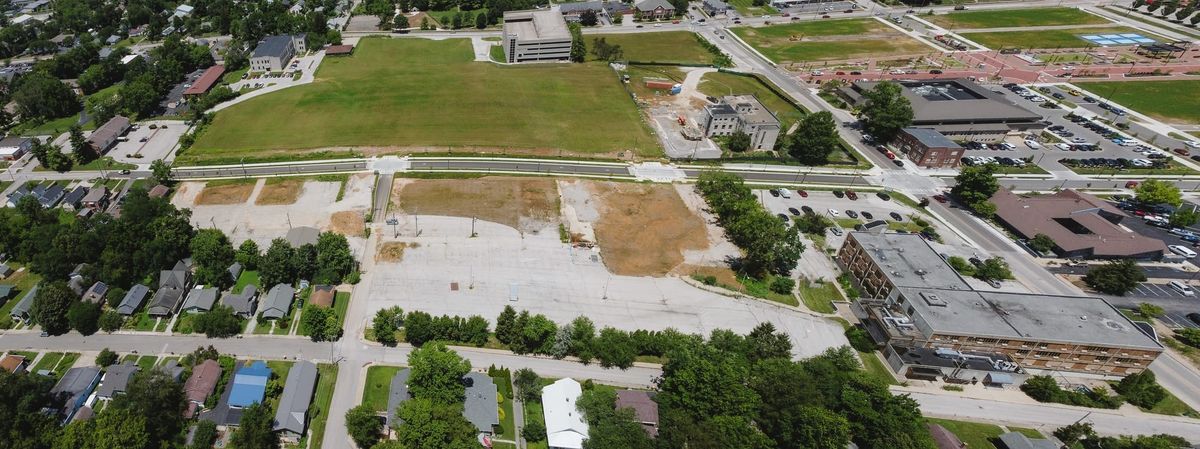
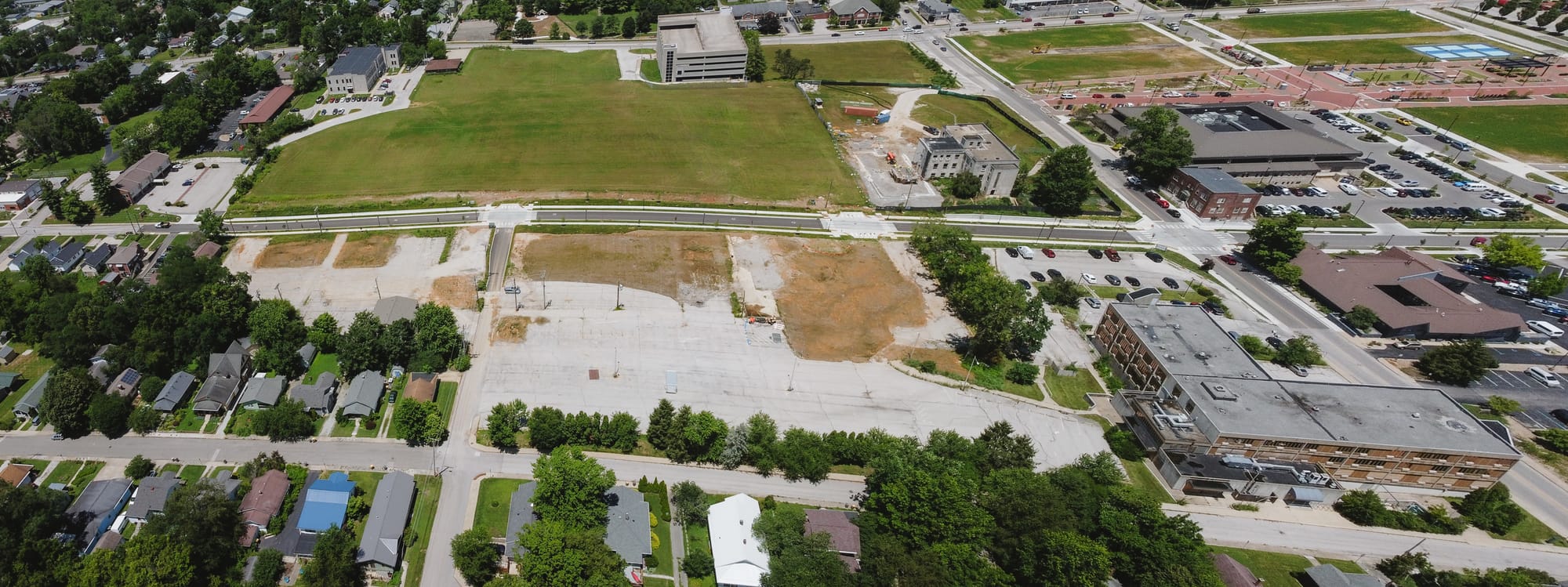
Bloomington’s redevelopment commission (RDC) used its regular meeting on Monday (June 1) to push the Hopewell South project out of the conceptual phase and into the mechanics of platting and permitting. In the western corner of the site, the RDC took a step towards getting potential home construction started before year’s end.
A few separate items on the agenda included Hopewell South: acceptance of the city council’s conditions on the planned unit development (PUD); blanket authorization for staff to pursue all necessary plats and permits; and a targeted lot line adjustment aimed at getting a handful of houses started ahead of the main infrastructure work.
Hopewell South is the portion of the IU Health hospital redevelopment project that sits south of 1st Street.
RDC accepts council’s Hopewell South conditions
On a unanimous vote, the RDC formally accepted the “reasonable conditions” the Bloomington city council attached to the Hopewell South PUD when it gave its approval of the rezone on May 6.
Assistant city attorney Dana Kerr told commissioners they essentially had two choices: accept the council’s conditions and move forward, or reject them and “try to draft a different PUD to go back and start, basically start again.”
RDC executive director Anna Killion-Hanson reacted to the idea of starting from scratch and submitting a new PUD rezone proposal to the city council: “Please don’t make me do that!”
Killion-Hanson reviewed the council’s reasonable conditions as they now appear in the ordinance. Some are largely technical, such as reformatting the allowed‑use table and confirming that infrastructure construction will proceed in one phase. Others have more practical impact. Cross‑sections for Wylie and Jackson will be revised to guarantee a minimum five‑foot tree plot between sidewalk and travel lane, with a narrow exception near 714 South Rogers if that existing building is preserved. Rogers Street will be brought into line with the city’s transportation plan, including a five‑foot tree plot and ten‑foot sidewalks.
Another condition requires a design for the internal streets at a target speed of 10 mph to create what the ordinance calls “a low speed and high comfort environment for vulnerable road users.” City project engineer Kendall Knoke told commissioners he will provide the RDC some choices of traffic‑calming options, ranging from speed humps to more elaborate, and more expensive, features.
Affordability, which was the most contentious topic throughout the city council’s deliberations, reappeared during the RDC’s discussion on Monday. The council’s condition requires that at least 35% of all dwelling units in Hopewell South be “permanently affordable,” with a goal of reaching 50%. Within that 35%, at least 15% of total units have to be reserved for households earning at or below 90% of area median income (AMI), and at least 20% for households at or below 120% of AMI.
Affordability requirements are supposed to be met with legal mechanisms that endure independent of ongoing subsidy, although public subsidy can still be used to “establish, preserve, extend, or deepen” affordability so long as the permanent restrictions remain in place.
Killion-Hanson told RDC members that satisfying the council’s affordability condition is “going to be difficult at best,” given the uncertain construction costs. But she said the administration will “do our ‘college try’ on trying to get as many affordable units as possible without creating an additional burden to the RDC.” She cited HOME funds, nonprofit partnerships, and a planned Hopewell South residential TIF as potential tools. She also noted that the council explicitly invited staff to return for an amendment, if some conditions prove infeasible.
The topic of establishing a residential TIF for Hopewell South got a mention from assistant city attorney Dana Kerr, who told RDC members they would likely be asked to get the process started at one of their meetings in July.
Councilmember Isabel Piedmont‑Smith, who addressed the RDC during public comment, defended the council’s condition as an improvement over both the original 25‑percent baseline and a failed proposal to require 50% permanently affordable units outright. “Even though it was very painful for everybody involved, especially Anna [Killion-Hanson], I think that the end result with the reasonable conditions is a better project,” she said, urging commissioners to vote yes.
With their acceptance of the conditions imposed by the city council, some commissioners were unwilling to give what they viewed as an unconditional pledge. RDC member Laurie McRobbie focused on the catch‑all clause in Kerr’s draft, which spoke of complying with conditions “to the extent that it is feasibly possible.” She called that phrase “not completely grammatical” and pushed for a more explicit standard tying feasibility to the project’s purpose.
The commission ultimately agreed to McRobbie’s proposed amended wording, which says:
The RDC fully intends to comply with the city council’s conditions to the extent they can feasibly be accomplished without significantly undermining the goals of the Hopewell South Project and the PUD.
Staff cleared to seek plats and permits
Also getting approval at Monday’s RDC meeting was a resolution to give the city staff broad authority to file the plats and permit applications needed to take Hopewell South from a conceptual PUD to a buildable subdivision.
From the engineering department, Kendall Knoke told RDC members that the list of tasks includes: a primary plat to be approved by the plan commission; vacation of the century‑old Dixie Highway Addition plat that still governs the site; a staff‑level secondary plat; the PUD final plan; site development permits; multiple approvals from City of Bloomington Utilities (CBU) and state regulators for water and sanitary infrastructure; and a state construction stormwater permit. Knoke sketched out a schedule that calls for the primary plat to be handled by the plan commission on July 8.
The timeline for the overall Hopewell South project will be much longer than for a small part of it in a western corner, with three buildable lots. That corner was the topic of an RDC resolution on lot line adjustment, which was approved by the RDC at Monday’s meeting.
Knoke told commissioners those lots date back roughly a century to the Dixie Highway Addition and are “lots of record,” a status that has practical consequences. The city can adjust the lot lines administratively through the planning department, and once that adjustment is recorded, a house builder can avoid the wait for the full Hopewell South subdivision plat. The builder can instead go straight to the building department, because the process is streamlined for Class 2 structures like these, Knoke said.
But because the RDC is the owner of the real estate, it has to follow steps laid out in state law, for redevelopment commissions to dispose of real property.
Killion-Hanson responded to an emailed question from The B Square with a list of next steps for the construction of the three future houses that had their lot lines adjusted on Monday:
- filing for building permits
- ordering appraisals (which typically take about 30 days to complete)
- issuing the public offering to prospective builder(s)
- selecting builder(s)
Killion-Hanson wrote that she hopes builders for the lot-line-adjusted homes will be selected by August or September. If the weather cooperates, that would allow enough time for foundations to be installed before winter conditions make that work difficult or impossible, she wrote. That means it’s possible that the lot-line adjusted homes could be framed and under roof before the end of 2026. In any case, Killion-Hanson wrote, those new homes will be completed by early 2027.
Killion-Hanson noted that the rest of the Hopewell South area still has to undergo the platting process in addition to completing infrastructure construction and site grading. Her best estimate based on normal weather conditions and no further complications, is that infrastructure work for the rest of Hopewell South will be completed by spring 2027.
RFPs for the other Hopewell South lots will be issued as soon as practicable, Killion-Hanson wrote, so builders can be prepared for an immediate construction start as soon as the infrastructure is done. If that basic timeline holds, it would mean some houses in the rest of Hopewell South neighborhood could be finished in late 2027.
Killion-Hanson wrapped up by writing, “2027 is going to be a good year for housing supply! It won’t be enough, but it should have an impact!”


Comments ()