
Bloomington Transit board OKs Keolis management contract 3–2, McDaniel now says he’s out
Bloomington Transit’s board voted 3–2 to hire Keolis as its new management firm, replacing RATP Dev starting Oct. 1. Nick Standefer, the new general manager, introduced himself to the board and staff.

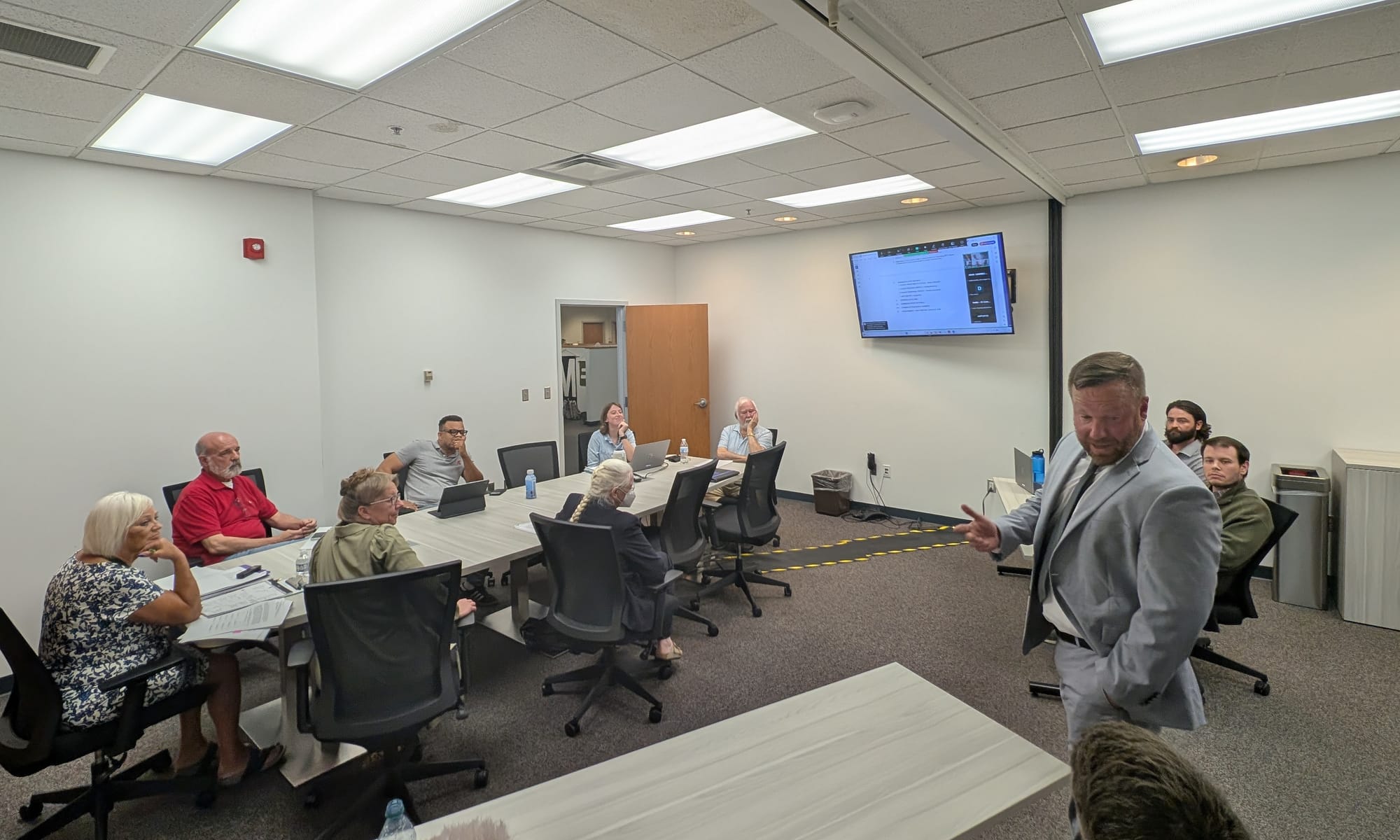
At its regular meeting on Tuesday (Sept. 15) Bloomington Transit’s board made final a decision that had been taking shape since July. Keolis Transit Services will replace RATP Dev as the agency’s management firm.
The new general manager who has been designated by Keolis is Nick Standefer. He will take over day-to-day leadership of the local bus system at the start of October.
Standefer attended Tuesday’s meeting in person and sat in the audience. Outgoing general manager John Connell, who had been RATP Dev’s designee for the last four years, attended his final board meeting through a remote electronic connection.
The Sept. 15 vote on the Keolis contract was 3–2, with James McLary, Don Griffin and Doug Horn voting yes, and Kent McDaniel and Nancy Obermeyer voting no. The same three-member majority had voted in July to begin negotiations with Keolis.
Immediately after the vote, McDaniel said he would be resigning from the board over the decision to change management firms. “So I’m retiring, and I’m going to get out of here,” McDaniel said. McLary thanked him for his 36 years of service.
McDaniel’s term was up at the end of July and the city council has been weighing McDaniel and at least three other candidates as the appointment for the next four-year term. McDaniel left the meeting right after the vote on the management firm, before the board reached some other big topics on the agenda.
On Tuesday, the board also approved its annual interlocal agreement with Indiana University. The board also authorized submission of a roughly $29-million federal grant application tied to Bloomington Transit’s planned new administration, operations and maintenance campus on Profile Parkway and the purchase of two diesel-hybrid buses.
The board also started work on two longer-term questions. One is how Bloomington Transit might respond when Rural Transit ends its Bloomington-to-Ellettsville service at the end of this year. The other is whether the five-member Bloomington Transit board should be expanded to seven members.
The final vote on the Keolis contract came after a final effort from the public mic by RATP Dev to convince the board to reconsider. But the 3–2 split on the board remained. Obermeyer and McDaniel covered ground from previous meetings. Obermeyer said, “Why don’t we look around here and hire somebody from our own staff. They have way more experience than this person with about eight years of experience in public transit.” She added, “I just think this is a very poor decision.”
McDaniel said, “The staff member here that I would like to hire would be John Connell.” Board chair James McLary then moved things to a vote by asking: “Do we have anything new to add to the discussion?” After several beats, the roll was called and it came out 3–2.
Keolis contract starts Oct. 1
The management contract approved on Tuesday begins Oct. 1, immediately after the current RATP Dev agreement expires, and runs through Sept. 30, 2029. It can be extended by mutual agreement for two additional one-year terms. Bloomington Transit can also terminate the agreement on 90 days written notice.
Under the contract, Keolis will provide Bloomington Transit with a resident general manager who is responsible for day-to-day operations of all of the agency’s departments. The agreement identifies Standefer as the initial general manager. Keolis can’t reassign him to another position without first providing a replacement reasonably acceptable to Bloomington Transit.
The monthly management fee starts at $25,781.30 for the first contract year, increases to $26,758.05 in the second year and $27,785.33 in the third. That puts the management fees for the three-year base contract at about $964,000. If both one-year extensions are exercised, the monthly fees would rise to $28,867.33 and then $30,000.63.
Those payments cover more than just the salary for the general manager. It covers advisory services from Keolis, corporate oversight, consultation, training materials and visits from senior management personnel. The contract separately allows reimbursement of up to $15,000 in actual and reasonable relocation expenses for Standefer. Those relocation expenses have to be documented and approved by the Bloomington Transit board before payment. Business-related cellphone and travel reimbursement is generally capped at $1,250 per contract year without prior written approval.
The relocation provision had been one point of contention when the board first discussed the contract in August. At that meeting, Obermeyer objected that an estimated $20,000 moving expense had not been shown as a specific amount in Keolis’s original pricing. McDaniel likewise argued that an estimate should have appeared in the proposal’s summary. McLary said at the time that the proposal contemplated transition expenses but that the actual amount had not been known when Keolis submitted its proposal. The final contract sets the ceiling at $15,000.
The board did not have a completed contract to consider at its meeting last month on Aug. 18. On Tuesday, McDaniel said he had not received his copy until Friday afternoon. He asked for he board to consider postponing action and suggested that the public get at least seven calendar days to review a proposed agreement before a vote. McLary said Bloomington Transit’s outside counsel had advised that such a public review period was not legally required.
RATP Dev makes one last effort
Before the board took up the ordinance on the Keolis contract, it held the required public hearing.
During comment from the public, RATP Dev chief development officer Steve Sherrer asked the board to reconsider replacing his company, which has provided Bloomington Transit’s management for more than three decades.
Sherrer said RATP Dev did not believe its history in Bloomington entitled it to another contract. Instead, he pointed to what he described as demonstrated performance under current general manager John Connell, including fleet electrification, securing federal funding for the proposed new facility, negotiating two labor agreements and expanding service beyond Bloomington’s city limits.
RATP Dev had formally challenged the procurement process after the board’s July decision. Bloomington Transit rejected that challenge in August. The scoring later released by Bloomington Transit showed Keolis with the highest overall score despite RATP Dev’s advantage on price.
Sherrer told the board Tuesday that the scoring showed RATP Dev’s disadvantage came mostly in the category of its proposed general manager and corporate support. He asked the board to weigh that assessment against Connell’s record, RATP Dev’s lower price and the disruption that could accompany a management change.
“What will Bloomington Transit gain from this change?” Sherrer asked. He asked if that gain outweighed the demonstrated performance, price advantage, and the continuity that BT would get from remaining with RATP Dev.
Ryan Adams, chief performance officer for Keolis North America, spoke next. Adams introduced himself as an IU graduate and former Bloomington Transit rider. He pointed to Keolis’s worldwide transit operations and said Standefer would have access to the company’s global “Center of Excellence,” its accumulated operating practices and its North American corporate support.
Standefer introduced
Near the end of Tuesday’s meeting, McLary gave Standefer a chance to introduce himself.
Standefer told the board he had been “in the transit game for almost 10 years” and said many of the issues discussed during Tuesday’s meeting were familiar problems being faced by transit agencies elsewhere. He said Bloomington Transit appeared to have a solid foundation and that he hoped Keolis could help the agency “bridge the gap and turn the corner.”
Standefer’s LinkedIn history includes work as a general manager for MV Transportation in Decatur, Illinois, and as assistant general manager for the Greater Peoria Mass Transit District/CityLink. His profile describes work on fleet electrification, federal and state grants, unionized workforces and development of a new operations and maintenance facility. It also lists a master of public administration degree from Webster University.
McDaniel, Obermeyer repeat objections
Before the vote, McDaniel told his colleagues his position had not changed.
“I’ve been on the board for 36 years, and this is the biggest mistake I’ve ever seen Bloomington Transit make,” McDaniel said. He said he expected the agency to “suffer for it in the future.”
That echoed what McDaniel had said when the board first chose Keolis in July. At the Aug. 18 meeting, he and Obermeyer also raised concerns about the transition expense, the amount of information made available to board members before decisions, and the extent to which Bloomington Transit employees had been consulted.
Obermeyer on Tuesday again objected to replacing Connell. She contrasted Connell’s roughly three decades in public transit, including Indiana experience, with Standefer’s shorter transit career. She said Bloomington Transit already has employees with greater local experience and institutional knowledge and questioned why one of them would not be considered instead.
IU agreement: Same money, new warning about ridership
After McDaniel’s departure, the board turned to its annual interlocal agreement with Indiana University that covers fares for university affiliates.
Under the 2026-27 agreement, IU will pay Bloomington Transit $1,251,726. It’s the same amount as the previous year. It covers fixed-route service on Routes 6, 7 and 9. IU students, staff and faculty can also continue to use other Bloomington Transit fixed routes with a valid CrimsonCard.
Connell said the agreement contained only a few changes, including some wording reflecting the electronic fare-collection validators and a new provision dealing with service utilization. “They’ll want to take a close look at the utilization during the upcoming school year,” Connell told the board. He called the agreement “a fair deal.”
The new wording on ridership is fairly pointed. It says: “Indiana University will continue to evaluate utilization of Bloomington Transit services by the IU community throughout the term of this Agreement.” It continues: “Continued declines in utilization may result in a review of the scope, terms, and financial structure of the arrangement when considering renewal for FY28.”
That provision comes as Bloomington Transit continues to see lower overall ridership. Planning and special projects manager Shelley Strimaitis told the board later during Tuesday’s that overall ridership for August this year compared to 2025 was down about 5.7%.
That’s not as bad as the year-to-date decline, which is around 12.6%. She said the decline was spread across both campus-oriented and non-campus routes, although campus routes accounted for the largest raw number of lost rides, because they carry so many passengers.
Federal ask: $29 million for new campus, hybrid buses
The board also approved a revised resolution authorizing Bloomington Transit to submit a federal Section 5339 grant application for its planned operations campus and two diesel-hybrid buses.
The formal resolution gives staff authority to seek as much as $35 million in federal funding, with up to $8.75 million in local share. But the project summary prepared for the board says Bloomington Transit’s planned federal request is $29,005,208.
Bloomington Transit has been planning to replace its Grimes Lane headquarters with a new campus on property it bought this summer at Profile Parkway and Curry Pike. The project summary puts the facility cost, spread across three phases, at roughly $56.8 million.
The first phase, estimated at $22.54 million, would use money Bloomington Transit has already reserved to complete site work and build the maintenance facility. Phase two, estimated at $19.28 million, would add the administration and operations building and the foundation for bus storage. Phase three, estimated at $14.96 million, would enclose the bus-storage structure.
The grant application will also include two 40-foot New Flyer diesel-hybrid replacement buses with an estimated combined price of $1.9 million. According to Bloomington Transit’s project summary, including low-emission buses makes the application eligible for the Low or No Emission portion of the federal Section 5339 program, where most of the available competitive money is concentrated.
The planned request is structured so Bloomington Transit could still proceed if the federal government awards less than the full amount. Grants and procurement specialist Zac Huneck told the board the minimum scaled request would be about $16.2 million, enough for phase two and one replacement bus. The project summary puts the anticipated local match for the planned $29 million request at about $7.13 million, which uses local income-tax money and the in-kind value of the Profile Parkway property that BT purchased in June.
Connell told the board a consultant had recommended the more detailed resolution to strengthen the application, even though the board had already authorized a Section 5339 application in May. The application was expected to be submitted the day after Tuesday’s meeting.
Ellettsville service after Dec. 31
The board also began considering whether Bloomington Transit could help fill a transportation gap that will open when Rural Transit ends its service between Bloomington and Ellettsville on Dec. 31.
Bloomington Transit had already studied service to Ellettsville after Monroe County approached the agency in 2024. Staff had developed alternatives that included Ellettsville, Park 48 or both. The Monroe County government ultimately funded service only to the Park 48 area, an arrangement that became Route 13 and is now incorporated into Route 16.
McLary called for a board committee to begin talking with Ellettsville and Monroe County about possible options. But staff cautioned that Bloomington Transit’s own resources are stretched. During the discussion, the board was told the agency had logged more than 800 hours of overtime in the latest pay period just to cover existing routes, and vehicle availability could also constrain an expansion.
Expansion from five to seven board members?
On Tuesday, the board also established a committee to investigate expanding the Bloomington Public Transportation Corporation board from five members to seven. It’s something that is allowed under state law.
The idea had surfaced at the August meeting as part of a broader discussion about Bloomington Transit’s increasingly regional role. McLary has suggested that a larger board could potentially create room for representation connected to Monroe County or Indiana University, although the details remain unresolved.
On Tuesday, McLary said the committee would need legal advice on state law and the city’s existing authority before recommending how an expansion should work.


Comments ()