
Bloomington utilities, Habitat settle Osage Place water dispute
Bloomington utilities approved a settlement letting Habitat for Humanity get water service for Phase 2 of Osage Place while a Phase 1 stormwater dispute continues. Habitat will withdraw its appeal, and CBU keeps authority to require approved drainage fixes by Oct. 30, 2027. The vote was unanimous.
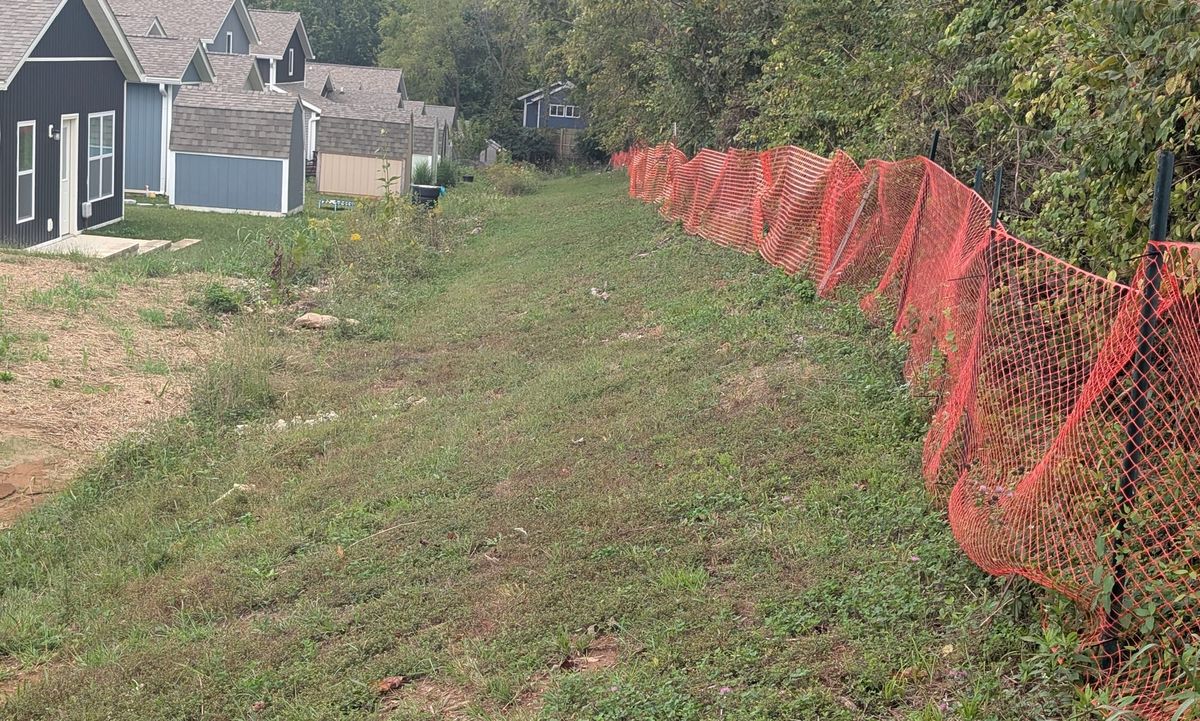
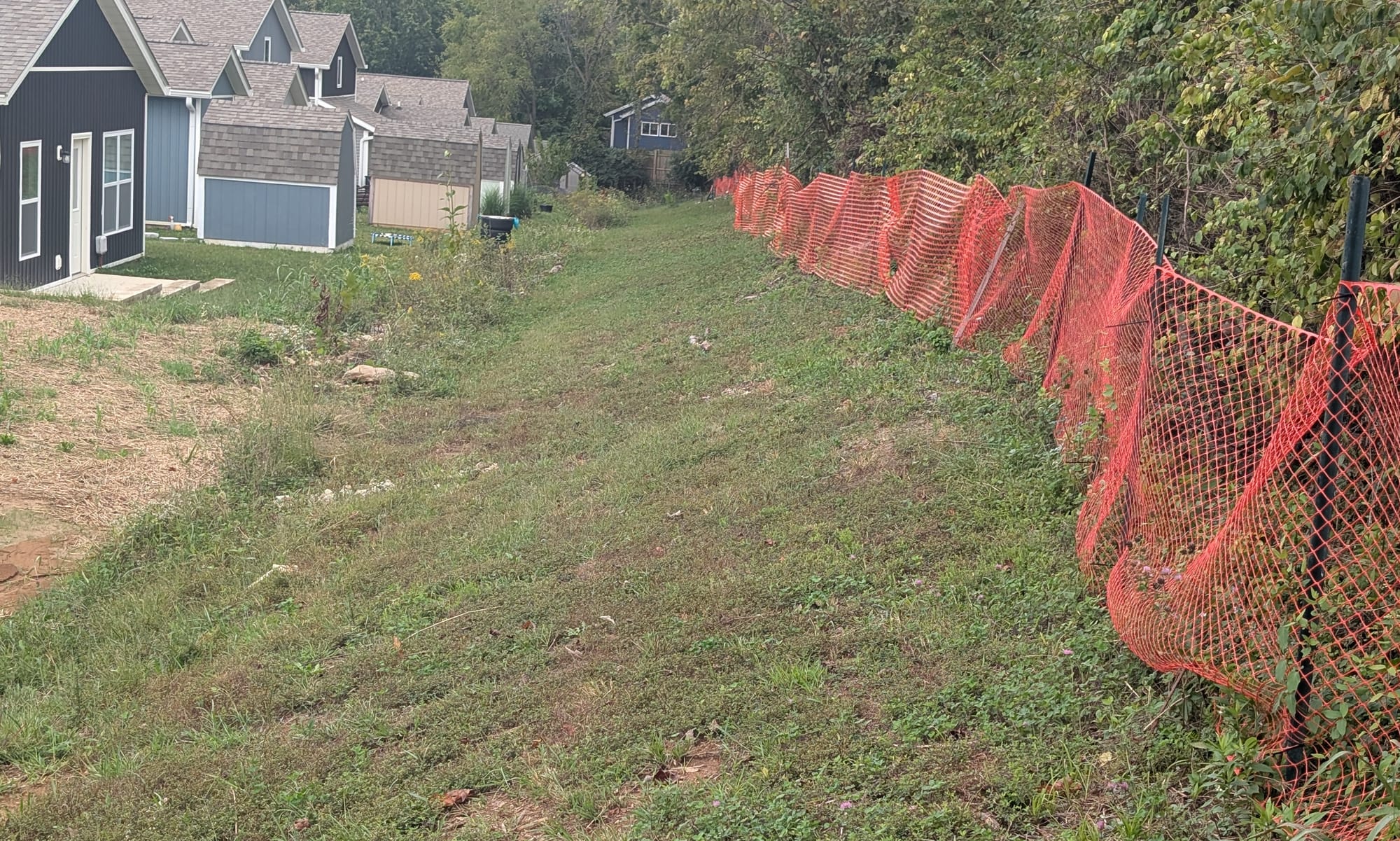
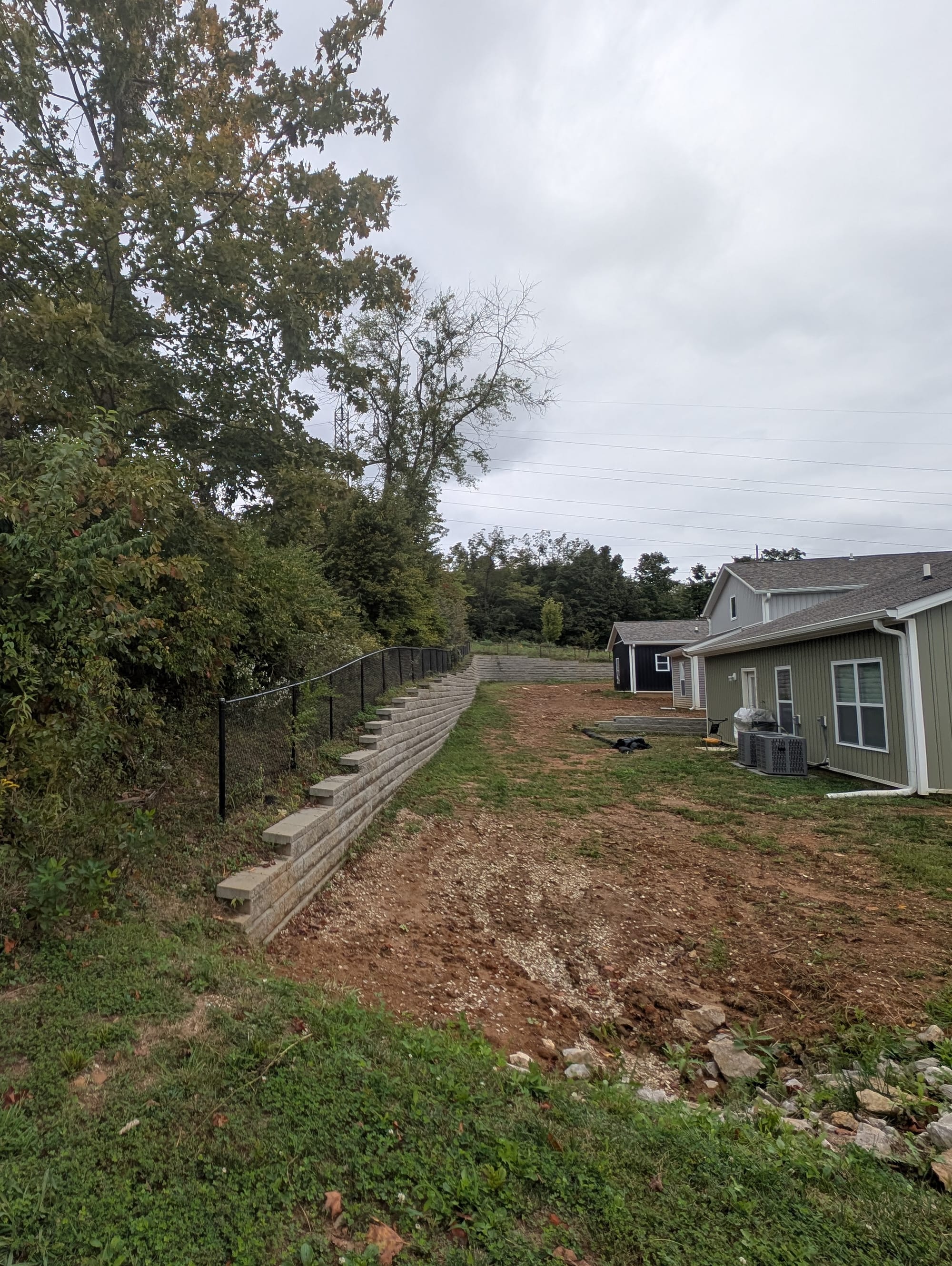
Left is the view southward along the disputed stormwater swale at Habitat for Humanity's Osage Place behind he houses on Bernard Drive. Right is the view northward. (Dave Askins, Sept. 24, 2026)
Habitat for Humanity of Monroe County will be able to get drinking water hookups to homes under construction in Phase 2 of its Osage Place neighborhood. That’s even while it continues to work out a separate stormwater dispute with City of Bloomington Utilities (CBU) over Phase 1 Osage Place work.
That’s the practical compromise in a settlement unanimously approved Monday (Oct. 5) by Bloomington’s utilities service board (USB) at its regular meeting.
Osage Place is a Habitat neighborhood planned for 69 houses, which first broke ground six years ago. It’s to the east of RCA Community Park and to the south of the county-government-owned Thomson property.
CBU had been withholding water meters for Phase 2 until a dispute over a drainage swale in Phase 1 was resolved. A swale is just the technical name for a shallow, sloped channel that is supposed to carry stormwater away from an area.
Under the settlement, those two issues are now separated: CBU will process Habitat’s applications and provide water service, while Habitat remains responsible for designing and building replacement stormwater infrastructure.
The settlement also ends, without a ruling, Habitat’s appeal challenging the way CBU decided to withhold the meters.
Assistant city attorney Chris Wheeler told the board Monday that Habitat and CBU had negotiated the agreement during the two weeks since the board first heard Habitat’s appeal on Sept. 21. Habitat had already signed the agreement when Wheeler read the full text aloud into the record.
Under the agreement, Habitat has to respond to comments CBU made Sept. 21 on Habitat’s latest stormwater design, which was submitted Sept. 2. The two sides will then meet on a mutually agreed date between Oct. 19 and Oct. 30 to try to resolve any remaining design questions. The meeting will be facilitated by Bloomington’s deputy mayor, Gretchen Knapp.
Habitat has until Oct. 30, 2027, to install the new stormwater infrastructure in accordance with plans approved by CBU. If the two sides reach an impasse over the design, or if Habitat fails to install the eventual approved design by that deadline, CBU can pursue enforcement and penalties under the city’s local utilities ordinance.
The settlement gives Habitat the immediate result it was looking for through its appeal, which was access to water service for Phase 2. But the USB did not have to decide whether CBU acted properly when it withheld that service.
How the dispute developed
Osage Place is a Habitat development on Bloomington’s southwest side that is planned for 69 single-family homes. Phase 1 includes 30 homes along Bernard Drive. Phase 2 includes 39 homes along Hope, Cherokee, Chambers and Duncan drives and Guy Avenue. The two phases were separately permitted and bonded.
The stormwater dispute concerns a drainage swale running through the backyards of homes on the west side of Bernard Drive in Phase 1.
Habitat’s written appeal describes the original CBU-approved design as a steep, grass-covered open swale. According to Habitat, the swale has successfully carried stormwater away from the homes, but its steep slopes are difficult for homeowners to maintain and vegetation washes away during intense rain. Habitat says those concerns led it to propose replacing most of the open drainage with a buried drain.
At the Sept. 21 appeal hearing, Wheeler told the board that what Habitat actually built did not match the stormwater plans CBU had approved. By the time the problem was being addressed, houses had already been built in a location that made it impossible to build the original design as drawn, according to CBU. That means CBU and Habitat spent considerable time considering alternatives.
The latest proposal centers on an underground pipe. At the Sept. 21 meeting, CBU utility engineer Ginger Davis said the concept could work, but utilities staff had concerns about inlets becoming clogged, water potentially leaving the drainage area and reaching homes, and water moving through the pipe faster than CBU standards allow. Davis told the board she believed those problems were fixable.
Disagreement about process
But Habitat’s appeal was not focused on the engineering dispute. Habitat was not asking the USB to decide what the replacement drainage system should look like. It was asking the board to decide whether CBU had followed the proper process when it used the unresolved Phase 1 stormwater issue as a reason to withhold water service in Phase 2.
Habitat’s written appeal says a subcontractor sought meter pits on Aug. 28 for two Phase 2 homes at 828 and 832 W. Guy Ave. CBU denied the request. Habitat operations director Kari Bennett then asked for the basis of that decision, and CBU director Katherine Zaiger responded on Sept. 2 that the meters were being held until there was a solution for the “undersized swale” and other deficiencies.
Habitat contended that CBU had never given it the kind of formal written notice contemplated by the city code. It also disputed CBU’s characterization of the swale as undersized and argued that withholding water in separately permitted Phase 2 was an improper remedy for a dispute involving Phase 1.
CBU’s response was that there had been no issuance of a formal violation that would have required the notice that Habitat says was missing. Wheeler told the board on Sept. 21 that CBU viewed the problem as a deficiency in development infrastructure, not a municipal-code violation. He said withholding water meters until development deficiencies are corrected is part of CBU’s ordinary process for making sure approved utility infrastructure is actually installed.
That distinction did not seem entirely satisfy board member Jim Sherman. “The outcome is the same,” Sherman said at the Sept. 21 meeting. “There’s no water meter.” He questioned why a developer facing the same practical consequence should not receive formal notice.
The board ultimately decided it did not have enough information that night to resolve the legal and procedural question. It tabled the appeal until Oct. 5 and asked the two sides to submit proposed findings for the board to consider. The eventual solution did not require the USB to choose sides by deciding which set of findings to adopt.
Reaching a settlement
During the intervening two weeks, Habitat and CBU reached the settlement that Wheeler presented Monday. Under its terms, Habitat will withdraw its appeal, so the board will never decide whether CBU’s original decision to withhold the meters complied with the city code.
Before the vote Monday, board president Kirk White thanked Habitat and city staff for working out a solution. He said the utilities board’s broader concern is making sure stormwater systems in new developments protect the people who eventually live there.
“When you have new homeowners particularly, we don’t want them to ever be in a spot where we need to go back in and do remediation,” White said. He added, “I think will be a really good resolution for our ratepayers and for developers and for the utilities.” The board approved the settlement unanimously.
For Habitat, the agreement means construction in Phase 2 does not have to wait for the Phase 1 drainage dispute to be completely resolved. For CBU, it preserves the requirement that Habitat ultimately install stormwater infrastructure that the utility approves.
And for the USB, it avoids having to answer the actual question that Habitat’s appeal put before board: Did CBU have the right process in place when it linked the two phases in the first place?



Comments ()