
CIB approves letter of intent with Dora for hotel, moves ahead with Seminary Pointe demolition
Monroe County’s CIB is moving ahead with Seminary Pointe demolition even though Dora Hospitality’s proposed convention center hotel would not use that real estate. The CIB said the remaining land would stay with the board for now and could later be offered for sale. Demolition could start Nov. 4.
The Monroe County capital improvement board (CIB) is moving ahead with demolition of the Seminary Pointe buildings south of the Bloomington Convention Center.
The land to be cleared is not one of the parcels that Dora Hospitality has identified for its proposed host hotel, which is planned just north of Seminary Pointe.
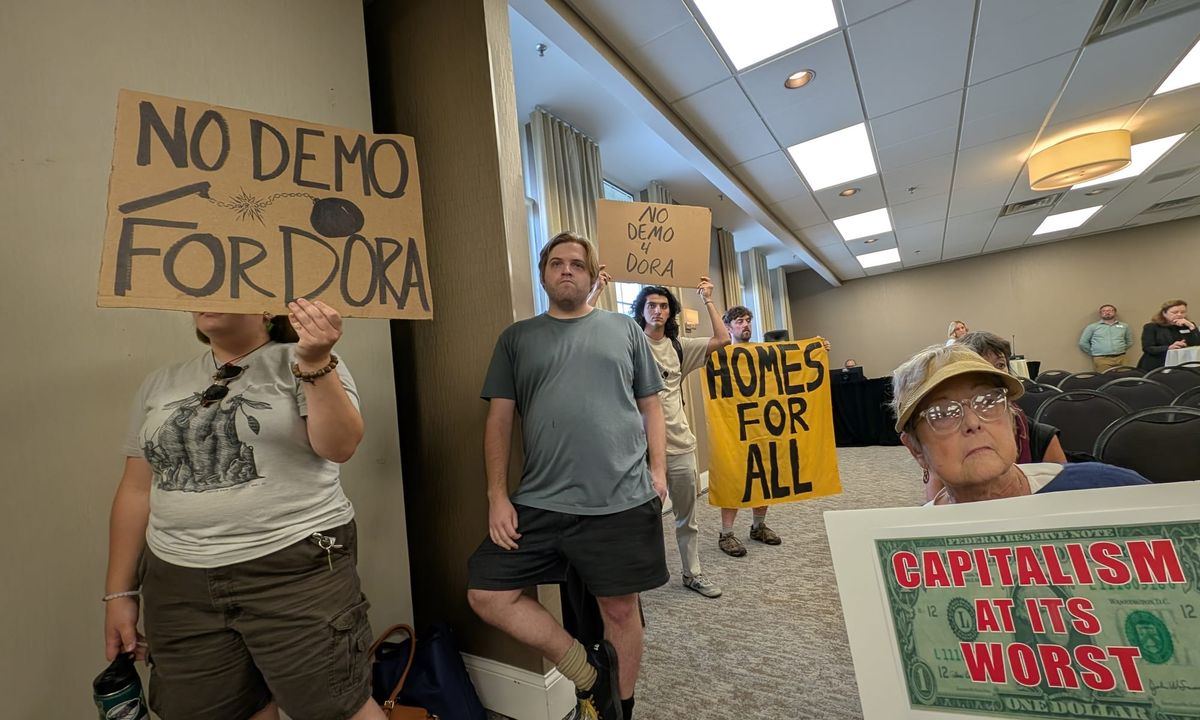
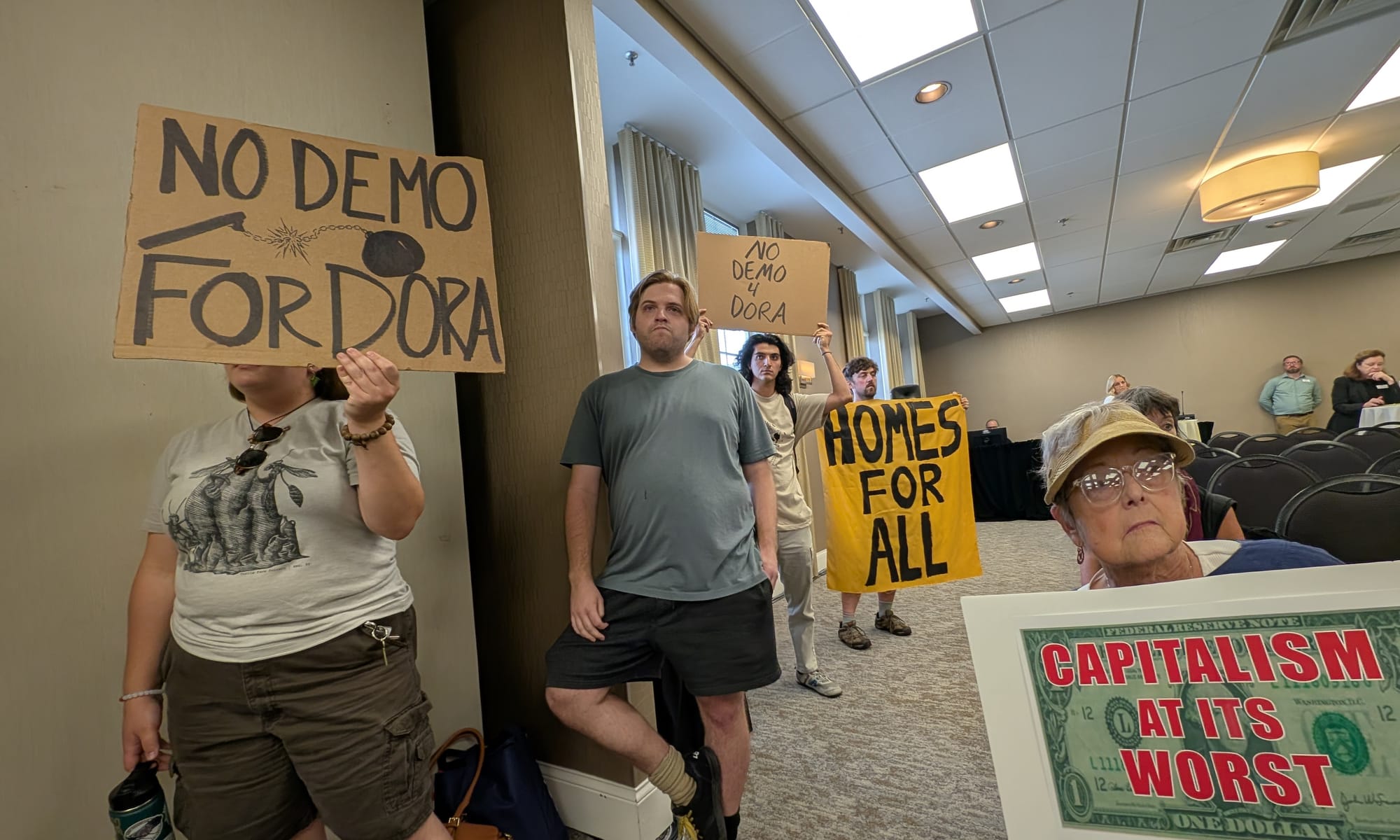
That apparent disconnect was at the center of public criticism at the CIB’s Wednesday (Aug. 19) meeting. From the public mic, housing advocates questioned why the board intends to demolish the remaining low-rent apartments and commercial buildings, if Dora does not need all of that land for its hotel. Donating all the land to Dora would amount to a developer subsidy for a housing project that Dora has described south of the hotel, housing advocates warned.
After the meeting CIB president John Whikehart responded to that point, telling The B Square: “We’re not giving them all the property.” The CIB offered hotel developers about 6.5 acres and asked them to identify what they needed. Dora’s proposal uses roughly three acres, Whikehart said. That consists of a portion of the parking lot immediately south of the convention center, the My Sister’s Closet property, and possibly land extending into the Jeff’s Warehouse area.
The remaining land farther south, including property stretching toward Second Street, stays with the CIB, Whikehart said.
That clarification came after five speakers used the CIB’s public-comment period, which was moved to the start of the meeting, to criticize both the demolition and the hotel arrangement.
Barry Herbers recalled the CIB’s unsuccessful effort this spring to trade Seminary Pointe to Bloomington’s redevelopment commission in exchange for College Square, which is the former Bunger & Robertson property north of the convention center. That proposed swap would have allowed the hotel to be placed north of the existing convention center while allowing for preservation of the comparatively low-rent housing at Seminary Pointe.
"Here you all are, about to pave paradise,” Herbert told the board Wednesday. “It was a lie that the CIB ever needed this land for the convention center, and that lie is more clear now than it has ever been. The idea that 29 units of super affordable housing must be destroyed, several beloved businesses displaced, and dozens of people forced to leave their homes was manufactured.”
[Bloomington Convention Center Timeline]
The CIB acquired the Seminary Pointe property and other nearby parcels from city and county governments this spring as it assembled land that could support a host hotel. The county-owned portion had been purchased with innkeeper’s tax revenue. In April, the county government approved transferring it to the CIB as part of the effort to secure a host hotel, while elected officials and housing advocates were still hoping a land swap might preserve the existing housing.
The land swap never materialized. On July 15, the CIB instead selected Dora to negotiate development of a roughly 200-room hotel on the CIB-controlled property south of the convention center. Dora’s preliminary plan used only three of the available southern parcels, leaving other CIB land available for future development.
From the public mic, Matthew Joseph contended that the excess land was effectively being used to subsidized Dora to develop market-rate housing. “What’s going to happen to Seminary Pointe?” Joseph asked.
That criticism appears to rest in part on either a conflation of two different formal proposals from Dora or a casual mention made as a part of a formal proposal. Dora has made a formal proposal for some market-rate housing to Bloomington’s redevelopment commission (RDC), but that’s for College Square, north of the convention center, not for the Seminary Pointe land the CIB plans to clear.
The RDC issued a public offering for the College Square property north of the convention center. Dora’s response to that offer includes not just 80 to 100 market-rate apartments or condominiums, but also a 135-room boutique hotel. That’s in addition to the convention center host hotel that Dora is proposing for the land south of the convention center.
At the Aug. 3 RDC meeting, when Dora Hospitality presented its College Square proposal, Vince Dora said his team was separately exploring with housing developer Travis Vencel the possibility of affordable housing on excess CIB land south of the convention center. But that idea is not part of Dora’s College Square proposal, and it is not part of the CIB’s current host-hotel deal.
The current host-hotel deal is not so much a deal as the concrete prospect of a deal to be negotiated. Approved at Wednesday’s CIB meeting was a non-binding letter of intent (LOI) which says the negotiation is limited to development of a convention center host hotel on “certain to be specifically identified land” owned by the CIB near 402 S. College Ave. The exact legal description, boundaries, easements and terms for transferring the property remain to be negotiated over the next 90 days.
The LOI also leaves major financial terms, like a purchase price, public incentives and developer equity requirements, to the eventual agreement to be negotiated.
After the meeting, Whikehart said the negotiations now underway with Dora will stay focused on those roughly three acres and the host hotel.
As for the excess property, Whikehart told The B Square after the meeting that CIB could hold it for future development. Or the board could eventually make the land available through a separate public offering, with proceeds used for the convention center or another tourism-related purpose. If Dora wanted that land at some point, Whikehart said, it could respond to such an offering like anyone else.
But Dora cannot simply fold the additional property into the host-hotel negotiations now underway, he said.
That leaves a separate question raised by the public speakers Wednesday: Why demolish the Seminary Pointe buildings if the hotel itself does not require all of the land?
Whikehart’s answer pointed to the condition of the buildings and continuing security problems.
During the meeting, he showed board members photographs of water damage, deteriorated floors, damaged doors and apartments left with significant amounts of debris. He said the CIB had documented 27 incidents at the properties over the previous 25 days, including 15 trespassing incidents, four instances of vandalism, two involving drug use and one drug arrest.
The CIB is now paying MSI Security $8,680 a month for eight hours of overnight security monitoring, Whikehart said.
About the buildings, Whikehart said after the meeting: “They’re dangerous.” He added, “They’re constantly occupied by squatters. They’re a public nuisance, and they need to come down.”
Public commenters disputed the CIB’s account of how unauthorized occupants were removed from vacant apartments on July 23. Mary Cashman said people who had been staying there described being given little time to collect their possessions, including one person who was away at work when a building was boarded up.
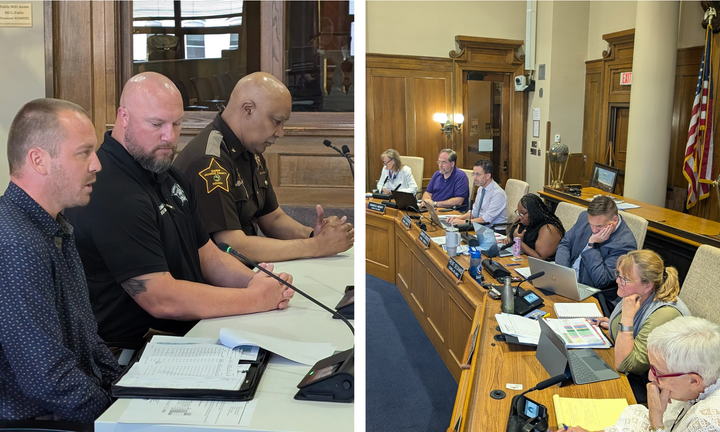
Whikehart told the board the occupants had been removed “peacefully and without incident” with assistance from Bloomington police, MSI security and Weddle Brothers.
The demolition schedule became more concrete at Wednesday’s meeting.
The CIB unanimously approved a $16,400 first-phase contract with Weddle Brothers to manage pre-construction work, permitting and preparation of demolition bid documents, with reimbursable actual expenses capped at an additional $5,000.
Environmental testing, surveys, utility disconnections, permitting and other preliminary work are expected to put the project in a position for demolition to begin around Nov. 4, assuming no unexpected environmental or permitting problems. Weddle project manager Andrew Scere told the board the goal is to have the buildings removed and the site stabilized by Dec. 31.


Comments ()