
Order from judges means no big inmate-transfer costs for Monroe County sheriff’s 2027 budget
A multimillion-dollar plan to move 50 to 100 Monroe County jail inmates to other counties is absent from Sheriff Ruben Marté’s proposed 2027 budget after judges declined to authorize the transfers. Jail population remains above Marté’s functional-capacity benchmark.
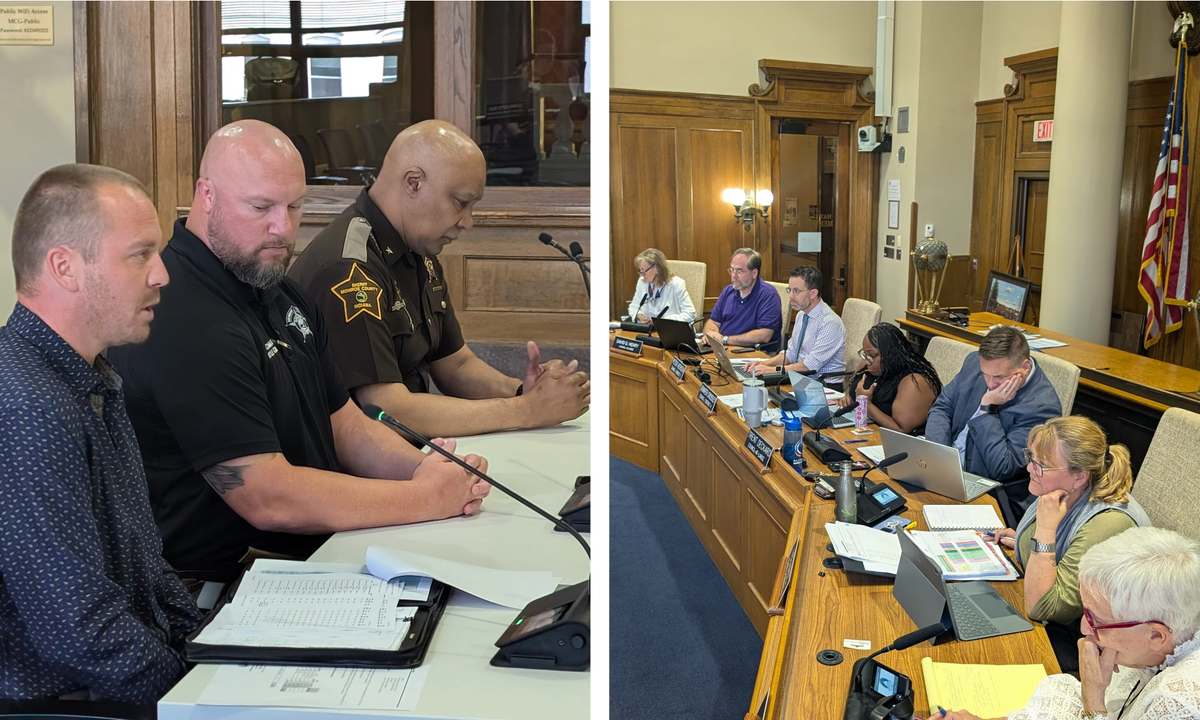
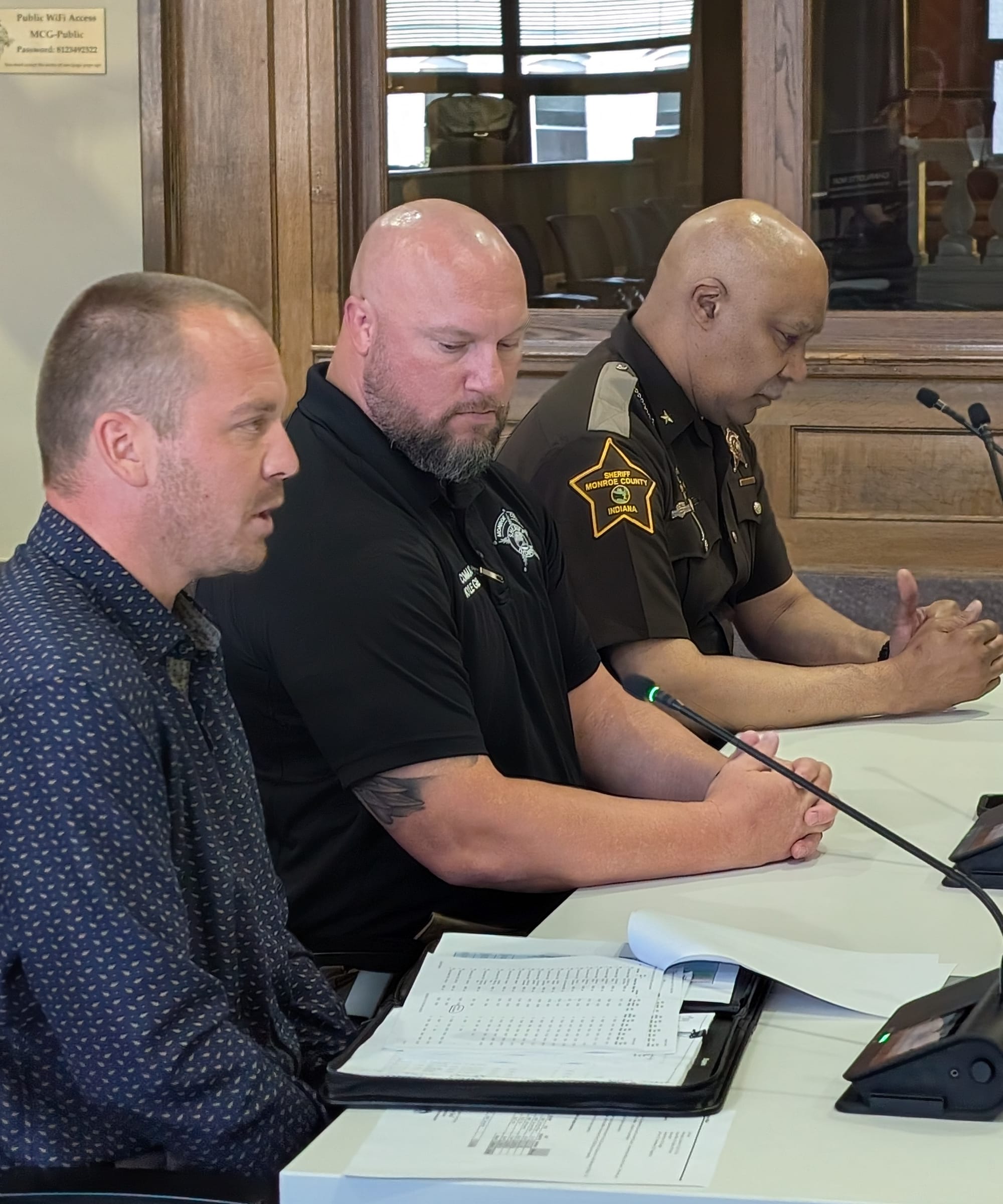

Left: From back to front are Monroe County sheriff Ruben Marté, jail commander Kyle Gibbons, and the jail's financial manager, Jordan Miller. Right: Monroe County councilors from back to front are Marty Hawk, David Henry, Peter Iversen, Jennifer Crossley, Trent Deckard, Kate Wiltz, and Liz Feitl. (Dave Askins, Sept. 9, 2026)
A plan that two months ago looked as if it could add several million dollars to Monroe County’s jail costs is absent from sheriff Ruben Marté’s proposed 2027 budget.
During Wednesday’s (Sept. 9) county council budget session, Marté and his staff presented the budgets for both the jail and the sheriff’s office. On the jail side, Marté said the only requested increase was for medical services. On the sheriff’s-office side, he said the only increase was for the merit-deputy pension.
But there was no new request to pay other counties to house Monroe County prisoners or to staff the large-scale transportation operation Marté had proposed this summer.
That is a big change from July, when Marté told county commissioners that overcrowding had reached the point where Monroe County should prepare to move 50 to 100 inmates to other county jails. His initial estimate put the first-year cost for housing and transportation at between $2.94 million and $5.09 million. The plan contemplated 14 to 17 transport officers, additional supervisors and administrative staff, and seven vehicles.
At the time, the commissioners declared an overcrowding emergency and encouraged the county council to identify funding for housing, transportation, medical and related operating costs. But the plan still required action by the county’s judges before the sheriff could carry it out.
Judicial OK did not come
On Aug. 7, Marté filed a verified petition asking the Monroe Circuit Court to authorize inmate transfers under state law. Under the law, a court can order inmates transferred, if the sheriff says the jail is overcrowded or inadequate and there is another facility that agrees to take them.
But on Aug. 14, all nine Monroe circuit court judges, acting together, issued an order dismissing Marté’s petition.
The reason given by the judges was the federal lawsuit over jail conditions that the ACLU of Indiana had filed a month earlier.
The judges noted that Marté’s petition itself cited the ACLU lawsuit and its challenge to the constitutionality of conditions at the Monroe County Correctional Center. Because the federal lawsuit alleges overcrowding and unconstitutional conditions, and Marté was citing those same conditions as the basis for transferring inmates, the judges invoked the legal principle of “comity.” That’s essentially declining to act on a matter involving the same subject already in front of another court.
The dismissal was “without prejudice,” meaning Marté was not permanently barred from asking for transport of prisoners later.
Federal lawsuit now moving ahead
The pending federal case is a class action filed on July 10 by the ACLU of Indiana on behalf of people incarcerated in the Monroe County jail. The defendants are the Monroe County council, county commissioners and sheriff Marté.
The plaintiffs allege that overcrowding, the condition of the aging downtown facility and the way it must be operated have produced unconstitutional conditions. County officials acknowledge substantial shortcomings with the existing jail, but deny that the conditions amount to constitutional violations.
The newest development in the lawsuit came Sept. 2, when the judge approved a case management plan that could keep the litigation on the calendar through much of 2027. Initial disclosures required by the federal rules are due Sept. 10. Liability discovery is supposed to be completed by Feb. 10, with motions that could resolve some or all of the case without a trial due by March 10. The parties have requested a three-day bench trial in October 2027, although the court has not yet set that as a trial date.
Two different capacity numbers
The question of whether the jail is overcrowded also depends on which functional-capacity figure is used.
Marté’s July overcrowding report starts with the facility’s nominal 294 beds, but subtracts housing that cannot ordinarily be used for the general population. That leaves 233 general-housing beds. Applying an 80% operating threshold produces Marté’s functional-capacity figure of 186. The 80% figure is supposed to factor in enough space to separate prisoners by sex, security classification, medical needs and other considerations.
The ACLU calculates the jail’s functional capacity at a higher number. The ACLU arrives at a figure of 229 people by starting with 287 permanent beds and applying the same 80% operating threshold. So Marté is excluding more beds from the usable general-population inventory than the ACLU is, before applying the same 80% threshold.
The most recent figure from the weekly B Square jail population reports was 227 inmates on Sept. 5. That put the jail just below the ACLU’s 229-person benchmark for a third consecutive day, but still 41 people above Marté’s 186-person figure. Over the 47 days tracked by The B Square through Sept. 5, the average daily population was about 240.
Some transports can continue
The order from the board of judges does not mean no prisoners held at the Monroe County jail can be moved elsewhere.
Jail commander Kyle Gibbons told The B Square that transports can continue to other facilities involving prisoners who have been sentenced and are awaiting a place in an Indiana Department of Corrections facility. That kind of transfer is different from the broader program Marté sought to establish through his petition to the judges.
Before the Aug. 14 order, Monroe County had already begun sending some DOC-linked prisoners to neighboring Brown County. Six were transferred in late July. Three were people who had already been sentenced to the state prison system and were waiting for IDOC placement, and three were being held on IDOC parole violations.
Because IDOC pays county jails a per diem to hold those prisoners, the arrangement did not require Monroe County to pay Brown County a new housing per diem out of local funds. Instead, the state payment that Monroe County had been receiving followed the prisoners to Brown County.
Even without the proposed 50-to-100-inmate transfer program, transportation remains a significant part of the routine activity of operating the jail and sheriff’s office. That’s something drawn out on Wednesday night by councilor David Henry. He asked how much staff time is consumed by transporting people to hospitals, mental-health facilities, other counties and sometimes other states.
Kyle Gibbons, the jail commander, said the jail staff and sheriff’s deputies share that workload and that the jail keeps a transport log recording time, mileage, officers and prisoners involved. Chief deputy Phil Parker said the transport burden has increased substantially over the last three or four years, while Marté said the number of deputies available to handle it has decreased.
The bottom line is that the multimillion-dollar emergency transfer operation that Marté outlined in July is not part of the 2027 spending plan now in front of county councilors.
But the situation that prompted the sheriff’s emergency plan persists for the county council and the county commissioners: the jail’s limited functional capacity, whatever the precise number; the expense and difficulty of moving prisoners; the question of how long the existing facility can continue to operate; and lingering decisions about where to build a new jail and how to pay for it, if that’s the solution county officials pursue.


Comments ()