
2027 budget: Council president proposes $2.5M across-the-board target for Bloomington general fund
Bloomington council president Isak Asare has proposed cutting $2.5 million from the city’s 2027 general fund, leaving Mayor Kerry Thomson’s administration to identify the specific reductions before final adoption. Council takes up 16 possible amendments Wednesday night.

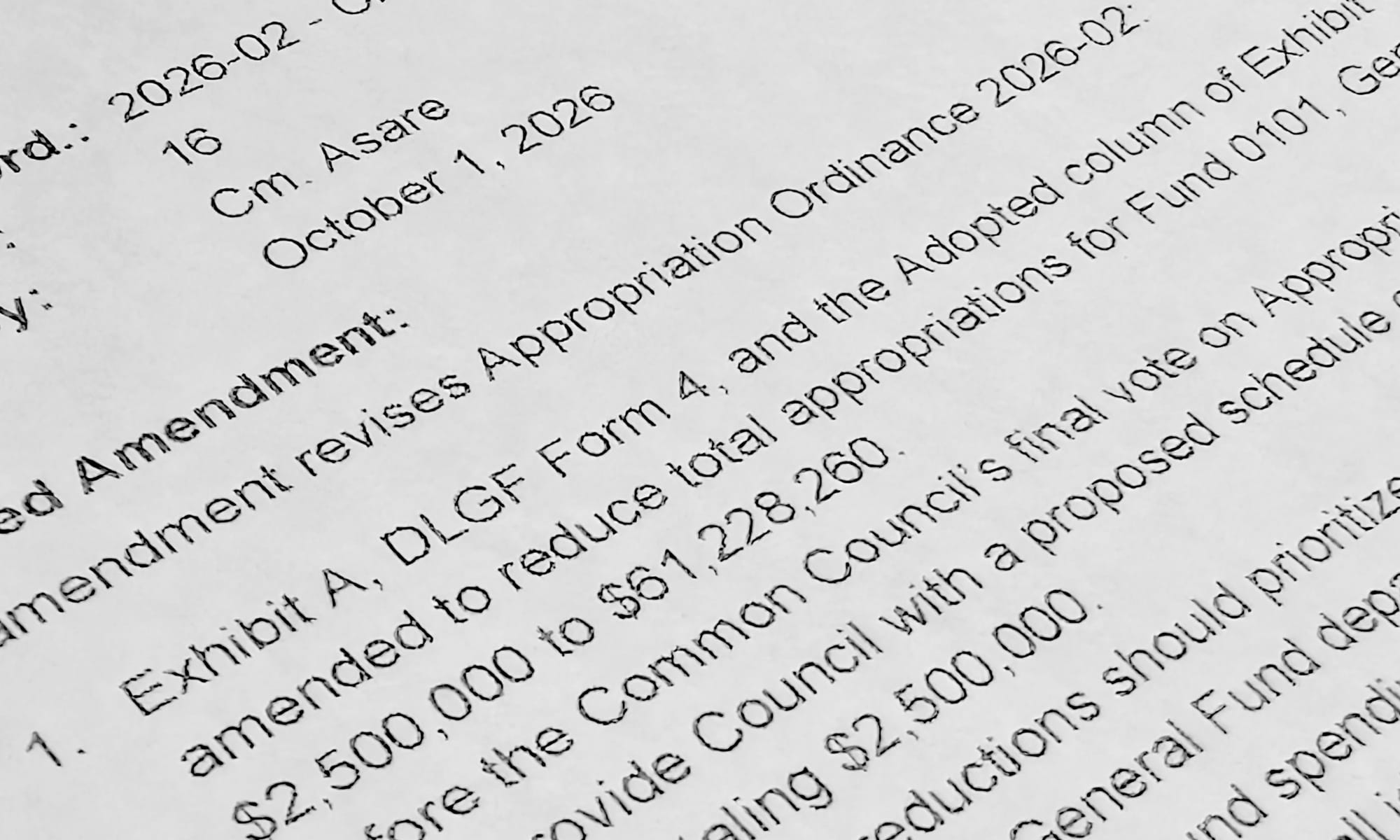
Bloomington city council president Isak Asare has proposed cutting $2.5 million from the city’s 2027 general fund budget, without specifying exactly which departments or programs should absorb the reductions.
Instead, Asare’s amendment would require mayor Kerry Thomson’s administration to come back with the details before the council takes its final vote on the budget.
The proposal is the last of 16 budget amendments now set for consideration when the council meets Wednesday night (Oct. 7). Asare’s amendment was released Tuesday night in a meeting packet addendum, along with responses from the administration to other amendments proposed earlier.
Asare’s newest amendment is separate from any of the other amendments that have been floated or reduced to writing up to now.
Bloomington’s proposed 2027 budget totals about $171.4 million across all funds. About $63.7 million of that is the general fund, which supports much of the city’s day-to-day government operations. Asare’s proposed $2.5-million reduction is about 4% of that fund. None of those figures include city of Bloomington utilities or Bloomington Transit.
Underlying Asare’s approach, he has said, is the idea that revenue growth is expected to slow under the revisions to property tax law that are already being phased in, and local income tax changes that will take effect in 2029, due to state legislative action. At last week’s city council work session he summarized that view with two words: “Lean times.”
Asare’s Amendment 16 would reduce total general fund appropriations from $63.73 million to $61.23 million, a reduction of just under 4%. It directs the mayor to identify $2.5 million in specific account-level reductions, and to “prioritize recurring, long-term savings.” The cuts are supposed to be distributed among departments in “rough proportion” to their shares of general fund spending.
The specific document to be amended is Budget Form 1, which is included in the packet as Exhibit D. That’s why all of the council’s proposed amendments refer to Exhibit D.
Asare’s Am 16 does not simply set a $2.5-million target for Thomson. Before the final vote, the administration would have to give the council a schedule showing the affected department and account, the amount of each reduction and the anticipated effect on services.
The amendment does not exempt the police and fire departments from the proportional cuts
The proposed reduction would also substantially narrow the gap between general fund spending and revenue that was built into Thomson’s original budget proposal. Based on the city’s Form 4-B, the original budget proposal calls for roughly $6 million more in general fund expenditures ($63,752,216) than 2027 revenues ($57,760,197). The difference would tap the fund’s cash balance, which was projected to decline from about $59.5 million at the end of 2026 to $53.6 million at the end of 2027.
The new proposal follows a Sept. 30 council work session when Asare floated potentially bigger changes to city staffing and organization, including the mayor’s communications operation and the economic and sustainable development (ESD) department.
At that work session, Asare suggested that all ESD positions could be funded for only part of 2027, which would force a decision during the year about which functions belong in city government and where they should be located. He also raised possible cuts involving the mayor’s vacant public engagement director, communications staff, and legislative affairs specialist.
The administration has not agreed to that immediate ESD restructuring. But in a 30-page memo added to Wednesday’s meeting packet, Thomson and her department heads showed signs of movement towards some changes.
The administration says it is willing to consider “broader reorganization and staffing cuts” and promises to bring the council a proposal by June 1, 2027. The administration says it wants time to consult department heads and consider how offices should be organized before making those decisions.
In the memo, the administration says it believes “there can be effective reorganization and cuts in personnel, even in the offices of elected officials.” On the mayor’s communications operation specifically, the administration continues to say that centralized communications staffing is needed, but says it could reduce the current two full-time positions to 1.5. It asks the council not to eliminate the legislative affairs specialist, who works out of the mayor’s office.
In the memo, there’s an implicit commitment to review the now-vacant public engagement director in the mayor’s office before posting it. It’s not currently advertised on the city’s jobs board. From the memo: “We do believe that before any vacant position is posted, the City should re-evaluate the need for the position. The Mayor commits to personally examining each role going forward.”
Those are not the administration’s only areas of agreement with proposed cuts by the council.
Thomson’s administration supports eliminating the vacant transportation demand manager position, supports cutting $10,000 reserved for branding work, and supports reducing the city’s ED-LIT subsidy to sanitation from $1.6 million to $1 million, with higher trash-cart rates expected to make up the difference.
On other proposals, the administration is offering reductions, but smaller than those proposed by the council. Instead of a council proposal to cut non-police and non-fire travel by $41,925, the administration says it can identify $35,000 in targeted travel cuts. Parks officials oppose a $48,145 reduction in program-guide printing and postage, but offer savings of $18,000 to $25,000 instead.
The administration has no objection to removing a $2.5-million placeholder in the parking meter fund for new parking systems. In that case, however, the reduction does not necessarily mean the city ultimately spends $2.5 million less. The administration could return to the council later for a new appropriation once specific parking projects are ready.
That distinction between actual reductions in the cost of city government and simply postponing spending authority is a theme of the administration’s response. Thomson’s administration contends that some of the proposed amendments would merely cause departments to return later for additional appropriations, adding council meetings and staff work without ultimately saving money.
Am 16: $2.5M cut would have to get specific
Asare’s new general fund amendment (Amendment 16) raises a practical question that does not exist for other proposed amendments: What happens if the council approves the $2.5-million total reduction, but the administration does not identify the underlying line-item cuts?
The amendment itself attempts to answer that question by requiring Thomson to submit the detailed schedule before final budget adoption.
City controller Geoff McKim has told the council that amendments have to work their way through the city’s accounting system and the state’s Gateway budget system, before a new state Form 4 can be generated. “It is ultimately the Form 4 that the Council is voting on,” McKim wrote.
For a single-line change, McKim said that process might take only minutes. Larger revisions can require days of recalculation and checking. If the changes approved Wednesday cannot be incorporated into Gateway that night, McKim says the council will have to put off the formal budget adoption to another date so it can vote on a completed Form 4.
That makes the $2.5-million proposal effectively a two-stage decision. The council could vote Wednesday to set the lower general fund ceiling. But before final adoption, the overall $2.5-million reduction would have to turn into actual appropriations. Somebody would have to decide which departmental accounts get smaller.
Under Asare’s amendment, Thomson gets the first chance to make those individual reductions. If the administration just refuses to do it, the council would still have to reconcile the detailed appropriations with its lower general fund total, by specifying the detailed cuts itself, revising the amendment with the $2.5-million cut, or delaying final adoption.
The administration has already signaled that it considers Oct. 14 as the likely date for a final vote, if council members approve enough amendments Wednesday to require substantial recalculation. But state law allows another two weeks before a municipal budget has to be adopted.
Table of Potential Amendments
Some or none of the following 16 amendments could be introduced at the city council’s Oct. 7, 2026 meeting. It starts at 6:30 p.m. in city council chambers at city hall. The table below is based on one included in the administration’s memo.


Comments ()