
Deadlock on delay leads to 5–3 approval by Bloomington for 360-unit residential project
Bloomington’s plan commission approved a 360-unit, 760-bed Greystar apartment project at the Bloomington Iron and Metal site on North Rogers Street after a failed 4–4 vote to delay the decision. The major site plan passed 5–3 with conditions on environmental testing, utilities and public paths.
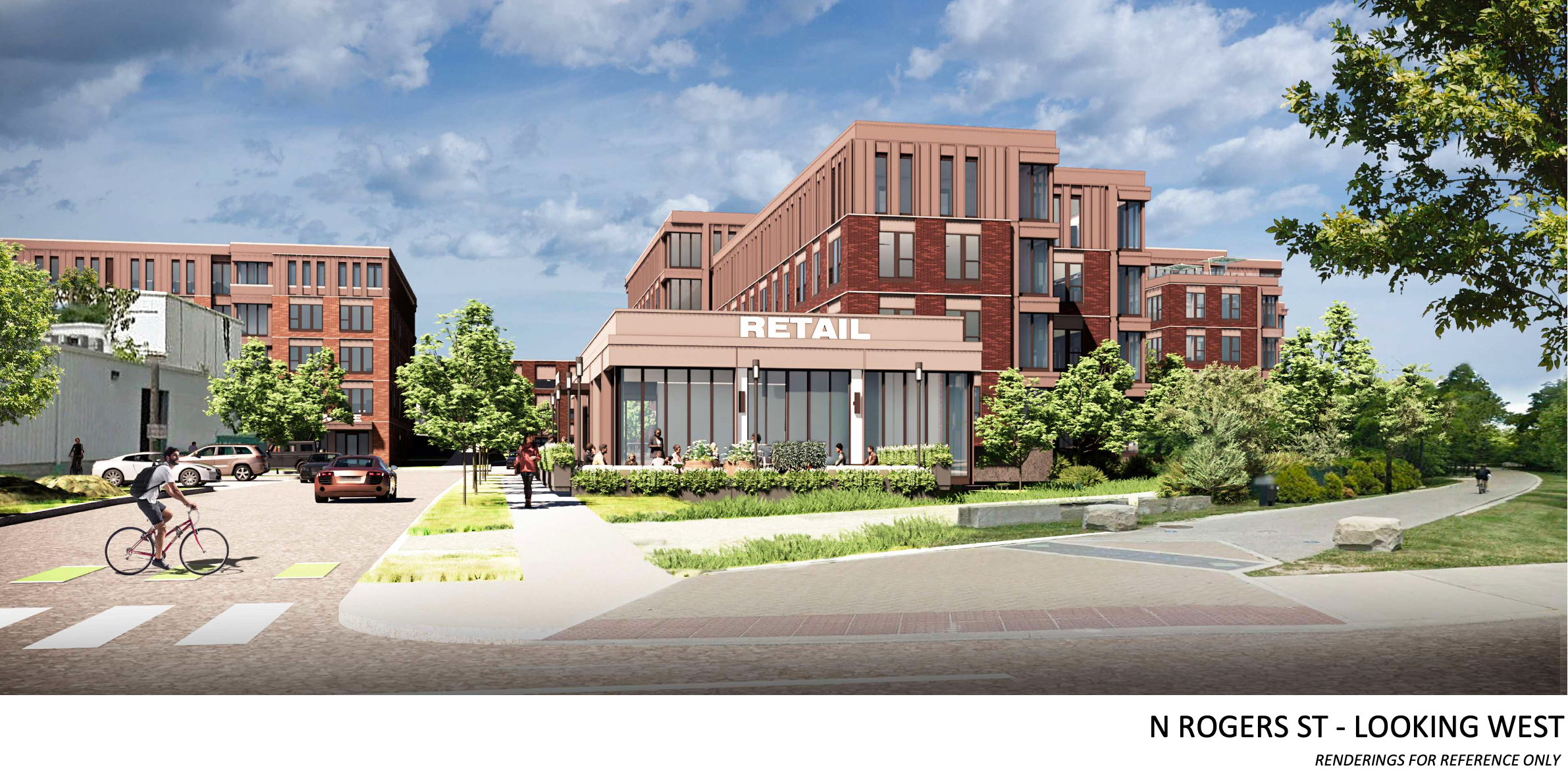
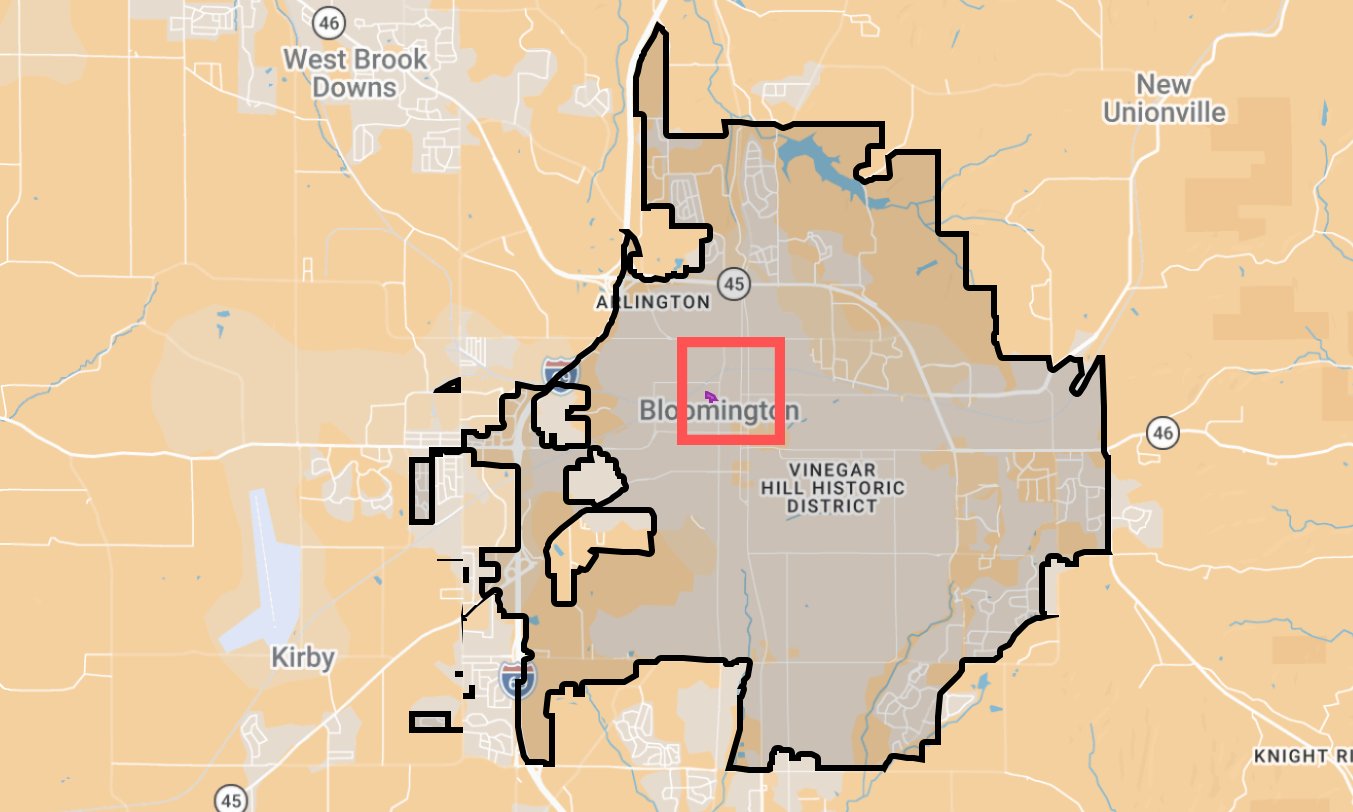
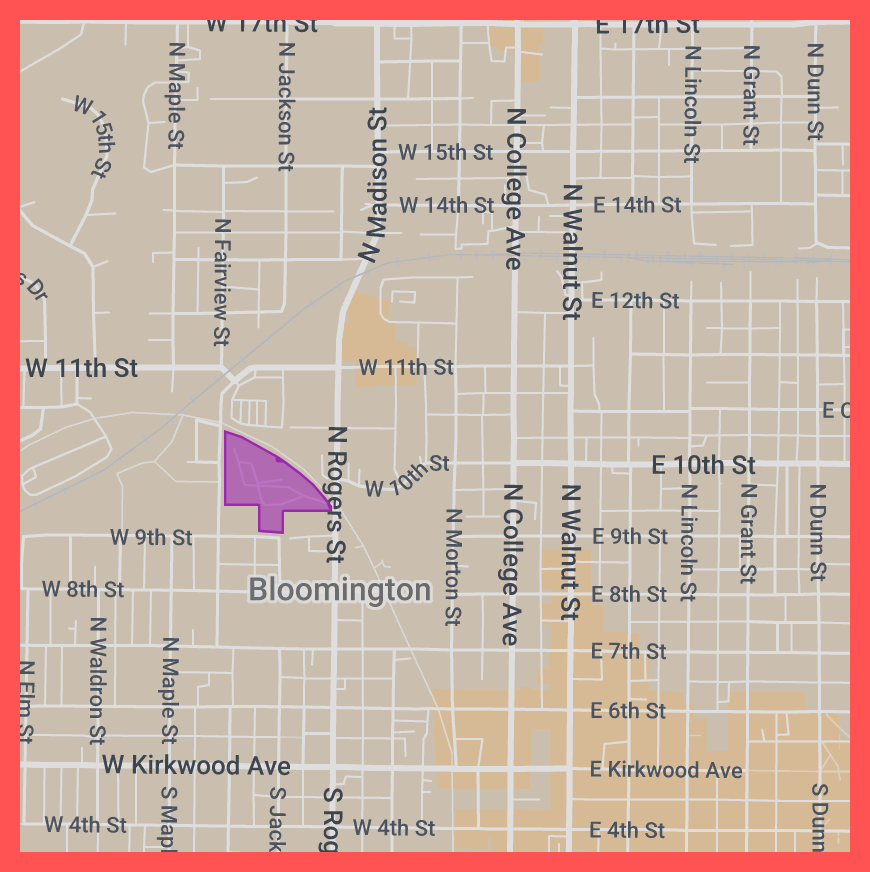
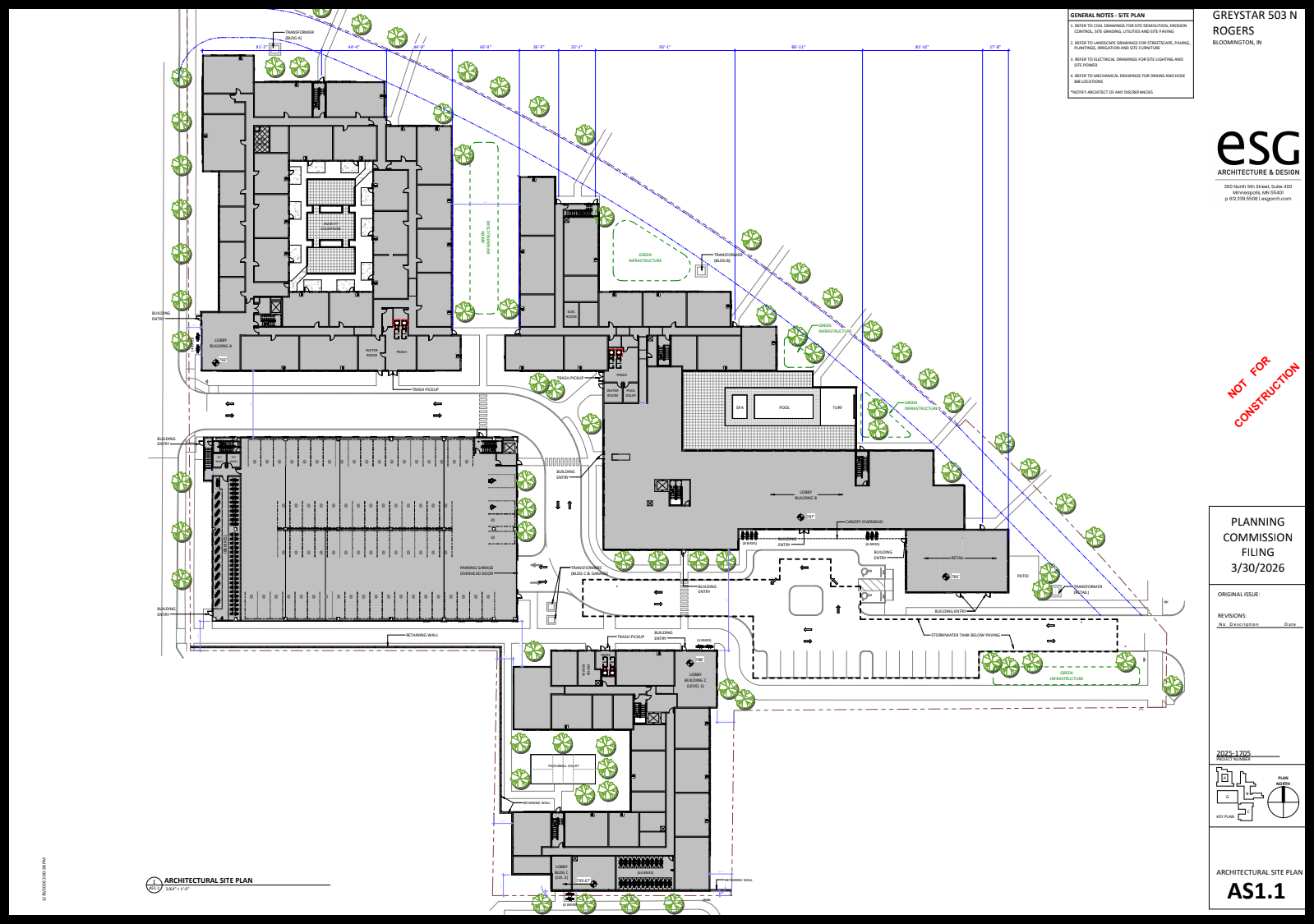
Maps by The B Square with information from the city of Bloomington. Site plan layout from ESG Architecture and Design from the April 13, 2026 Bloomington plan commission meeting information packet.
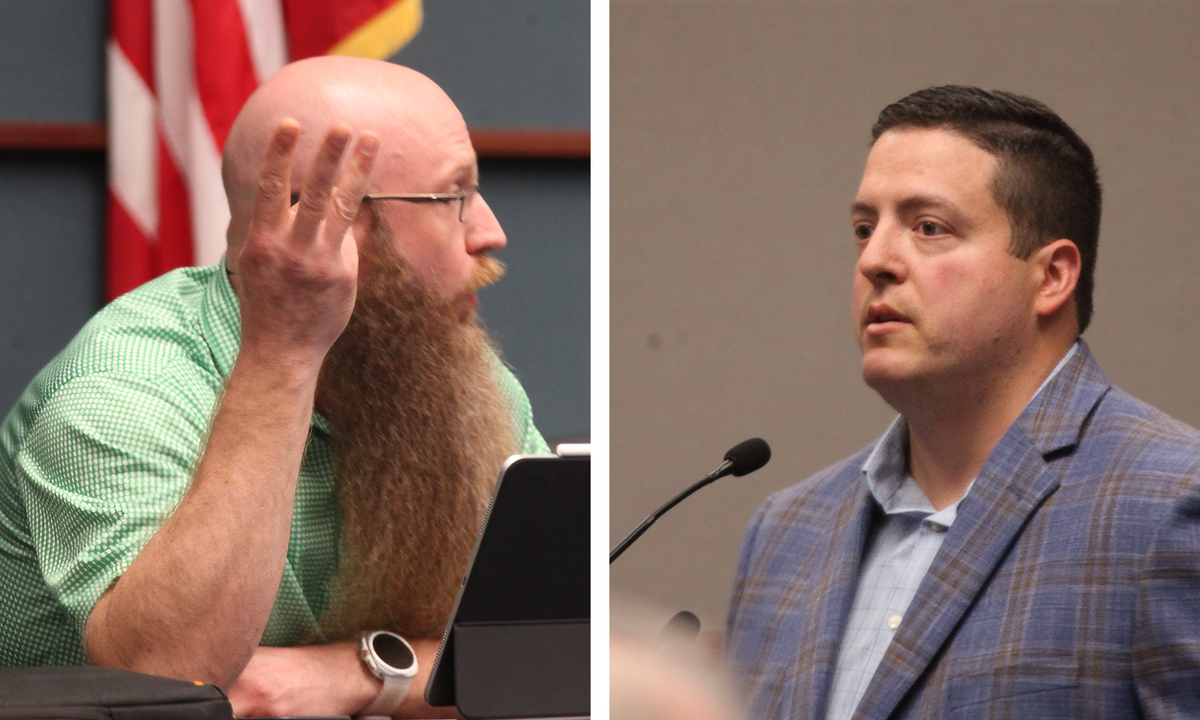
Left: Plan commissioner Steve Bishop. Right: Greystar director of development John Anest. (Dave Askins, April 12, 2026)
A proposal to turn the Bloomington Iron and Metal scrap yard at 503 North Rogers Street into a 360‑unit, 760‑bed apartment complex cleared the Bloomington plan commission late Monday night (April 13). The approval came only after commissioners first deadlocked 4–4 on whether to postpone the decision.
The project, by national developer Greystar, will put three multi‑family buildings and a parking garage on the 5.2‑acre site, bordered by Rogers Street, the B‑Line Trail, Fairview Street, and 9th Street, across from Rev. Ernest D. Butler Park and at the edge of the Trades District.
A motion to continue the hearing to the commission’s May meeting, in order to dig more into parking, traffic, and environmental conditions, ended in a 4–4 tie. That meant the motion failed.
Commissioners Jillian Kinzie, Steve Bishop, Ellen Coe Rodkey, and Patrick Holmes voted to continue. Commissioners Hopi Stosberg, Brad Wisler, Flavia Burrell, and Andrew Cibor voted against continuing. The tally did not add to nine, because Tim Ballard was absent.
After the failed effort to postpone, the commission then took up the staff‑recommended motion to adopt findings and approve the major site plan with ten conditions. That motion passed 5–3. Voting yes were Stosberg, Wisler, Burrell, Cibor, and Kinzie. Voting no were Bishop, Coe Rodkey, and Holmes.
Plans call for 292 parking spaces, most of them inside a garage, along with bicycle parking, landscaped open space, and a new public multi-use path running east–west through the site to connect the B-Line Trail with the Rev. Ernest D. Butler Park.
The site sits inside the city’s Mixed-Use Downtown district with the Showers Technology character overlay, an area intended to support higher-density housing near the Trades District and downtown employment centers
The site has a long industrial history that includes a federal Superfund cleanup for PCB contamination completed in 1996. Recent environmental site assessments found soil conditions currently meet state and federal screening levels, though some testing areas were limited by the presence of scrap material piles.
As part of the approval, the developer will be required to conduct additional soil testing after the remaining material piles are removed and provide the results to state and federal environmental regulators.
The buildings will stand five stories tall, with heights ranging from about 52 to 60 feet. That’s a scale allowed through sustainability and affordable-housing incentives in the city’s unified development ordinance.
Formally, the project is approved as “dwelling, multi‑family,” not “student housing” or “dormitory,” which would trigger a different set of standards. Still, the floor plans show a high share of three‑bedroom, three‑bath units, which several commissioners noted looks very similar to modern student‑oriented product.
To lock in multi-family instead of student housing, a condition of approval requires the property owner to record statements of commitment, including a promise that individual rooms will not be advertised or leased by the room and that roommate‑matching programs will not be used. Greystar’s team told commissioners, “This project will be leased by the unit.”
Greystar is satisfying the sustainability incentives by committing to sustainable design standards, including achieving Silver certification under the National Green Building Standard.
Greystar is satisfying the affordable housing incentives not by building income-restricted units on site. Instead, the project will make a payment to the city’s housing development fund. Under the city’s formula in force at the time of Greystar’s application, the payment equals 15% of the total number of bedrooms multiplied by $20,000 per bedroom, payable before final occupancy. That works out to $2.28 million.
That’s less than the new formula, which was changed in the administrative manual to $50,000 per unit which means both the amount and the ‘unit’ changed—it’s no longer per bedroom—in connection with an ordinance enacted by the city council in February of this year. That would have worked out to $5.7 million $2.7 million.
The 292 parking spaces that will be provided are less than would ordinarily be required, except that projects using an affordable housing incentive have a reduced requirement under Bloomington’s UDO (Unified Development Ordinance).
A previous developer went through the variance process in late 2023, but did not move the project forward after that.
Greystar’s case
In his main presentation, Anest framed the project as a direct response to Bloomington’s housing shortage in a location the city itself has targeted. “Bloomington needs more housing, and the most responsible place to add it is where the city already has planned for it,” he said. “That is this site in downtown, where the zoning plans for it, the Trades District vision plan calls for a complete, walkable neighborhood, and this project helps deliver that.”
Anest described the scrap yard today as “a chain link fence and a scrap metal operation that’s been there since the 1950s,” and the redevelopment as 360 apartments across a range of unit types, approximately 3,000 square feet of ground‑floor commercial space on Rogers. The project includes extensive landscaping on site and over 140 trees planted off‑site under a variance deal, a new 10‑foot public path connecting the B‑Line Trail to Butler Park, and a building program that Greystar says will meet the National Green Building Standard’s Silver certification.
Anest says it expects to build, own, and manage the complex long‑term.
Questions raised by commissioners
Commissioner Steve Bishop delivered the sharpest questions, pressing Greystar on rents, affordability, and its corporate track record. John Anest, director of development for Greystar, told the commission the units would open at “market‑competitive” rents, not below‑market.
Bishop challenged the idea that adding more high‑rent apartments meaningfully helps local renters. “If you bring in new units at the same rent as everyone else, how is that alleviating or lowering rent across the board?” he asked. “Bring them in at market rents, … that doesn’t help, because we’re just perpetuating the problem, right?”
He also requested from Greystar at least an estimated figure for the rents that the developer is planning to charge. “I mean, you have investors in this company that want a return on investment,” Bishop said. “So if you were ever to tell them, ‘Hey guys, we’re going to dump $10 million into this project, but I can’t tell you what that return would be,’ do you think they would give you the money? I think the answer is no.”
Bishop continued, “So for you to ask us to invest in you trying to be a good neighbor in Bloomington without any sort of transparency on a ballpark idea of what we would look to expect for … what we would consider of housing that anyone can get into, that’s hard for me to accept.” Bishop added, “So if you could please provide us with any sort of pricing details that would be delightful.”
Bishop also pursued a line of questions that cited recent federal enforcement actions involving the company. “Last year, in 2025, the Federal Trade Commission and the state of Colorado brought a suit against you for deceptive pricing practices for $24 million, which your company agreed to settle,” Bishop said. “And then again, the U.S. Department of Justice Antitrust Division came after you for colluding with other real estate landlords and RealPage to price‑fix based on market rents.”
Bishop included those cases in the context of Greystar’s insistence in Bloomington that “market rate” would guide pricing: “I hear you guys talking about you’re going to go in line with market rents here in Bloomington, and that concerns me,” he said, pointing to Greystar’s scale—hundreds of thousands of units nationwide—and its ability to shape the very market it says it will follow.
Anest responded in general terms. “Like any big company, Greystar has been involved in litigation from time to time, but we cannot publicly comment on litigation matters,” he said. “Greystar is committed to always doing things the right way, and that direction comes straight from the top of our company, with the focus on the residents and the communities that we serve.”
Eventually, after checking local comparables, Anest came back to Bishop with a range. For a one‑bedroom unit, he said, the company found current Bloomington rents “between $1,300 and $1,600,” and would aim to be “price‑competitive” within that range when the project opens.
Public comment overview
From the public mic, comments highlighted some unresolved questions that appeared to build some momentum on the plan commission for postponement. They asked what the traffic study actually shows about additional car volumes, queuing on Rogers, and diversion onto Fairview and neighborhood streets—especially during Fairview Elementary’s drop‑off and pick‑up times. That came in the context of an observation from commissioner Andrew Cibor, who is the city engineer, and who said he had not seen the traffic study that Greystar representatives had mentioned.
From the public mic also came questions about the assumptions behind providing 292 parking spaces for 760 bedrooms. How confident is the city that spillover into already tight historic neighborhoods will be minimal, given current on‑street constraints?
Residents also pressed for harder facts on contamination and air quality: How many soil and groundwater borings have been done, in which locations, to what depths? They wanted to know how much is unknown under existing scrap piles and old structures, whether there is asbestos in the former limestone mill roof, and whether there will be any independent air‑quality monitoring during demolition and construction to protect nearby homes and Fairview Elementary.
On stormwater, they asked why a vote was proceeding before City of Bloomington Utilities (CBU) had fully signed off, and what modeling exists on how relocating the storm sewer and adjusting detention outflows will affect downstream flooding risk.
Finally, neighbors probed the numbers around incentives, wanting to know exactly how the payment‑in‑lieu to the housing development fund reduces required parking. How much will the project save from not building those parking spaces, and will that be more than the $2.3 million check that Greystar will be writing for its affordable housing incentive? From the public mic, residents also wanted to know how the city will verify that, despite its layout and unit mix, the complex will not function in practice as student housing.
Some plan commissioners were keen to get clarification about whether the payment-in-lieu approach to the affordable housing incentive could be rejected by the plan commission. Assistant city attorney Enedina Kassamanian said, “So my understanding is, even though it’s allowed via the UDO, it doesn’t mean that the plan commission cannot reject it.” She later said she would need more time to research the legal basis and limits of the plan commission’s authority.
Commissioner Hopi Stosberg pointed out that even if the commission somehow rejected the payment‑in‑lieu option, the developer could instead choose to build on‑site “affordable” units under the current UDO definition and still claim the same parking reductions, which led to the concerns from neighbors about adequate parking.
Turning point on postponement
Patrick Holmes argued for postponement. Even though multi-family housing is allowed on the proposed site, it’s not the kind of housing Bloomington needs, Holmes said. “I think that Bloomington needs single family housing. I think we need houses that people can own. I wish that this were that type of development, but multi-family is allowed in this district and so we don’t get to reject this based on that.”
But Holmes saw a different way to reject the project: “Now I do think that we can reject this based on the failure to mitigate adverse impacts on the surrounding neighborhood. I think the parking and the traffic, those are real issues.”
Holmes felt that by rejecting the payment-in-lieu affordable housing option, there was a path to getting additional parking spaces built in the project. “If we can deny that and get 500 or more parking spaces in here, I think that would make a big difference in the outcome here. I think that would be much better for the surrounding neighborhood,” Holmes said.
So Holmes made the motion to postpone a vote to get more precise information about what the city’s options are in connection with parking and the affordable housing incentive, and to give Greystar a chance to come back and voluntarily accept more parking.
The turning point on the question of postponement seemed to come when plan commission president Brad Wisler pushed back on using parking and traffic concerns to delay or deny a project that, in staff’s view, meets the Unified Development Ordinance (UDO) as written, with granted variances.
“We can’t deny a request on the grounds that there’s insufficient parking when the petitioner followed our guidance on the parking,” Wisler said. “If there’s a problem here, then we need to fix the UDO. It’s not grounds to deny a petition when they’ve complied with the outline we set forth in the UDO.”
Wisler called it “very frustrating” to “take it out on petitioners when all they’ve done is follow the rules we’ve set forth for them.” “They’ve done literally everything the code calls for,” Wisler said. “So I don’t see a reason to continue this. If we want to see things change, we need to change our rules, not continue to bend the rules when petitioners have done everything that we’ve asked of them,” Wisler said.
Wisler’s argument seemed to help peel off at least one potential vote for a postponement, leading to the 4–4 tie on the motion to continue the petition until next month and forcing an up‑or‑down vote on approval.
On the question of denying the overall petition, Holmes said it’s not a matter of simply complying with each point of the UDO: “I personally, I do believe that we are within our bounds if we choose to reject this. It’s not bare compliance with the UDO. It has to be consistent with the comprehensive plan, and it has to have mitigation of adverse impacts.”
With site plan approval in hand, subject to ten conditions, Greystar can move toward demolition and construction.
Conditions include: final sign‑off by City of Bloomington Utilities; additional soil borings and submission of all results to IDEM and EPA; recording of easements for the multi‑use path and portions of public sidewalk on private property, with explicit language added by the commission that the property owner will maintain the path; implementation of off‑site tree planting under a memorandum of understanding with parks and recreation; payment to the housing development fund before final occupancy; and documentation of NGBS Silver certification, or acceptable proof that it is pending, before final occupancy.


Comments ()