
Ellettsville–Richland Township reorganization passes by narrow margin outside town limits
Voters approved the Ellettsville–Richland Township reorganization Tuesday, but the margin outside town was just 35 votes. A recount would require hundreds of petition signatures by Nov. 17. The change would expand Ellettsville’s boundaries and could affect future local income tax distributions.
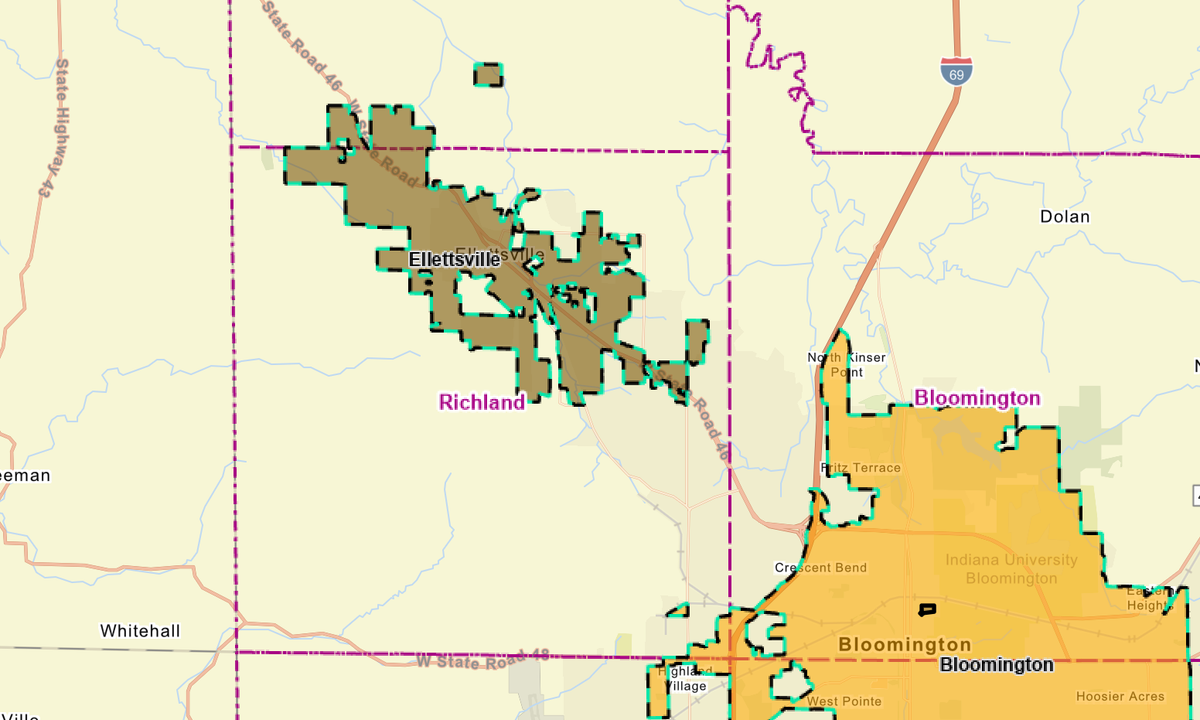
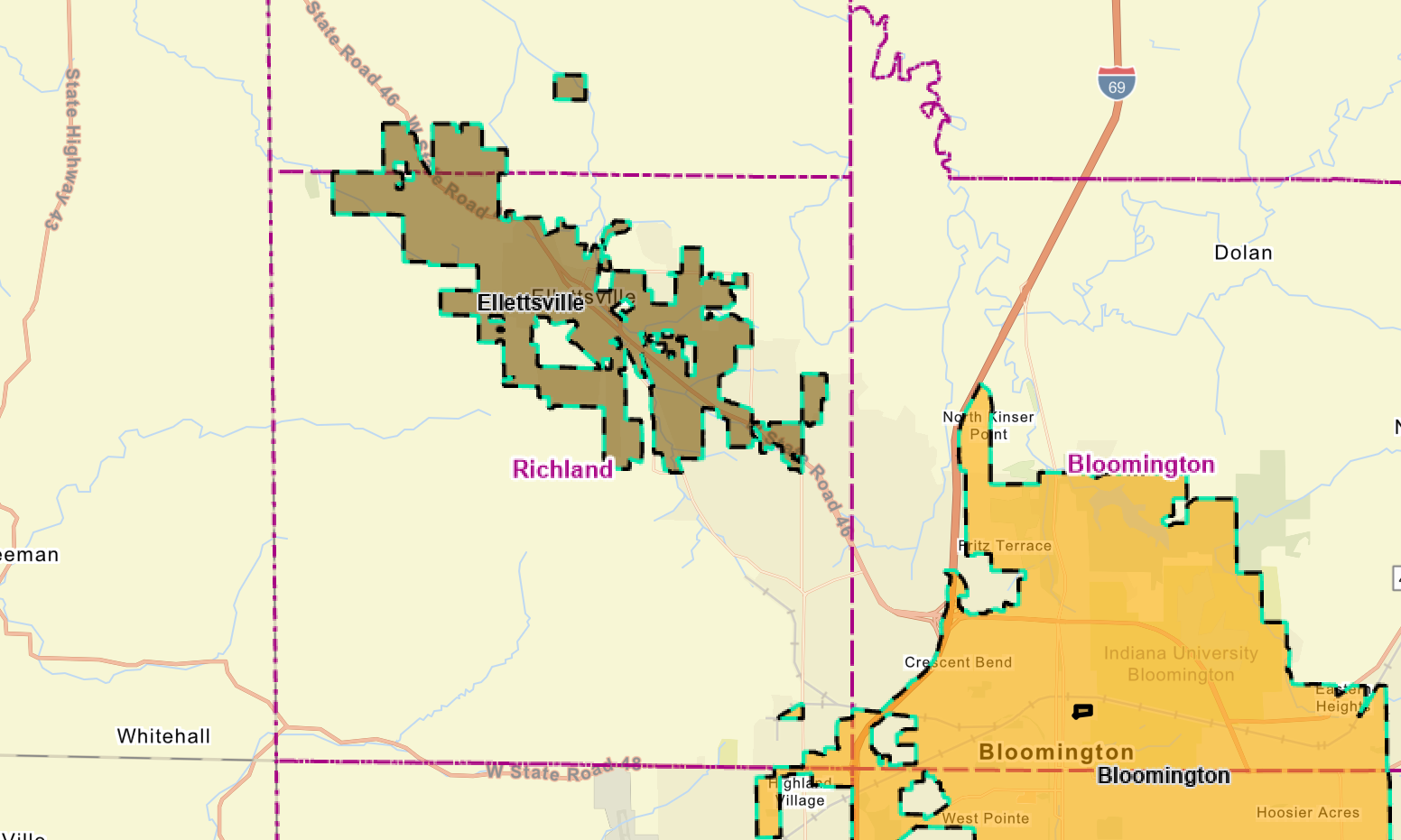
Voters in Ellettsville and Richland Township approved a plan Tuesday (Nov. 3) to combine their local governments. But the margin among voters outside the existing town limits was just 35 votes, based on a precinct by precinct tabulation of votes. That amounted to a difference of 1.2 percentage points.
The overall vote was 3,007 in favor and 2,480 against, or 54.8% support. But the overall margin was not enough by itself. Under Indiana state law, the proposal also needed separate majority approval from voters inside Ellettsville and those in Richland Township outside the town limits.
The proposal would dissolve Richland Township government and fold its responsibilities into a reorganized Town of Ellettsville, covering roughly 35 square miles. The new government, scheduled to take effect Jan. 1, 2027, would have a seven-member town council, with five district seats and two at-large seats.
The plan also establishes separate urban and rural taxing districts. The reorganization would change responsibility for police protection, road maintenance and planning and zoning in rural Richland Township.
Andrew Henry, who was unopposed on the ballot for a seat on the town board, said in a statement to The B Square, “I’m really pleased that reorganization passed…” But he also took the close margin as a sign that there’s a lot of work ahead.
Henry put it like this: “The extremely narrow margin in Richland Township makes it clear that there’s still a lot of trust that needs to be built and a lot of work ahead of us.” Henry added, “I am so excited to join the reorganized board in January and get to work.”
Corrected vote totals
The B Square’s initial election-night display omitted results from two precincts that were included in the county’s election data stream: Bean Blossom 1 – Town; and Richland 9. The omitted results were 19 yes and 23 no votes in Bean Blossom 1 – Town, and two yes votes in Richland 9.
Adding those votes produces numbers that match the county’s election dashboard overall results. Bean Blossom 1 – Town certainly looks like it belongs in the inside-town count.
The B Square has asked legal counsel for the Indiana Election division about the inclusion of Richland 9 in the vote on the reorganization election at all. Richland 9 is a part of the city of Bloomington. If the outcome of passing the reorganization is to put Richland 9 in the new town of Ellettsville, instead of the city of Bloomington, then that would have an immediate impact on the property tax collections for the city.
That leaves a 492-vote margin in favor inside Ellettsville and a 35-vote margin outside the town.
Possibility of a recount
The proposal to reorganize Ellettsville and Richland Township won outside the town limits by just 35 votes, 1,514 to 1,479. The narrow margin in the vote outside Ellettsville raises the question of a recount.
Indiana law does not make recounts automatic, no matter how close the vote is. But under state law, a voter who cast a ballot in the election and lives in the district where the question appeared on the ballot can ask for one.
Even though the outside-town result was close, the 1.2-percentage-point margin was greater than the 1-percentage-point threshold that Indiana law uses to set a lower monetary deposit for candidates who want a recount. That threshold does not apply to public questions.
Unlike a candidate for office, who can file for a recount without gathering signatures from other voters, someone who is looking for a recount on a public question has to collect signatures. That could be the biggest hurdle to a recount on the Ellettsville reorganization.
Under state law, a recount request needs a number of signatures from voters equal to at least 10% of those who cast ballots on the public question in the “election district.” Based on the unofficial results, 5,487 votes were cast on the question across the entire reorganization area.
If that entire area counts as the election district, a recount petition would need at least 549 signatures. But if the district is interpreted as just the area outside Ellettsville, where 2,993 votes were cast, the requirement would drop to 300 signatures.
The B Square has asked the legal counsel for the Indiana Election Division how “the district” would apply in this case. Indiana defines “election district” under state election law as the area where voters eligible to vote on a public question live. That points toward using the entire reorganization area. On the other hand, the state law on reorganization requires separate vote counts and approval thresholds for voters inside and outside the town.
That at least raises the question of whether the outside-town area could count as a separate district for recount purposes. The difference is the additional effort it would take to collect 249 more signatures. It also affects who could sign: Under the broader interpretation, signatures could come from eligible voters anywhere in the reorganization area. Under the narrower interpretation, they would have to come from outside-town voters.
A recount would not have to cover every precinct. Under state election law the person asking for a recount can specify just one precinct or a group of precincts. The person also has to put down a cash deposit or bond to cover recount costs, starting at $100. Additional amounts can be added depending on the margin of victory and the number of precincts involved. But those additional amounts apply only when more than 10 precincts are recounted.
That distinction is unlikely to matter here, because a recount focused on the narrow outside-town margin would likely be limited to fewer than 10 precincts, keeping the required deposit at $100.
Under state law, the deposit is returned if the recount reverses the result. Otherwise, the deposit can be used to pay recount expenses.
The deadline for filing a recount request in court works out to noon Tuesday, Nov. 17.
Implications for local income taxes
The reorganization also has implications for Monroe County’s future local income tax system. State legislation calls for a major restructuring of local income taxes starting in 2029, with municipal boundaries helping determine how income tax revenue is raised and distributed.
The county’s Municipal Unit Strategic Taskforce (MUST) includes representatives of Bloomington, Ellettsville, Stinesville and county government. In late October, the MUST specifically identified uncertainty about Ellettsville’s future boundaries as one reason to avoid recommending tax rates for 2029.
The local MUST asked state lawmakers instead for more flexibility and clearer rules on how annexations and government reorganizations should affect local income tax distributions.
With voters now approving Ellettsville’s expansion, one of those uncertainties is closer to being resolved. But the financial consequences will still depend on how Indiana’s new income tax system is implemented.


Comments ()