
Jail site committee will score renovation-plus-Curry option for Bloomington location
Bloomington’s jail-site committee finalized evaluation metrics Monday and added a renovation option combining the current jail with the Curry Building. The panel will weigh size, utilities, costs, floodway limits, transit and service access, with more meetings set before a mid-July recommendation.
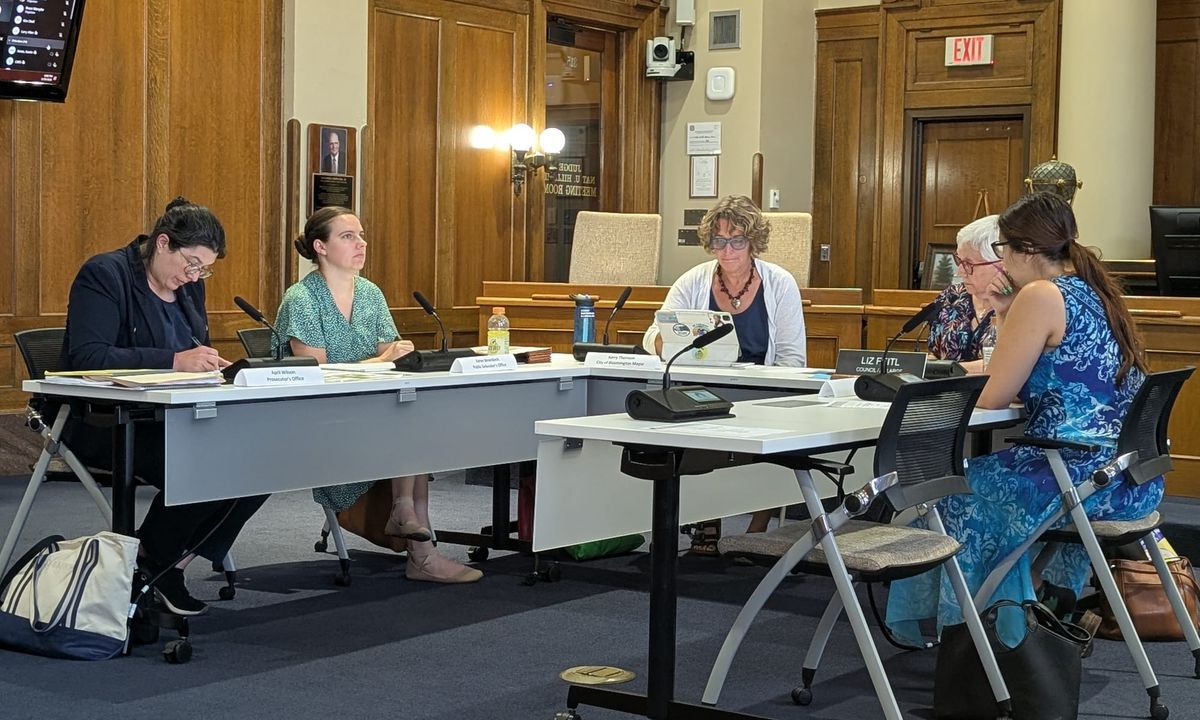
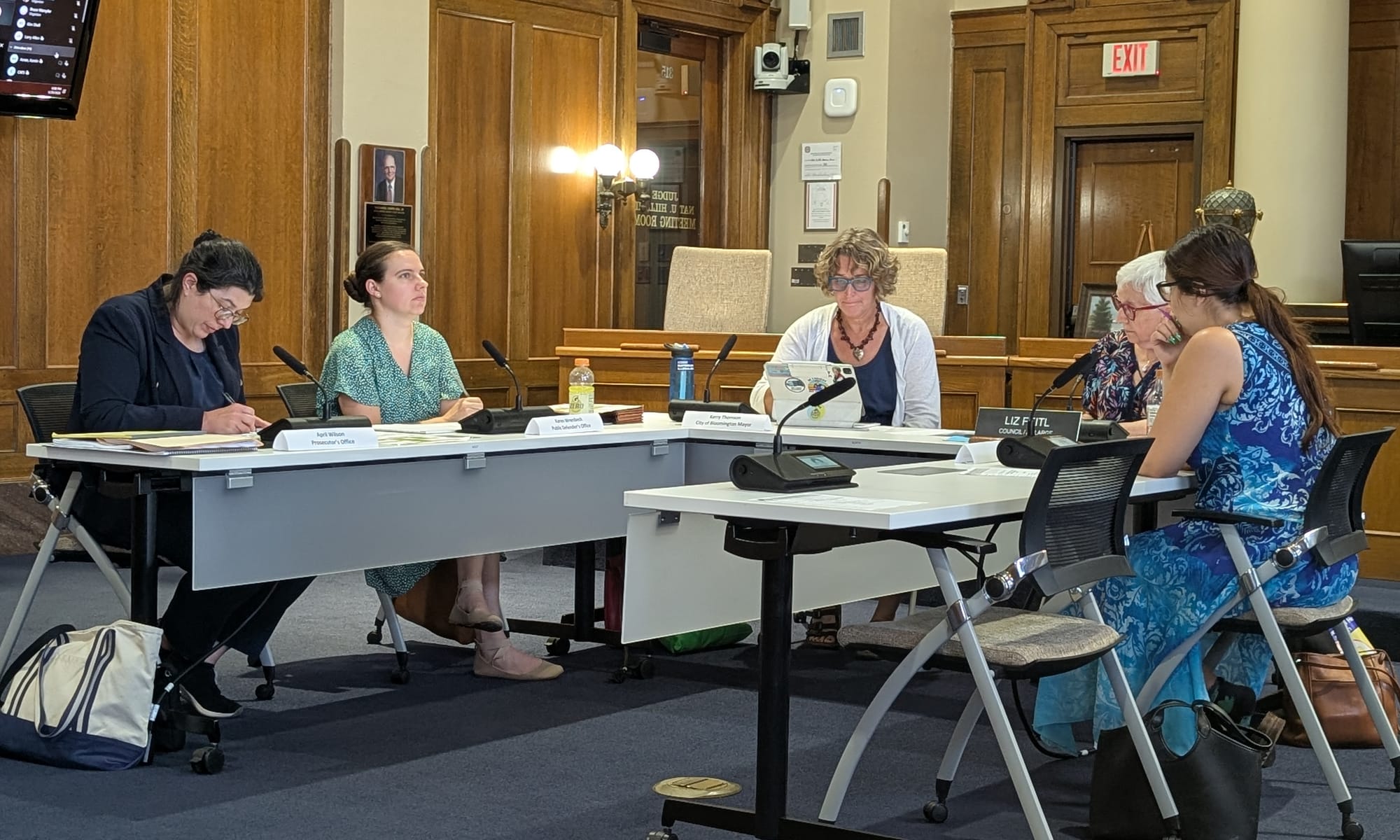
A committee composed of city and county officials, which is supposed to recommend a site for a new jail inside Bloomington by mid-July, finalized a set of site evaluation metrics at its meeting on Monday (June 29).
The formal name of the group is the Collaborative Justice Project Working Subcommittee. Attending the meeting on Monday were April Wilson (deputy prosecutor); Karen Wrenbeck (deputy public defender); Kerry Thomson (mayor, city of Bloomington); Liz Feitl (Monroe County councilor); and Sydney Zulich (Bloomington city councilmember).
Not yet on board with the committee are the county commissioners, who have not yet agreed to send a representative to participate. A decision by commissioners on that could come at their July 2 meeting.
News out of Monday’s meeting was a consensus on the committee to add a column for renovation of the existing jail to the sites to be evaluated.
Already to be evaluated was the county-owned Curry Building just south west of the current justice facility and jail, which houses the county’s veterans affairs, child support, and probation offices. A second column involving Curry, would consider explicitly the possibility of renovating the existing justice facility and jail, and adding capacity by using the Curry Building.
The new column heading reads “Renovations of current building and adding Curry.”
The committee is working under the pressure of expected litigation over jail conditions, after a settlement agreement in connection with a previous lawuit expired. [Timeline of Monroe County Jail History]
During the public commentary period, Zach Ammerman urged the committee to hold some public discussion on why they might think renovation is not an option. “Because I’ve yet to see any serious or convincing public discussion from elected officials about why you think renovation isn’t possible,” he said.
Over the last few years, renovation has not been given much consideration, because renovation would not provide additional space—there would be no more space for inmate beds, or for programming of activities that could help prevent recidivism.
Inclusion of the Curry Building as a possible expansion site in connection with a renovation scenario came after Ammerman’s comment, starting with a mention by Bloomington city councilmember Sydney Zulich. “My understanding of the Curry Building is that it’s potentially an expansion of the Zietlow Justice Center,” she said. Followup on the point from Kerry Thomson, Bloomington mayor, resulted in creation of a separate column head for the renovation option, with Curry as expansion space.
The beginning of the meeting, which took place at the Nat U. Hill meeting room at the Monroe County Courthouse, was dedicated to finalizing the metrics that would be used to evaluate each property’s suitability for the project.
Notable among the metrics was the choice of 448 beds as an upper limit for the future extension capacity of the jail. Deputy prosecutor April Wilson said that the number is based on the 2020 Criminal Justice & Incarceration study conducted by a group led by Kenneth Ray. “It says a 30 year bed capacity estimate indicates that Monroe County needs 448 to 450 jail beds by the year 2049,” Wilson said.
The committee also discussed evaluating the utility needs of each site—whether it is already connected or if there would be a cost of connection to utility services. The ability of any potential site to accommodate a single-story jail design was also included as a separate metric. That came in the context of remarks from county commissioner Julie Thomas in a talk to Bloomington North Rotarians the previous Thursday (June 25) that a one-story design for the new jail is “necessary”.
The committee also decided to consolidate many of the separate requirements of a jail site into a minimum square footage requirement. County attorney Jeff Cockerill agreed that those numbers could be parsed from the design of the North Park site, even though the county council rejected the proposal to build a jail there last month.
Thomson suggested evaluation of “fiscal considerations for additional site development” as one of the criteria, to judge whether a site is particularly cost heavy and could add to the fiscal burden during development.
During the meeting, the committee discussed the importance of including distance to services such as transit as an evaluation metric.
Committee chair Liz Feitl said, “When I think of services, I can’t help but think of the testimony we heard [at a previous meeting] from the woman who works in a community service, and she herself had been in jail and was released and she walked two blocks to get to services and that said something to me how important it was. Because she also testified, in her current role in her current community service job, that someone actually had to walk nine miles from somewhere to get [there], and it was freezing cold, and it was a near medical emergency for him.”
During discussions, county attorney Molly Turner-King clarified for the members that Indiana state law disallows the building of a permanent structure in a floodway for use as a place of residency, which would exclude any sites that fall within floodways for the location of a new jail.
From the public mic, Seaforth Breeze, a Monroe county resident, pressed on the importance of considering access to public transit and proximity to services, based on his experience volunteering at the Bloomington Bike Project for a few months. “We’ve already had two people on the one day a week I come in who have come in asking if they can get a bike—because they’ve just been released, they don’t have any other transit connections, they don’t have, you know, a phone or someone that they can reach out to with that phone, and they are desperate for a way to start reaching all those other services,” Breeze said.
The Collaborative Justice Project Working subcommittee is slated to meet again on Wednesday (July 1) at 6 p.m.
Next week, the committee has meetings set for Monday (July 6) and Wednesday (July 9), at 6 p.m., as well as at noon on July 13. The meeting on July 6 will allow public commentary.


Comments ()