
One-story jail design is ‘necessary,’ Monroe County commissioner tells Rotarians
At a Thursday Rotary talk, Monroe County commissioner Julie Thomas said a one-story jail is necessary, not just preferred. The stance could narrow site options as a city-county group works toward a July 13 location recommendation after the county council twice rejected North Park.
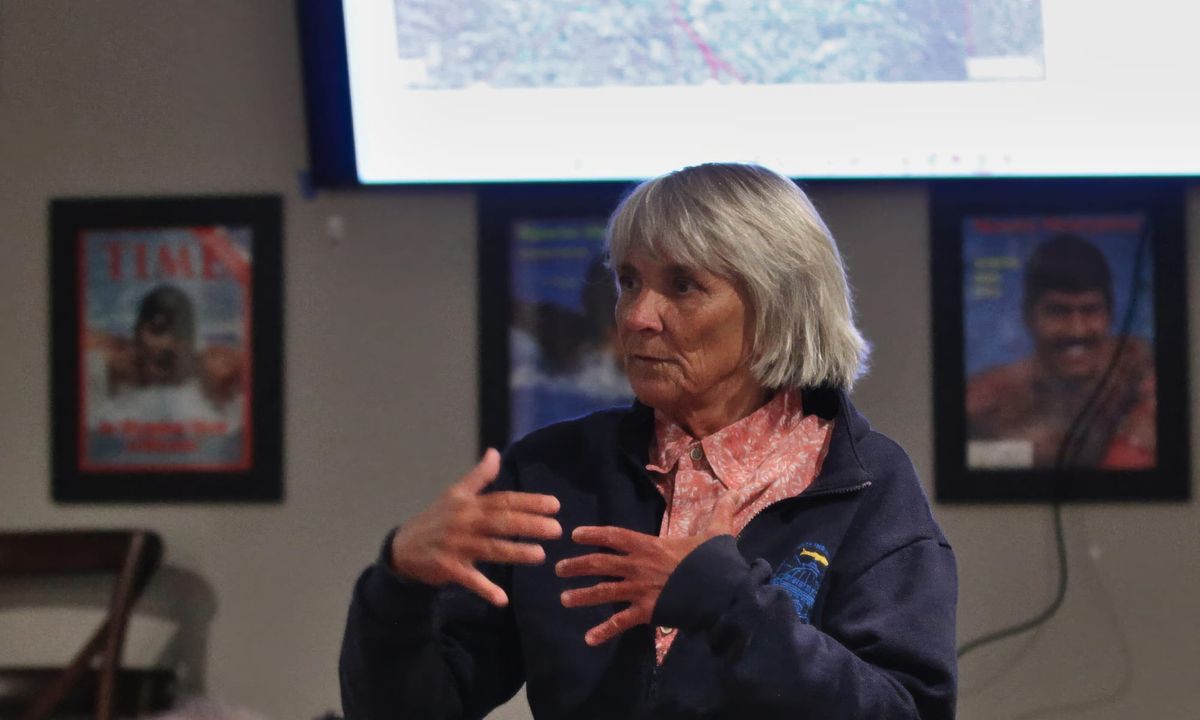
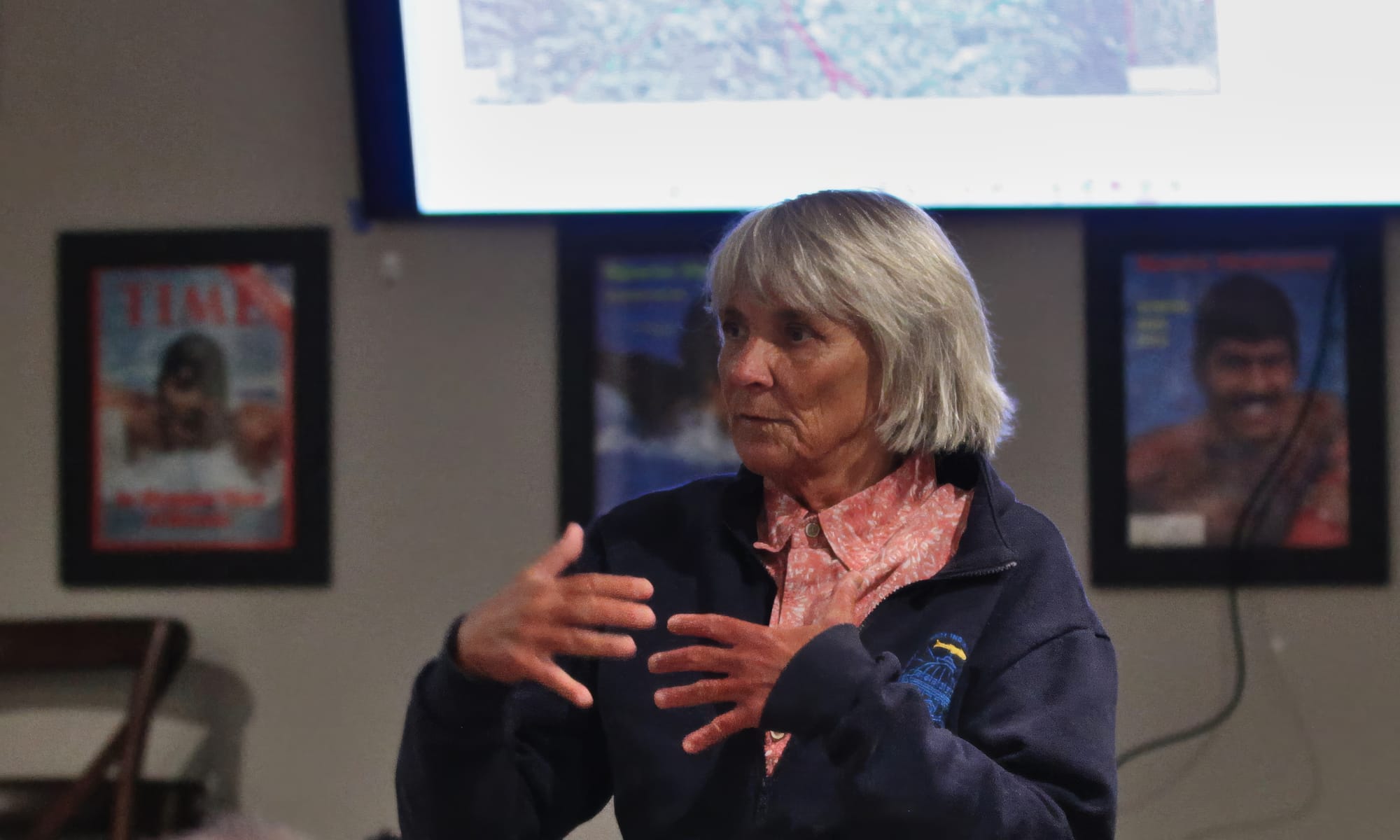
At a Thursday (June 25) lunchtime talk to Bloomington North Rotarians at Crazy Horse, Monroe County commissioner Julie Thomas offered what she described as a historical review of the county’s long-running jail problem, which is fraught with litigation—but not exactly the “new perspective” that was advertised in the flyer.
That left Rotarian Marty Donnelly to ask the question hanging over the room and, more broadly, over Monroe County government: “Where’s the solution slide?”
That slide was not included in the deck.
Thomas’s answer, essentially, was that the solution still depends on a decision on a new jail site. But she made clear that, from her perspective, not every site can work. A one-story jail, she said, is not a design preference that can be traded away to fit a tighter location.
After the presentation, The B Square Bulletin asked Thomas whether a multi-story design could be considered “optimal,” even if not “ideal.” Thomas rejected the idea that a one-story design was “ideal” in the sense of just highly preferable. Instead, she said about a one-story design: “I put that as necessary.”
That distinction could shape the work of the Collaborative Justice Project Working Subcommittee (CJPWS), the city-county group now trying to recommend a new jail location by July 13. That’s after a Monroe County council vote in May, to reject a purchase agreement for North Park as a jail site for a second time, left the county without a selected new jail location.
Basic background presented to Rotarians
About 15 people attended Thursday’s Rotary Club presentation, including recognizable local civic figures such as Greater Bloomington Chamber of Commerce president and CEO Eric Spoonmore, Amplify Bloomington CEO and former Bloomington mayor John Fernandez, and former Bloomington city councilmember Jeff Richardson.
Thomas used a good chunk of her talk to walk through the structure of county government and the county’s history with the jail. As the fiscal body, the county council controls the money, she said, while the commissioners are responsible for buildings. Sheriff Ruben Marté runs the jail’s operations, while judges control many decisions that affect the jail population.
That division of authority, Thomas said, makes a jail project unusually complicated.
Building a new facility, Thomas told the Rotarians, expands the list of essential players beyond the commissioners, council, sheriff and judges, to include the prosecutor, public defender, probation and clerk. “Creating a new site makes this dance necessary,” she said. “I can’t say that the dance has gone well.” But she added, “I am the eternal optimist.”
Thomas traced the urgency to act to address conditions at the jail back to the ACLU’s 2008 jail litigation and the 2009 settlement agreement. The old federal case was recently dismissed, but county officials are expecting new litigation over current conditions in the downtown jail. In fact, the day before Thomas addressed the Rotarians, lead ACLU attorney Ken Falk was in the Monroe County jail interviewing prisoners who could serve as plaintiffs in the new litigation.
Thomas said the downtown jail has basic physical problems that cannot be solved by better management. She described a facility with no medical ward, just one programming room, limited recreation space, sewer problems, only one elevator for jail operations, and no realistic ability to expand upward. The one room for structured programming has to accommodate everything from adult education, to reentry preparation to religious gatherings, to programs that address substance use disorders, Thomas said.
About the basic reality of the space limitations, Thomas said: “We can make changes, but we can’t make it bigger.” That is where the one-story issue is pivotal.
One-story jail design: Essential, not just ‘ideal’
Thomas told the Rotarians that modern jail design calls for a horizontal facility, except in dense urban settings where there is no alternative.
Thomas confronted the county-owned Curry building site, just to the west of the existing justice center as an option. The Curry building got a little bit of air time at the previous day’s meeting of the CJPWS. Pursuing Curry would almost certainly mean considering more than one story for the new jail. “People don’t build multi-floor jails anymore, unless they’re in a dense urban environment,” Thomas said. “We need a one-floor jail.”
After the talk, she told The B Square that a multi-story jail would add expense and operational difficulty. She said that based on her understanding from conversations with the sheriff and jail commander, Thomas said, the single-story operational efficiency is related to the task of monitoring inmates. “It’s much more difficult to do on multiple floors,” Thomas said.
Impact of one-story design on site selection
That requirement narrows the universe of possible sites. A one-story jail needs a large, flat, buildable footprint, with utilities, room for expansion. The county government is also looking for a site where there aren’t long delays due to needed zoning approvals, assessment of karst conditions, stormwater, sewer or power-line conflicts.
That backdrop is why the commissioners have continued to see North Park as more workable than several alternatives. She said the North Park site had available utilities, relatively flat land, a favorable geotechnical review for the area studied, and a planned unit development (PUD) that already contemplates a jail and government/court facility.
By contrast, Thomas described Hopewell as too small. A location at Fullerton Pike had been previously rejected by the Bloomington city council when the county sought a rezone for a jail. She described the Thomson property (aka the RCA property) as burdened by high-voltage Duke Energy power lines, a road requirement embedded in its PUD zoning, and karst issues. She described the site south of Monroe Hospital as too small and constrained by karst features.
A voice from the audience called out a question: “What’s wrong with the RCA property?” Thomas answered: Karst, slope, and the need to move electrical poles at an estimated cost of $1.5 million and a delay of at least a year and a half.
Spoonmore pressed Thomas on the question of co-location for the jail, sheriff’s office, courts, prosecutor, public defender, and clerk’s office. In addition to the one-story design, colocation of other facilities has been a top consideration when it comes to site selection.
Spoonmore asked how many other Indiana counties have co-located facilities, contending that Monroe County is one of only two counties in the state that do. Thomas responded to Spoonmore saying that co-location is what the prosecutor, judges and sheriff have said they want.
The most recent expression of the firm position of the board of judges in favor of colocation also came over lunch at a different restaurant, at a meeting of the Democrats Club at DeAngelo’s.
But Thomas also separated co-location from the immediate jail need. When a voice from the audience asked whether the county government would completely empty the current downtown justice building, Thomas said yes—eventually. For now, she said, the county can afford to build only a new jail, while hoping to co-locate courts and related functions later.
The ACLU’s concern, Thomas said, is not whether the jail is co-located with courts. “The only thing the ACLU cares about is the jail,” she said. “They do not care whether [it is] co-located or not.”
That creates a practical distinction for the jail-site working group: Co-location may be a longer-term goal, but for Thomas the single-story design is a basic threshold requirement.
Participation in the CJPWS
The timing of Thursday’s Rotary talk made it more than just another civic-club briefing. It came one day after the revamped Collaborative Justice Project Working Subcommittee finally met with a quorum, and mapped out a series of meetings aimed at a July 13 recommendation.
The county council had just reduced the group’s voting membership from eight to six, making the sheriff’s office and board of judges “ex-officio” members after both indicated they would not participate.
The same legal tension that has shaped participation in the working group also hovered over Thomas’s Rotary presentation. The sheriff, as well as commissioners, have cited the potential new litigation as a reason to be circumspect about site selection in public discussions.
At 9:38 a.m. on Thursday, a few hours before the talk, county councilor David Henry emailed Thomas, copying other county and city officials, after learning that she was scheduled to speak to the Rotary club about the jail. Henry cited Thomas’s earlier May 29 email saying commissioners had been advised it would be premature to publicly discuss or evaluate additional properties before litigation counsel was retained.
“I’m surprised that you’d discuss anything that might not survive scrutiny in the federal litigation process,” Henry wrote Thursday. He also wrote that “there are no preserved options at this point, as the North Park purchase has been repeatedly rejected by Council,” and asked for “the expeditious appointment of a commissioner” to the jail-site committee.
Thomas’s May 29 email, included in the same thread, had warned that public discussion of additional properties before retaining litigation counsel could send staff, officials or consultants “down paths that may not survive scrutiny in the Federal litigation process.”
Asked after the Rotary talk why the presentation had not really offered a “new perspective,” Thomas said she had told the Rotarians in advance that she would stick to a historical review.
“I have to be careful with litigation pending,” Thomas said. “I was told, yes, you can do anything you want to talk about what happened, so that’s what I did.”
That leaves the public working group at its future meetings to do what Thomas largely avoided Thursday: compare live options in public, under a tight deadline, with a new ACLU lawsuit expected, and with North Park twice firmly rejected by the county council.
If Thomas’s view prevails, the group’s site search will not turn simply on whether a parcel is downtown, city-owned, county-owned, cheaper, or politically easier to explain. It will also have to answer a more basic design question: Can the site hold a one-story jail? For Thomas, that answer is not negotiable.

Comments ()