
Mayor: Transit payment, election costs account for nearly all of Bloomington’s 2027 budget gap
Bloomington’s proposed 2027 budget continues a four-year reduction in its planned general fund shortfall. Mayor Kerry Thomson says a final $3.8M payment to Bloomington Transit and $650K for municipal elections account for nearly all of the remaining operating gap.
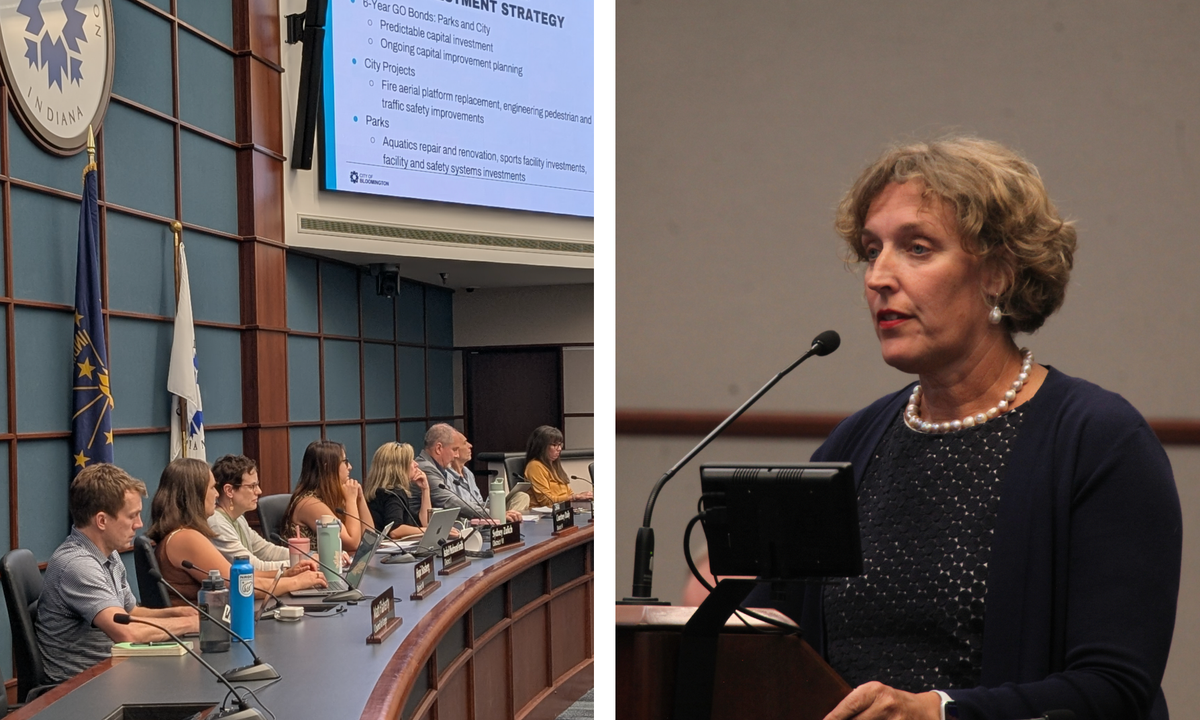
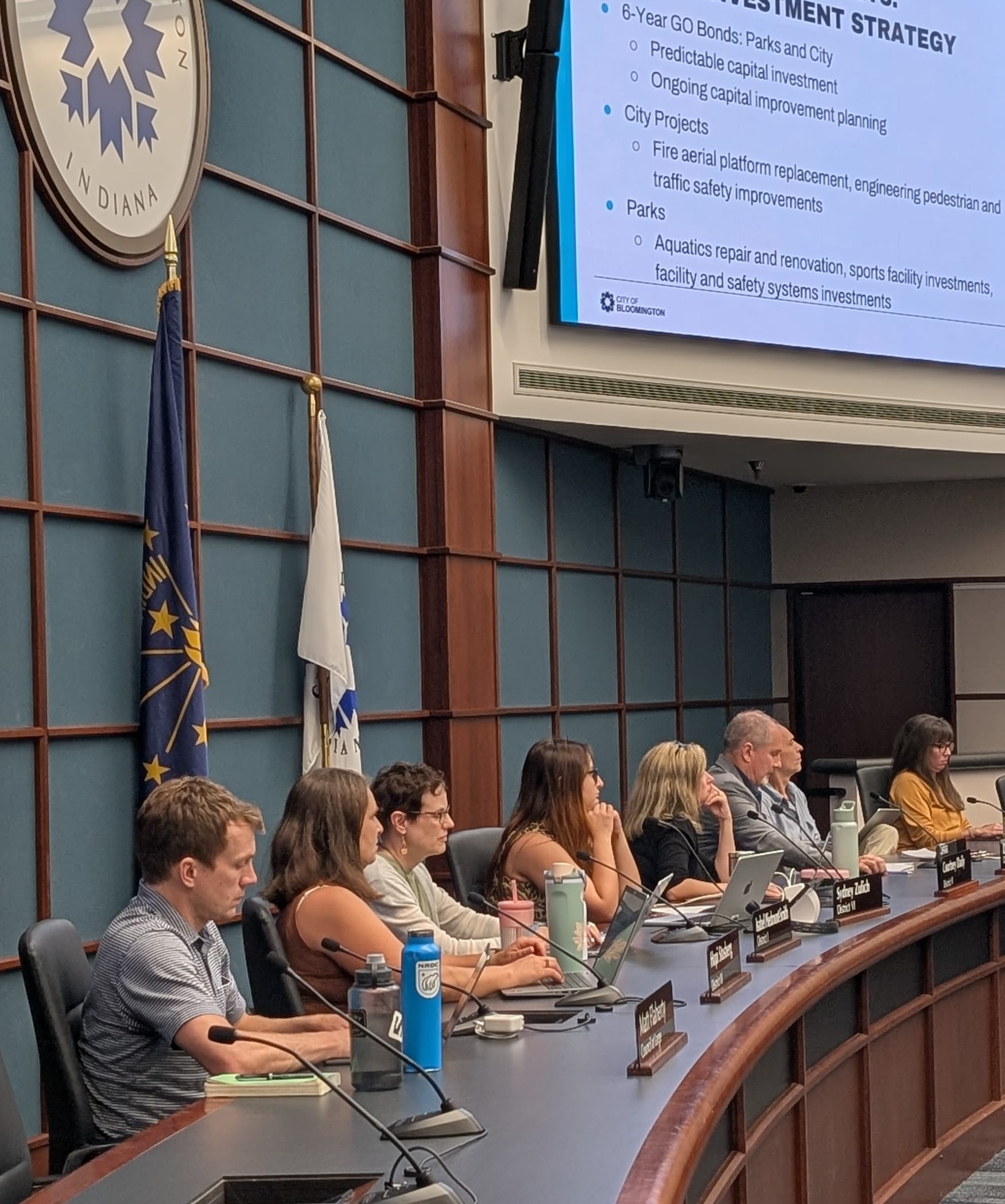
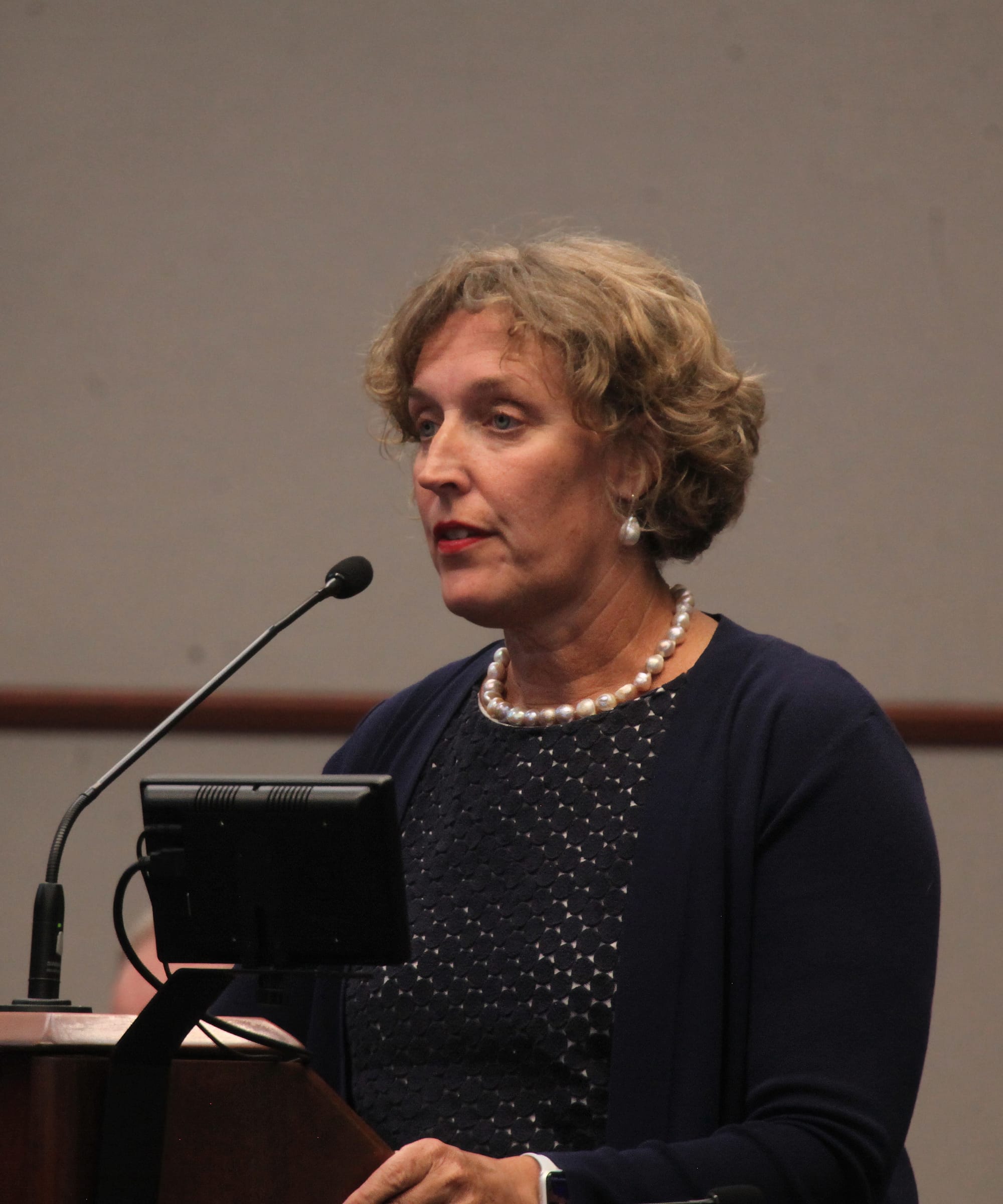
Left: Bloomington’s city council from left to right: Matt Flaherty, Hopi Stosberg, Isabel Piedmont-Smith, Sydney Zulich, Courtney Daily, Dave Rollo, Andy Ruff, and Kate Rosenbarger. Isak Asare was absent. Right: Bloomington mayor Kerry Thomson. (Dave Askins, Aug. 17, 2026)
Bloomington mayor Kerry Thomson opened the city council’s 2027 budget hearings Monday (Aug. 17) by pointing to a year-over-year shrinking gap between projected revenues and authorized spending.
She said two specific obligations account for essentially all of the remaining operating shortfall. “With the exception of a payment of the final commitment to Bloomington Transit and our share of election funding, we would not be forecasting an operational deficit,” Thomson told the council.
Thomson was referring to a somewhat broader operating picture that includes more than the city’s general fund, but not the entire city budget.
The proposed 2027 general fund by itself calls for $63.73 million in spending against $58.25 million in projected revenue. That’s a $5.47-million budgeted deficit. But the economic development local income tax (ED-LIT) fund is projected to run a $681,519 surplus, based on the slide city controller McKim showed the council.
Taken together, the two funds show a gap of about $4.8 million. McKim told the council he thinks the two funds are best viewed together because spending has been shifted between them, and both support general city operations.
The two expenses Thomson singled out in the 2027 proposal total about $4.46 million. That comes from adding $3,806,100 in ED-LIT money paid to Bloomington Transit, which is the final year of a multiyear commitment, to $650,000 for Bloomington’s share of the 2027 municipal elections, which is an expense that occurs once every four years. [Aug. 3, 2026 budget book release]
Both Thomson and McKim also emphasized the downward trend in the city’s budgeted general fund deficit. McKim’s comparison in the 2027 budget book puts the adopted 2024 gap at $15.42 million, the adopted 2025 gap at $12.13 million and the adopted 2026 gap at $9.48 million. The proposed 2027 gap is $5.47 million.
For Thomson’s three budgets, that means the adopted 2025 and 2026 deficits fell from $12.13 million to $9.48 million, followed by the proposed $5.47 million for 2027.
What city of Bloomington officials call a “deficit” is the budgeted difference between expected revenue and the maximum amount the council authorizes the city to spend. It’s not a measure of how much debt the city is incurring, because the city can tap reserves to cover the difference. And a budgeted deficit does not always materialize. Thomson noted on Monday that vacancies, temporary salary appropriations and capital lines routinely go unspent. Illustrating that point was the 2024 general fund which showed an adopted budget with a $15.42-million deficit, when actual revenues exceeded actual spending by nearly $5 million.
McKim took over as controller in mid-January of this year. In addition to his professional experience, he brought to the job 16 years as member of the Monroe County council, the fiscal body for the county government. He is overseeing his first annual Bloomington budget process.
McKim told councilmembers that personnel costs, the city’s largest expense driver, are consuming more of the city’s limited revenue and leaving the administration cautious about adding positions. The 2027 proposal adds no new full-time positions. It includes a 2.7% cost-of-living increase for non-union employees and 3% for union employees. A state-mandated increase in police and firefighter pension contributions adds roughly $1.8 million in general fund costs, he said. Health insurance had initially been budgeted for a 9% increase, but the city has since received a final figure of 5.8%, which will reduce the eventual appropriation.
McKim also reported a new $142-million reduction in net assessed property value across the city of Bloomington for 2027, which he attributed to property-tax changes enacted in SEA 1. The city now expects about $1.3 million in circuit-breaker losses across its funds. McKim warned that the effects will continue as additional deductions for rental property phase in through 2031.
On budgeting practices, Thomson said the city has backed away for now from trying to implement the kind of outcomes-based budgeting called for by the council in 2024, because its roughly 15-year-old financial software requires too much manual work to track spending across priorities. The 2027 proposal includes money for a replacement system.
Councilmembers Isabel Piedmont-Smith, Hopi Stosberg and Matt Flaherty all pressed the administration on outcomes-based budgeting. They said that the city could begin defining and measuring outcomes even before a new financial system is in place.
Not covered in this article are presentations to the council on Monday from the fire department, the police department, community and family resources (CFRD), and housing and neighborhood development (HAND).
The three remaining budget presentations take place Wednesday this week, followed by Monday and Wednesday meetings next week.
Wednesday, Aug. 19: planning and transportation; engineering; streets; parking; city of Bloomington utilities (CBU).
Monday, Aug. 24: parks and recreation; economic and sustainable development; public works administration; animal care and control; facilities; fleet; sanitation.
Wednesday, Aug. 26: Monroe County capital improvement board; clerk; council; mayor; controller; legal; human resources; information and technology services.

Comments ()