
MCCSC board to start digesting findings from yearlong redistricting effort
At its April 28 board meeting, MCCSC staff presented key findings from a redistricting commission, showing boundary changes could better balance student populations but would involve trade-offs. The presentation included no specific maps. A full report has not yet been released.
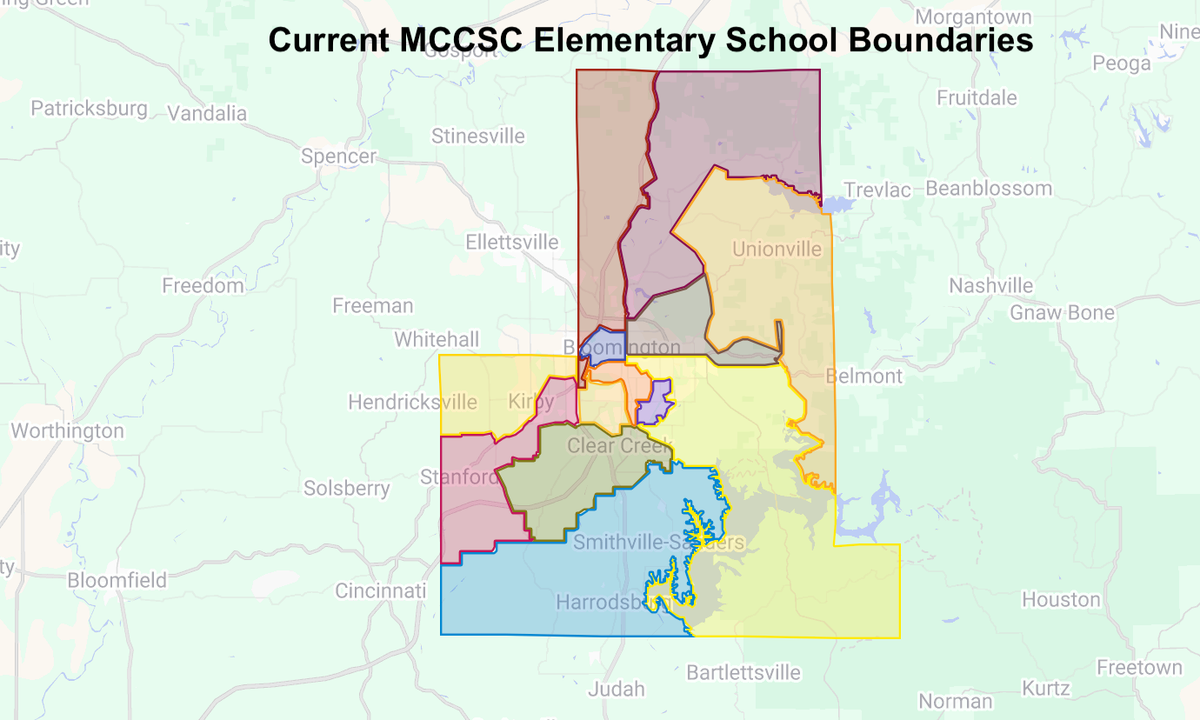
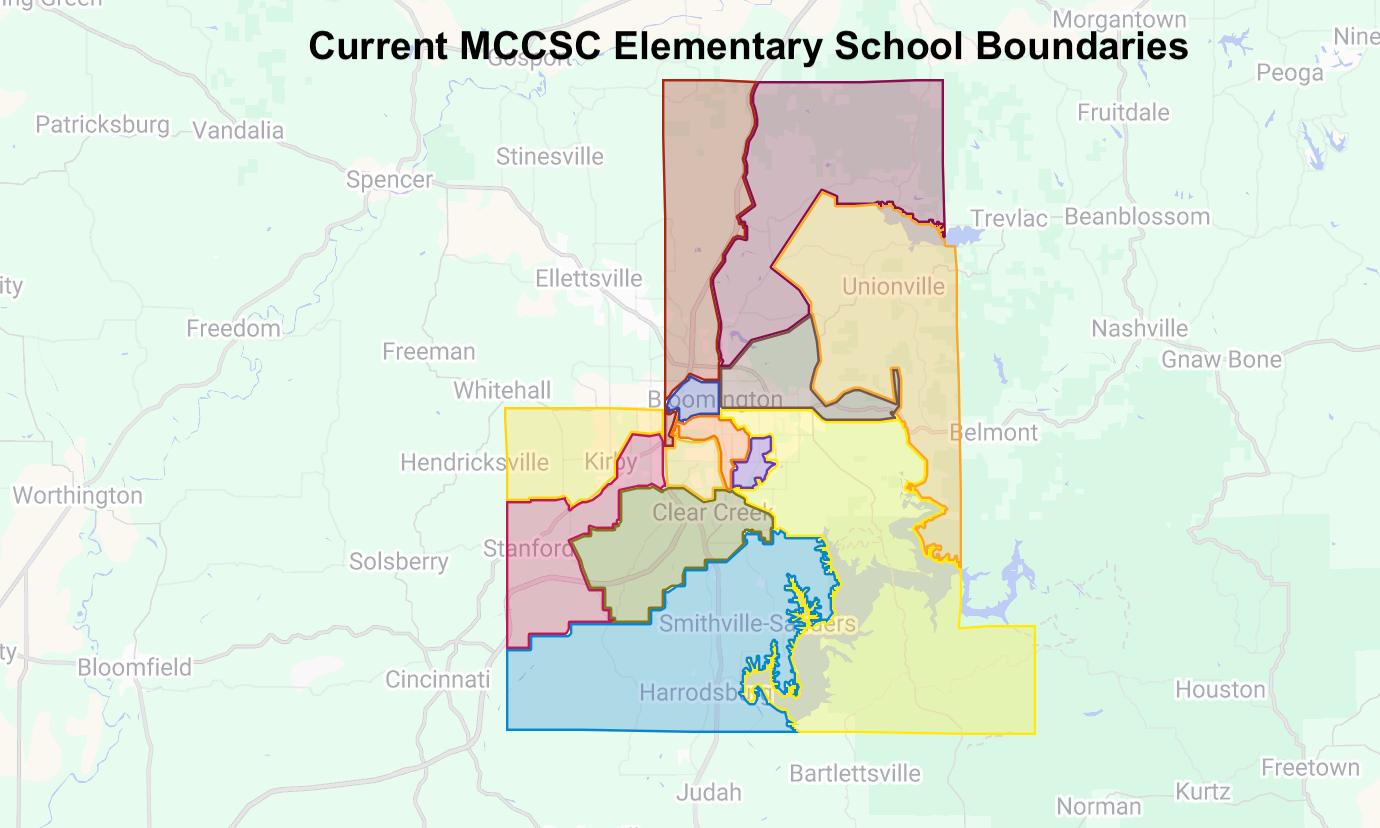
Key findings by a commission on elementary school redistricting got their first public airing at last Tuesday’s (April 28) regular meeting of the Monroe County Community School Corporation (MCCSC) trustees.
The findings generally point to redistricting as a workable way to get a better balance of students at the district’s schools, but made clear that there are costs, trade-offs and community impacts depending on any specific implementation. The findings don’t include recommended new boundaries.
The effort traces back to February 2024, when the school board adopted Resolution 2024-05, which set in motion a review of school attendance boundaries with the goal of creating a more even socio-economic mix of students across schools. In the wording of the resolution, the idea was to start a process of “examining attendance zones with the intent to create greater balance between elementary schools.”
About a year later, in April 2025, the board formed a Redistricting Study Commission with 92 members, which included parents, teachers, staff, students and others. The board asked that group to look at two things in particular. The first was whether and how redistricting could achieve a balance for student socio-economic status. The second was how redistricting could be done in a cost-effective way.
The commission worked through potential map scenarios and identified the factors it thought should matter most when changing boundaries. The commission wrapped up its work in December 2025.
At last month’s board meeting, MCCSC director of early learning and enrollment Tim Dowling said that direction from the school board and input from the public had boiled down considerations to the most important four factors:
- capacity, resource allocation, and class size
- minimizing student reassignment
- transportation
- neighborhood or community schools
Dowling said the result of the commission’s work will be a final report that includes a review of the commission’s research, methodology, results from each meeting, and a summary with key findings.
On Tuesday (April 28), the summary with key findings was included in a presentation from Dowling.
According to the presentation, commission members studied 50 example redistricting scenarios over the course of nine meetings, which totaled more than 25 hours, or about three full work days per commission member.
The six findings were less about any specific boundary maps and more about factors the district would need to weigh, and some further study that would need to be done, if it decides to redraw elementary school boundaries.
The commission found that changing attendance zones can, in fact, make the mix of student economic backgrounds more even across schools, based on the sample maps it tested. The key is setting clear targets and rationales.
On the question of cost effectiveness, the group said it did not study the topic thoroughly, because the district hasn’t defined what “cost-effective” really means. As Dowling’s slide deck put it, there is a “lack of specificity” on the question of cost effectiveness.
For the mechanics of drawing boundaries, the commission pointed to census-based mapping tools as a practical approach. That approach uses established geographic lines and gives planners a neutral, data-based place to start.
Closing one or more schools could be an option, based on the commission’s consideration of some examples that didn’t overload the remaining elementary buildings and still improved the balance of student populations.
The commission also found that the balance achieved at the elementary school level helps balance the schools that are fed by the elementary schools. That is, if elementary zones are balanced, middle and high schools tend to follow suit.
But the commission also found that tradeoffs would have to be made in any redistricting scenario. Achieving balance across schools means students would be reassigned to different schools, and closing schools can disrupt transportation patterns and neighborhood ties.
After the presentation, board president Erin Cooperman said, “I think it’s a lot for us to digest, as a board.” She said she hasn’t had a chance to “think through all of the implications of the report.”
MCCSC has not yet published the information in the redistricting study report, except for the six findings in Dowling’s Tuesday presentation. Responding to an emailed question from The B Square, an MCCSC spokesperson wrote: “The report will be shared publicly at a later date.”
Even commission members themselves have not yet seen a final report. A final commission meeting was scheduled for Monday, April 27, which was the day before the board meeting. But the meeting was rescheduled due to severe thunderstorms and flooded roads.

Comments ()