
New federal lawsuit alleges unconstitutional conditions at Monroe County jail
The ACLU has filed a proposed class action on behalf of two Monroe County jail prisoners, alleging unconstitutional overcrowding, unsafe conditions and a deteriorating facility. The suit was filed one day after commissioners declared an overcrowding emergency in preparation for inmate transfers.

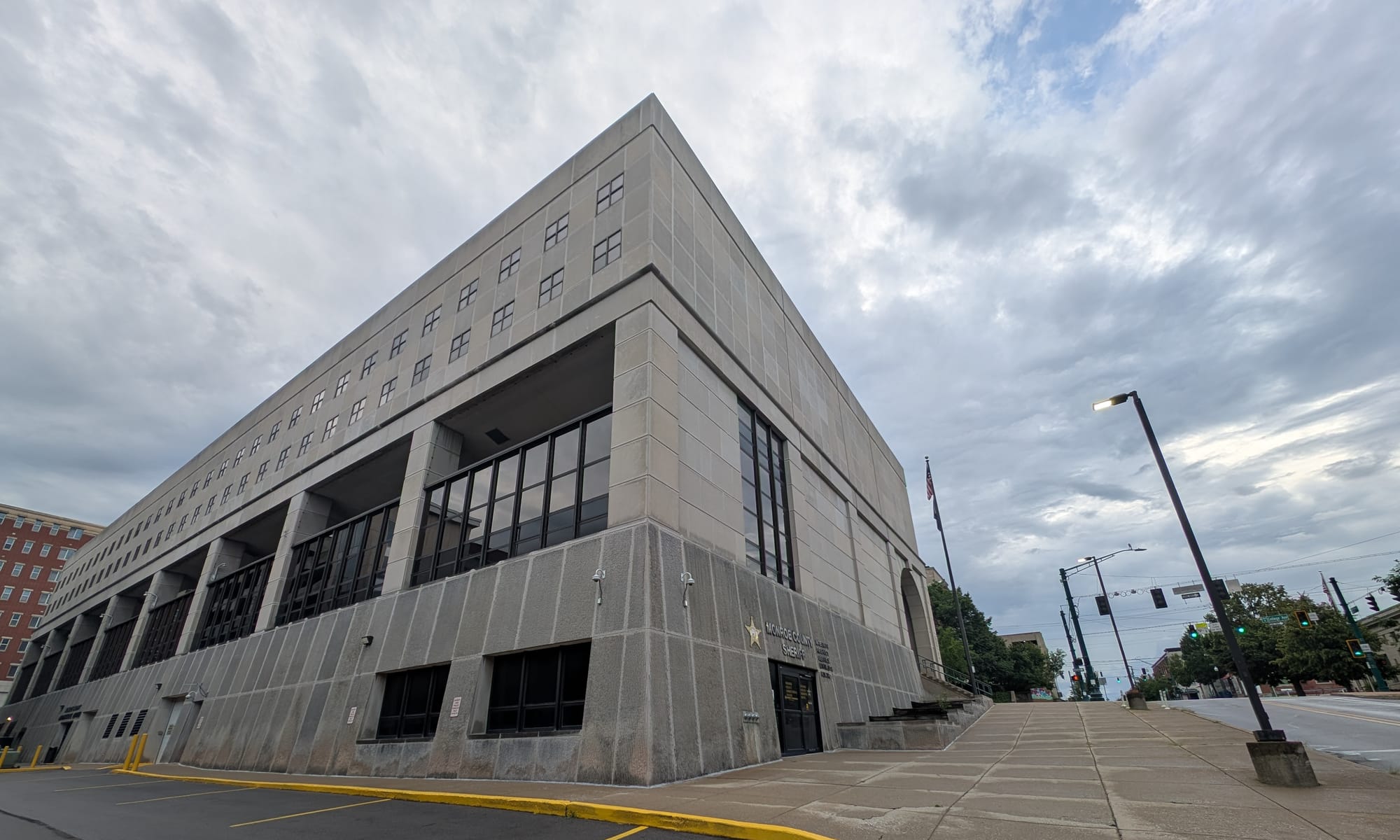
Two men confined in the Monroe County jail filed a proposed federal class action Friday (July 10) alleging that persistent overcrowding and a deteriorating, poorly designed building have subjected prisoners to unconstitutional conditions, including floor-sleeping beside toilets, extreme temperatures, mold, broken plumbing, and violence that sometimes goes undetected by jail staff.
The July 10 complaint, filed by Tayler Grubb and Joseph Marrero in the U.S. District Court for the Southern District of Indiana, revives constitutional litigation over the jail, about a month after a federal judge finally dismissed a class action that had remained pending since 2008.
The new filing has the case number 1:26-cv-01460. The does not yet appear when searched on the PACER (Public Access To Court Electronic Records) system. The B Square was provided a copy of the complaint by a county official.
Named as defendants are the Monroe County council and the Monroe County commissioners in their official capacities, and the Monroe County sheriff, also in his official capacity. The complaint asks the court to certify a class consisting of everyone now confined in the jail or held there in the future, declare that the conditions violate the U.S. Constitution, and issue a permanent injunction requiring county officials to bring the jail into compliance with constitutional requirements.
The requested relief does not include a claim for compensatory damages. It asks for court costs, attorney fees and an order compelling institutional change. ACLU of Indiana attorneys Ken Falk and Joshua Bleisch represent the plaintiffs and have asked to be appointed class counsel.
The lawsuit landed one day after county commissioners voted 2–0 to declare a jail-overcrowding emergency and directed county lawyers to pursue agreements for housing prisoners in surrounding counties. Sheriff Ruben Marté recommended preparing to move 50 to 100 people, with estimated first-year housing and transportation costs ranging from $2.94 million to $5.09 million.
Different calculations, same overcrowding finding
The complaint filed on Friday says the jail, which opened in 1984 with an original capacity of 128, now contains about 287 permanent beds: 253 beds in one- or two-person secure cells and 34 bunk beds in two dormitory blocks. Five segregation cells and two holding cells are not included in the total, because they are not permanent housing.
Applying an 80% operational threshold intended to preserve space for separating prisoners by security classification, sex, medical condition and other needs, the lawsuit calculates the jail’s functional capacity at slightly more than 229. Between June 2 and July 3, the complaint says, the total population averaged just under 260, while the average number of people occupying secure beds was nearly 233.
On July 10, the day the complaint was filed, the Monroe County jail’s inmate search app showed 246 prisoners in the facility. The following morning, on Saturday (July 11), the population was 256.
Marté’s report computes a smaller bed count for functional capacity than the legal complaint. Although the jail lists 294 beds, the sheriff says only 233 are available for general housing, producing a functional capacity of 186 when the same 80% threshold is applied. His report puts the January-through-June average population at 244, the June average at 260 and the six-month peak at 275.
The functional capacity calculations are different, but both conclude that the jail is operating beyond the population level at which prisoners can be classified and separated safely.
The complaint says A-Block and B-Block, which generally house people classified as minimum- or medium-security concerns, routinely contain more prisoners than beds. A third person is placed in a two-person cell with a mattress on the floor. In some cells, the mattress can be placed in a molded plastic container known as a “boat.”
In smaller cells, the mattress lies directly on the floor beside the combined toilet and sink. People sleeping there must be stepped over when cellmates use the toilet, the lawsuit alleges, and are sometimes splashed with toilet water. Leaking fixtures can soak the mattresses. Crowding also leaves too little room for meaningful exercise, too few seats at dayroom tables and too many people competing for showers, telephones and electronic kiosks.
Meals are served in the housing blocks, according to the complaint, so people without seats must eat standing up or inside their cells.
The lawsuit alleges that overcrowding and inadequate classification generate frequent arguments, fights and predatory behavior. There are no direct sight lines from staff control areas into the housing blocks, it says, and surveillance cameras contain blind spots. Staff members make hourly checks, but some fights and assaults allegedly occur without officers learning about them.
Several failing elements of the building are listed out in the complaint. The complaint cites a report from 2021 by Kenneth Ray, commissioned by the county government for several failing components: broken showers, crumbling concrete, deep wall cracks, obsolete and leaking plumbing, recurring mold and an HVAC system that leaves some blocks dangerously hot during summer and cold during winter. The complaint says the entire jail contains only one cell accessible under the Americans with Disabilities Act, which is located in a male housing block.
Specific allegations from the plaintiffs
The complaint includes sections dedicated to the specific complaints of the two plaintiffs currently listed in the lawsuit.
Grubb has been confined in the jail for nearly a year while awaiting trial and being held on a probation violation, according to the complaint. He is now in B-Block, where a third person sleeps on a mattress near the toilet in his two-person cell.
Grubb says he previously slept on the floor in D-Block and was splashed when his cellmates used the toilet. B-Block is described in the complaint as “brutally hot,” with little or no ventilation, while D-Block reached 52F° during the winter. Of three showers in B-Block, only two work.
According to jail and court records, Marrero has been jailed since the third week of May, and is awaiting trial. Marrero says he was required to sleep on a bare mattress on the floor in A-Block, with his head near the toilet. Liquid splashed on him and seeped into his mattress, according to the complaint.
The complaint says that only one of three showers works in D-Block and that cracks in the jail walls are deep enough to hear wind blowing through them. Because D-Block becomes so hot, Marrero says, officers have left cell doors unlocked overnight so prisoners can get the air from large fans in the dayroom.
Marrero also alleges that younger and stronger prisoners prey upon or rob older and smaller prisoners because the jail cannot maintain adequate classifications. People who use wheelchairs cannot take the chairs into housing blocks, the complaint says, and some cannot reach a bunk and must sleep on the floor.
According to the complaint, Grubb submitted a grievance about the overcrowding and other problems. He received a response stating that the sheriff and his staff were attempting to deal with these problems. Because there was no way to appeal the grievance further, the complaint concludes that Grubb “has therefore exhausted all grievances available to him.” That claim matters because federal law generally requires prisoners to exhaust all available administrative remedies before filing suit over jail conditions.
Defendants
The lawsuit describes the different responsibilities of the three defendants.
Under Indiana law, the commissioners have the duty to establish and maintain the county jail, including keeping it in repair. The sheriff is responsible for taking care of the jail and its prisoners. The county council controls the county’s fiscal resources.
The complaint acknowledges that the sheriff is not responsible for the size, design or deterioration of the building. But it says that he remains “responsible for the fact that [prisoners] are being housed in an unconstitutional environment.”
The council and commissioners, meanwhile, are accused of having ample notice of the problems through public meetings, sheriff’s reports, studies by consultants and the previous litigation. The complaint alleges that the commissioners and councilors have been “deliberately indifferent” to a substantial risk of harm by failing to provide an adequate facility.
For people awaiting trial, the lawsuit invokes the Fourteenth Amendment’s prohibition against punishment without due process. For people serving sentences after conviction, it invokes the Eighth Amendment’s prohibition against cruel and unusual punishment.
New lawsuit follows end of 2008 case
The case is the direct successor to Richardson v. Monroe County Sheriff, a class action filed in February 2008 over overcrowding and conditions in the same building. The parties reached a private settlement agreement in August 2009, which the court approved that December.
That agreement was originally supposed to expire Oct. 1, 2011. Instead, it was extended repeatedly while county officials attempted to control the population under specific terms laid out in the settlement agreement.
The now-expired settlement required county officials to notify judges and local elected officials as the secure-bed population approached capacity. If the number exceeded 258, the sheriff was required to seek beds in other Indiana jails. It also required institutional-grade temporary bunks that kept prisoners off the floor whenever the population exceeded available beds.
After the county council rejected the North Park jail purchase on May 26, Falk and county attorney David Schilling filed a stipulated dismissal on May 27. Their filing said ending the old settlement would permit new litigation over the existing jail and possible remedies.
On June 8, the court dismissed the Richardson case “with prejudice as to this action only,” while expressly stating that nothing prevented a future class action by a Monroe County Jail prisoner.
The lawsuit filed Friday is the new case anticipated by those filings.
Years of studies, failed site decision efforts
The county has been warned for years that the existing building cannot support safe, modern jail operations.
A 2021 criminal justice and incarceration study by Kenneth Ray of RJS Justice Services concluded that the jail had exceeded its structural and functional life, lacked sufficient bed capacity and presented high liability risks. The study identified 53 facility problems, including inadequate camera coverage, deficient medical and counseling space, poor ventilation, mold, damaged masonry, inadequate segregation space and a lack of ADA compliance. Friday’s complaint cites the Ray study in detail.
A subsequent study by RQAW, which is also cited in the complaint, found insufficient space and medical facilities, inadequate isolation cells, obsolete design and significant liability concerns.
Marté has separately documented deficiencies involving fire protection, HVAC equipment, sewer systems, locks, elevators, roofing and structural components. Other county officials have been unable to agree on a location and financing plan for a replacement.
In 2024, the county council adopted a 0.17% local income tax for correctional facilities, and commissioners and councilors initially approved an $11.375 million purchase of the North Park property. Commissioners later advanced designs for a jail and justice complex there.
But the council unanimously rejected an appropriation to close on the property in October 2025. When commissioners returned with another purchase agreement this spring, on May 26, the council voted 1–6 against approving it. That left the county without a selected site as the Richardson settlement ended.
On June 11, the county council and Bloomington City Council formed the Collaborative Justice Project Working Subcommittee and directed it to recommend a jail location inside Bloomington within about a month.
The panel has now narrowed its review to five scenarios: renovating the current justice center and expanding into the county-owned Curry Building; two sites near Tapp Road and Interstate 69; the Thomson property on South Rogers Street; and the Fullerton Pike property near State Road 37. It is scheduled to make a nonbinding recommendation on Monday, July 13. .
The new federal complaint does not endorse a particular site, prescribe a design or require construction of a new jail. It asks the court to require whatever steps are necessary to provide constitutional conditions in the facility where Monroe County holds its prisoners.


Comments ()