
Monroe County jail impasse: After $4.2M North Park design spend, council-commissioner rift persists
Two months after the county council rejected funding to buy North Park for a new jail, Monroe County still has no other site—while an April 15 deadline in long-running ACLU litigation nears. Commissioners and councilors are at odds over how talk to each other, but a joint meeting could be set soon.
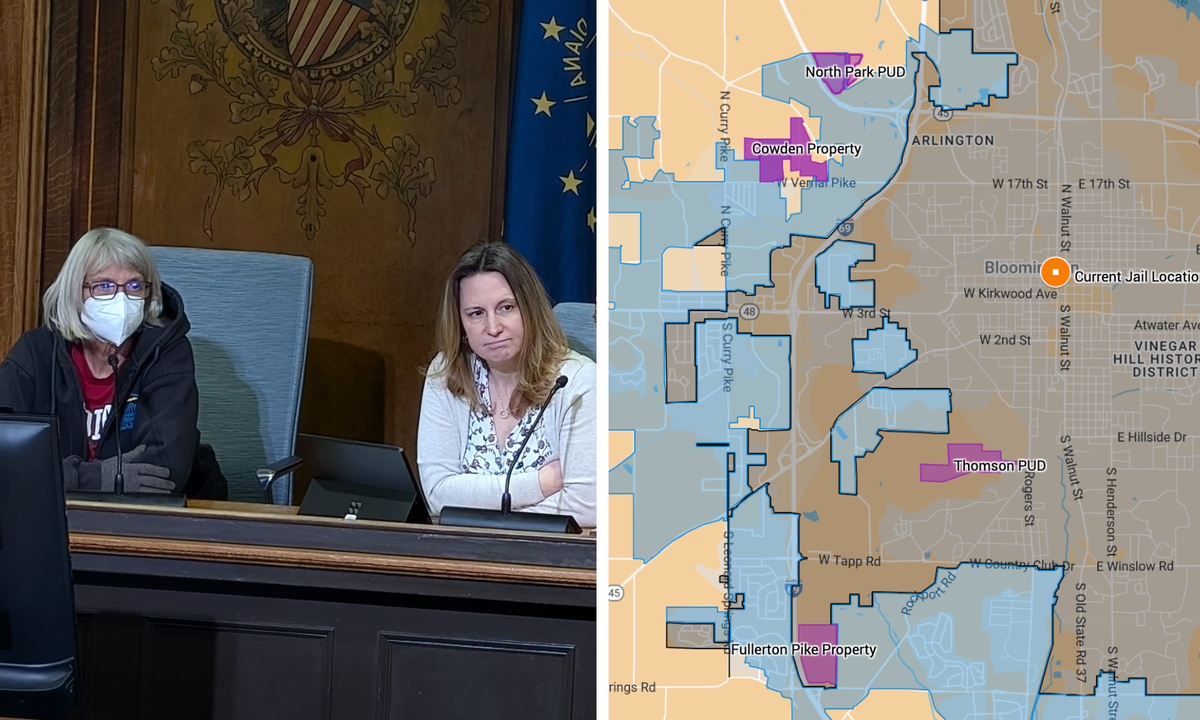
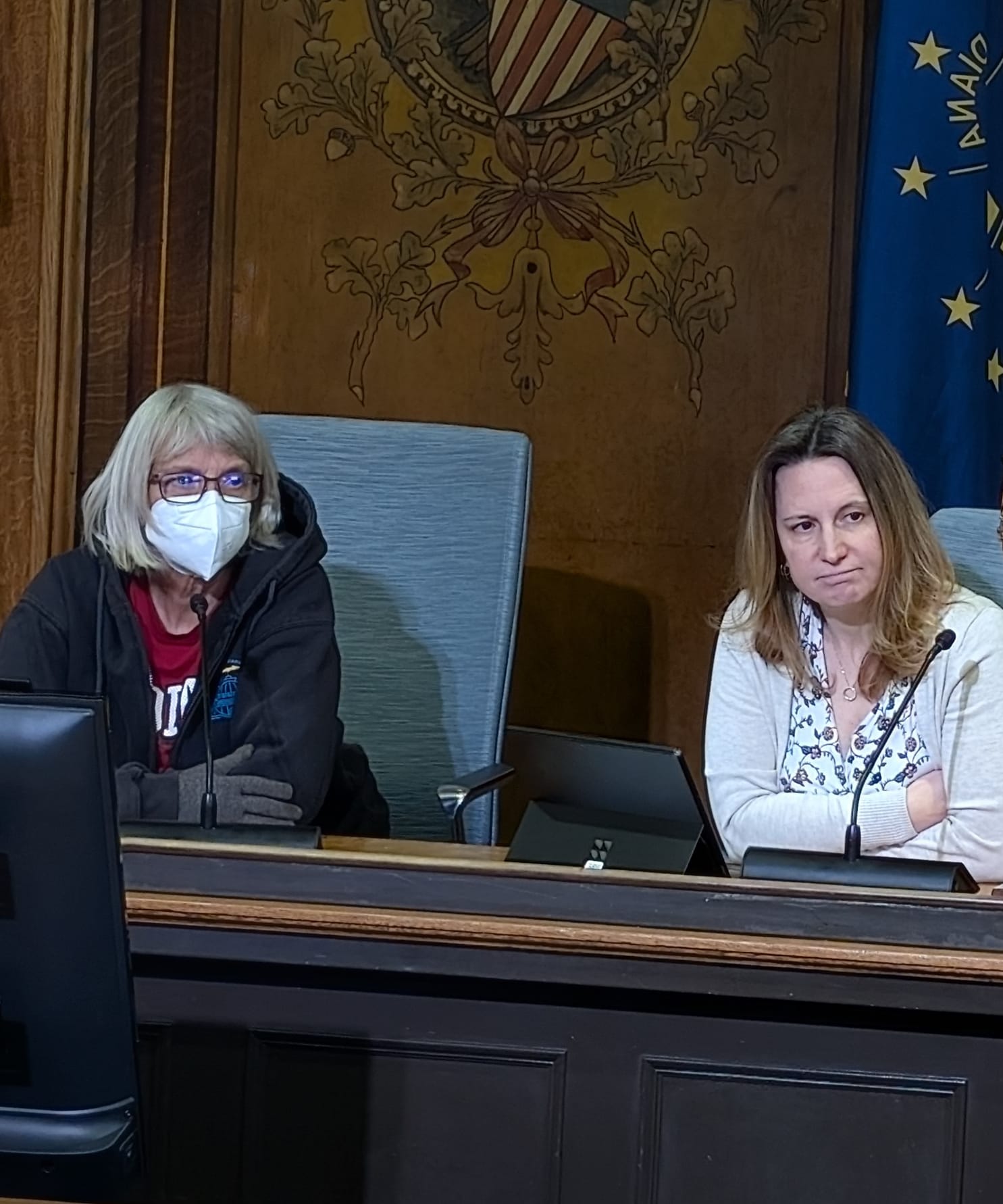
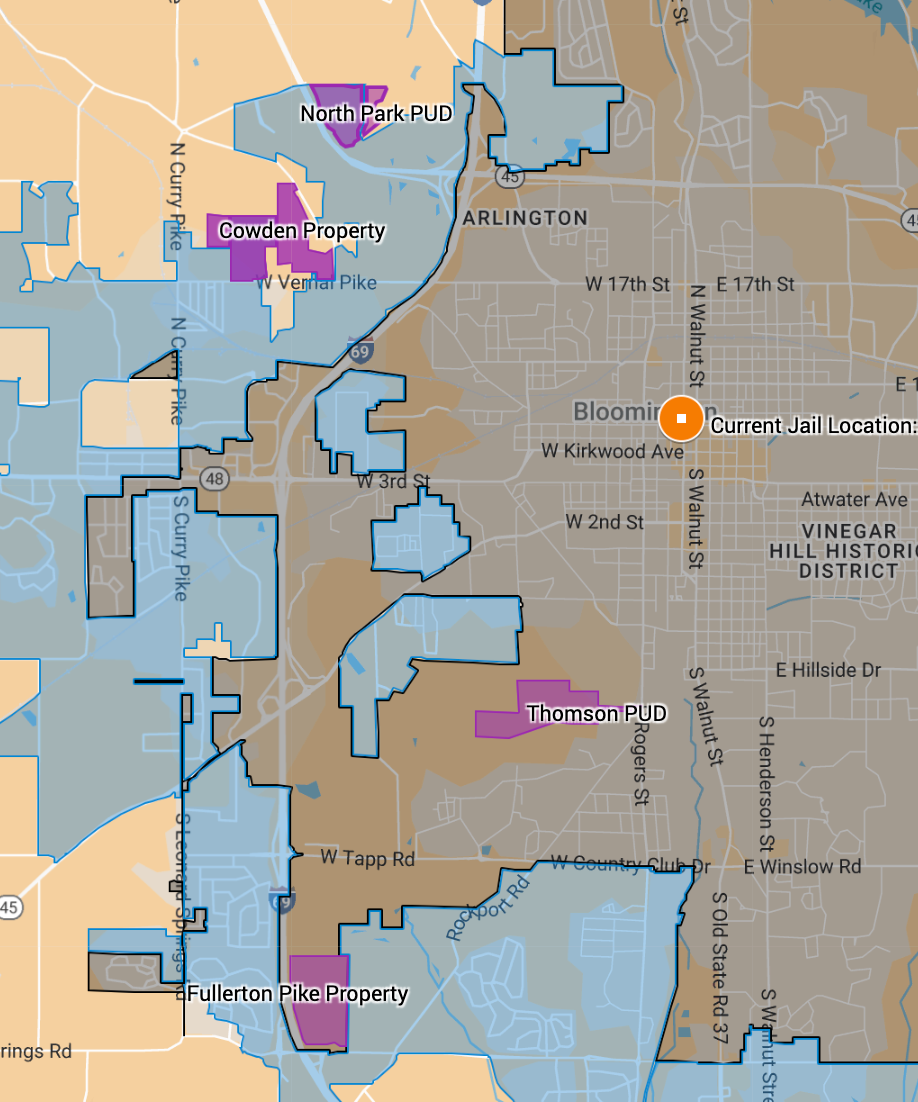
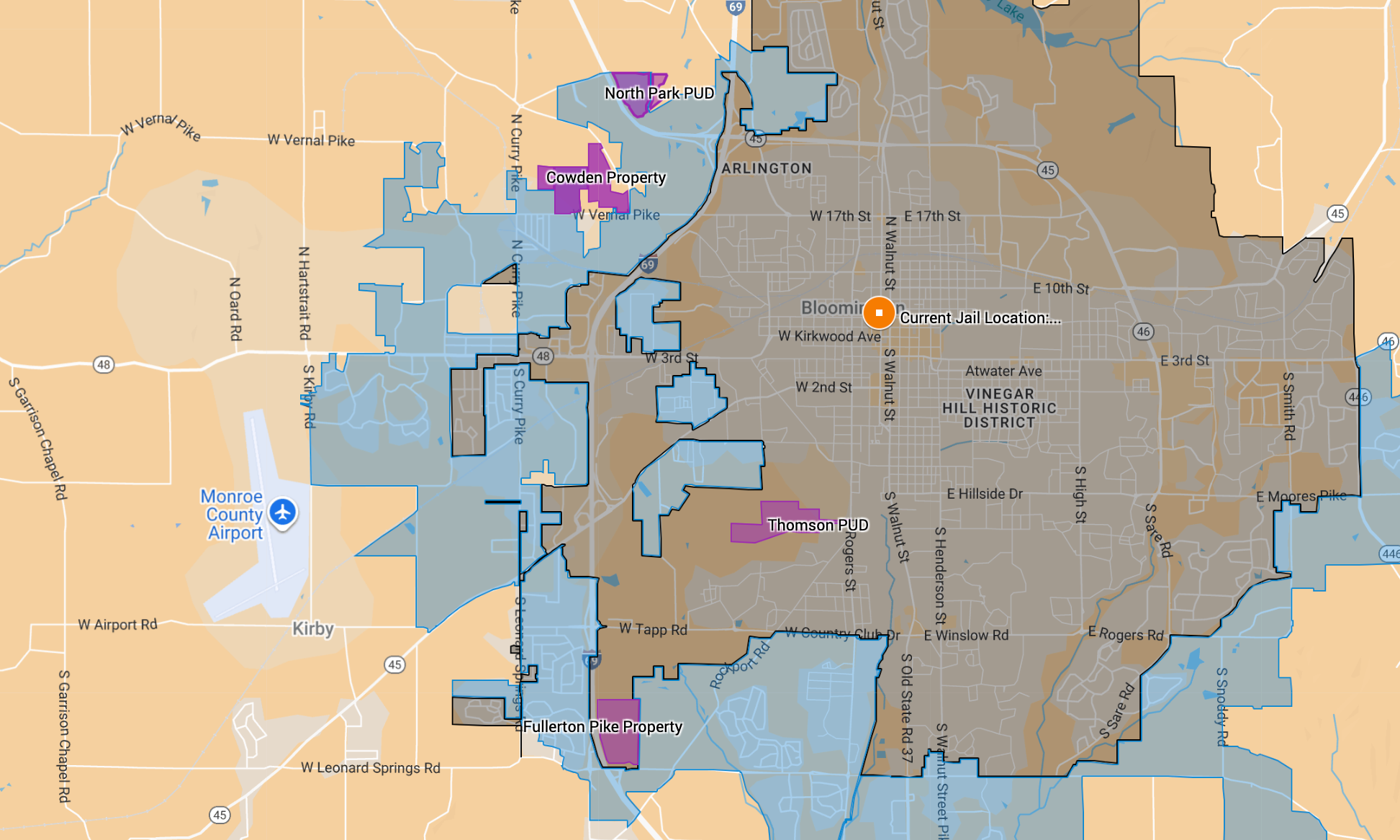
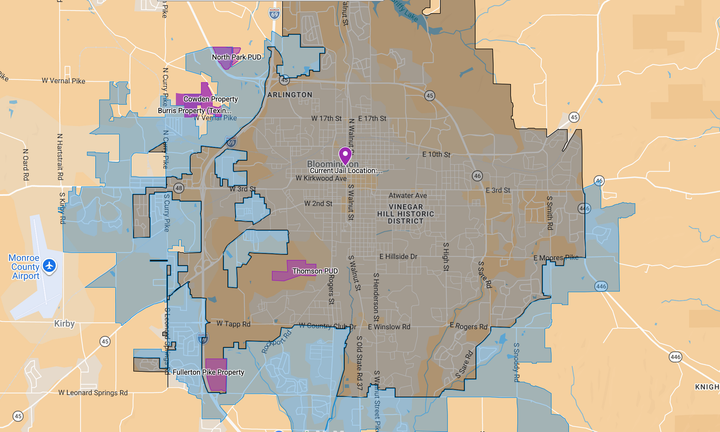
Left: From left, county commissioners Julie Thomas and Jody Madeira. Right: Map by The B Square. Purple properties have been given serious consideration by Monroe County official as the site of new jail. The orange dot is the location of the current jail. The blue areas are all a part of pending litigation involving their annexation into the city of Bloomington. [link to dynamic map]
After the Monroe County council in late October 2025 unanimously rejected the appropriation needed to purchase the North Park property as a new jail location, county commissioners attended a council meeting in early November 2025 with a list of five questions.
The list of questions boils down to this: If not North Park, then where?
Now two months later, Monroe County government is no closer to answering that question. That’s even as an April 15 deadline looms in connection with a settlement agreement for a 2008 lawsuit on jail overcrowding. After granting one-year extensions for more than a decade, the ACLU has agreed this year to extend the settlement agreement for just 90 days. That could open the door to fresh litigation, based not just on overcrowded conditions, but on the generally poor condition of the facility.
At a Thursday noon (Jan. 15) work session, the gaping chasm between the county commissioners, who have the statutory responsibility to construct the jail, and the county councilors, who hold the county’s purse strings, came into sharp relief. None of the seven county councilors attended Thursday’s work session.
From the perspective of commissioners they had asked councilors to give answers to their five questions “by January 8th during a Board of Commissioners’ public meeting.” From the perspective of councilors, the Jan. 8 regular meeting was, just two days before that day, rescheduled from 10 a.m. to 3:30 p.m. and had its agenda reduced to just the approval of the claims docket.
Councilors also chafe at the idea that the topic should be reserved for an agenda of the commissioners. Councilors want a joint meeting of the two groups of electeds in the evening, not during the working day.
The possibility of a joint meeting, to be scheduled as early as next week, is about the only thing that might be counted as an outcome of Thursday’s work session. The county attorney who supports the county council, Molly Turner-King, attended the work session to convey the council’s view that a joint meeting should be scheduled, sometime in the evening.
Based on the ensuring back and forth, the staff from the two offices will now work to find a time for a joint meeting.
At the center of the current friction between the two county elected officials is the proposed North Park site for a new jail and justice center. In 2024, the county council approved its part of the purchase agreement for the property. In late 2025, when commissioners brought forward the appropriation to actually buy the land and move into design and construction, the council voted it down.
A big part of the council’s decision was last year’s SEA 1 legislation, which has a big negative impact on the ability of local governments to finance and bond for large capital projects like the planned new Monroe County jail, with its working price tag of $225 million.
Commissioners say that reversal by the council on the North Park site has undermined both the project and the county’s legal position in longstanding jail litigation. “We started with an aerial map of the county and looked at all the lots that are large enough,” commissioner Julie Thomas said on Thursday. There are simply not other sites that have not previously been considered, she said.
At their regular meeting earlier that morning, Thomas was elected president of the three-commissioner board. Jody Madeira was elected vice-president. Both of those votes were 2–0 as Lee Jones was absent.
A big point of emphasis for Thomas was the amount of money that the county has already paid DLZ Corporation, its design-build consultant on the project for design work that is specific to the North Park site: $4.25 million. Thomas said, “Now we’ve blown through another $4 million, and we can’t use that design if we’re not locating there. But where are we locating?”
About the county council’s unanimous vote against the appropriation needed to purchase the North Park site, Thomas said: “It’s mind‑blowing. I don’t get it.”
Thomas framed the situation as failing to take responsibility in a way that risks leaving key decisions—including location, size, and design—to a federal judge, if the current agreed order in the county’s jail conditions lawsuit is allowed to lapse. If the settlement agreement ends, that opens the door to fresh litigation, which could ultimately lead to an order from a federal judge to construct a new jail on the court’s terms—that’s what county officials fear.
“We are running out of time,” Thomas said, continuing, “Any authority on location, size, number of beds for the facility [is] no longer in our hands.” She added, “That, to me, is an abdication of responsibility that shouldn’t happen.”
Thomas was willing to have a joint meeting with the county council scheduled, but said she was not sure what the point of it would be, unless the council had a consensus on a location. “I don’t want us to spend money with DLZ doing another property investigation when they’ve already done it.” Thomas continued, “We’ve been there, we’ve done that. … I don’t want to redo the work we’ve already done, because the outcome’s the same.”
Thomas’s frustration was apparent: “I just don’t understand. I don’t understand. And the fact that some councilors seem to be angry with us for doing something—I don’t understand that, and I hope that’s not the case, but that’s what I keep hearing and feeling.”
Madeira offered a comment that could be analyzed as conciliatory, or at least a call for cooler heads on both sides: “We’re running out of all the qualities that we need for this process, which includes time and patience and respect and collegiality—those are all really in short supply right now, and we all really need a greater quantity of those than we have.”
But Madeira is squarely on the side of using North Park as a jail site, based on its adequate space for constructing a one-story jail. [Added Jan. 16, 2026 at 9:34 p.m. Madeira told The B Square after publication: “I am definitely not in favor just of North Park exclusively ... I think that site is dead based on the county council vote. I think a one-story jail is much safer and that is an imperative. But the council has killed North Park so that means right now we need to look elsewhere. Not everyone is going to get what they want out of this.”]
Madeira pointed to the uncertainty that last year’s SEA 1 has on the project, but framed the issue as a question of values, focusing on the people who will be spending significant time in the facility, either working there or as prisoners. “We’re building for the next 50 years, and we don’t want to shortchange … number one, our staff, and number two, the people who will be housed in this facility,” Madeira said.
Madeira continued, “None of them should be shortchanged, and so we shouldn’t compromise on the values that have always and should always drive this decision.”
Based on that framing, Madeira said thinks the new jail should be a one-story facility, “because that’s safer.” Madeira the question of why the current justice center can’t be rehabilitated has not been answered to a number of people’s satisfaction, and for that reason, a comprehensive explanation needs to be given.
Madeira said she thinks a joint evening meeting could be productive but cautioned: “We all have to come to that meeting with definitive commitments and answers, and … a willingness to be open to new solutions.” She added, “We have to, I think, move forward on this question, because we don’t have much time left.”
There does seem to be agreement on the county council’s side about the need to come to a consensus on a location. Responding to a B Square question last week, county council president Jennifer Crossley said “A location is what we need to focus on ...” She added, “We as a council have to be on one accord with [the location] as well as the commissioners and we need to do this sooner rather than later.”
In the hour before its regular Tuesday (Jan. 13) meeting this week, the county council held an executive session on the topic of the ACLU’s litigation, attended by ACLU attorney Ken Falk. But at their regular meeting, an expected conversation among councilors on the topic of the new jail did not materialize.
After Thursday’s work session, county attorney Jeff Cockerill responded to a B Square question by saying that if the settlement agreement with the ACLU expires, he would be surprised if new litigation were not filed by the end of 2026.
That’s why Cockerill is looking to one sentence in an end-of-year letter that ACLU lawyer Ken Falk wrote to the legal department: “Of course, if there is some clear movement for resolving the jail problem during the 90-day extension of the PSA [private settlement agreement], and a commitment by officials to doing so, I will be happy, as class counsel, to consent to a further extension.”
Whether any progress towards “clear movement” will be achieved at a joint meeting of the county council and the county commissioners will depend first on whether a joint meeting even gets scheduled.
In Falk’s letter he expresses pessimism that his “clear movement” benchmark will be hit: “Given past experience, however, I am not optimistic that anything positive is going to occur.”
Map of previously considered jail locations
Comments ()