
Monroe County jail panel narrows options inside city to five sites ahead of final meetings
A jail-site panel narrowed its active list to five options Monday, including: renovation of the current justice center in combination with the Curry Building; and three sites near I-69. Members also refined evaluation criteria and sought more data before meetings on July 9 and July 13.
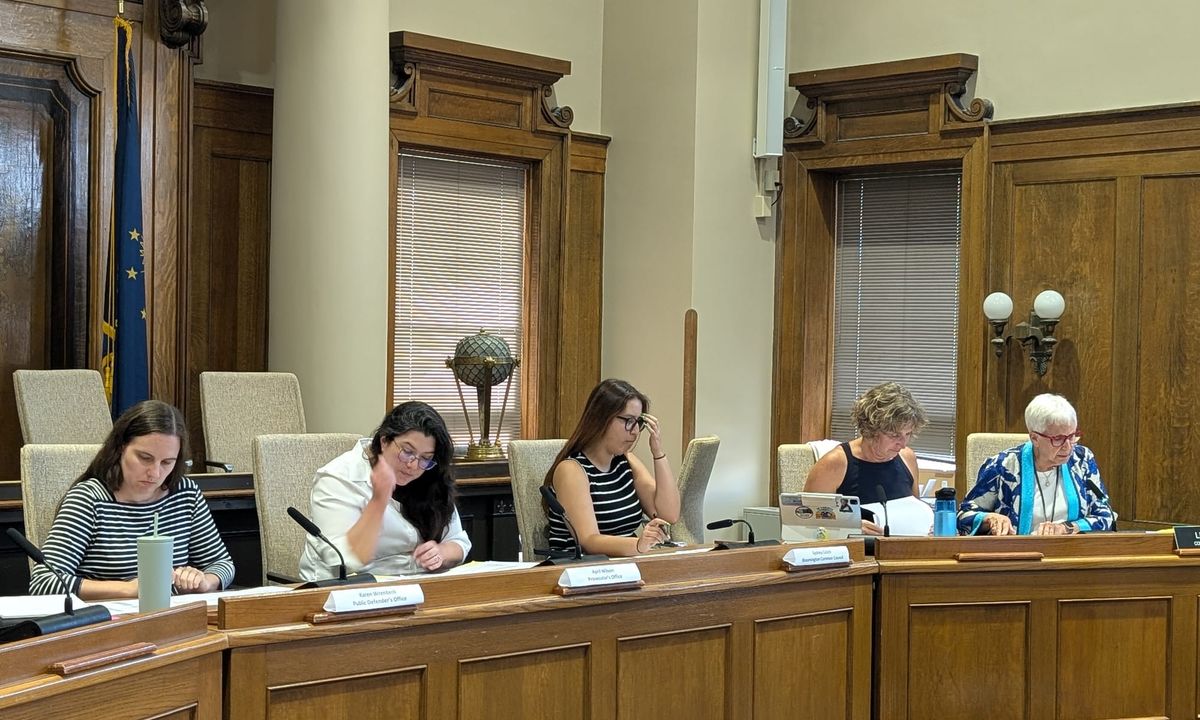
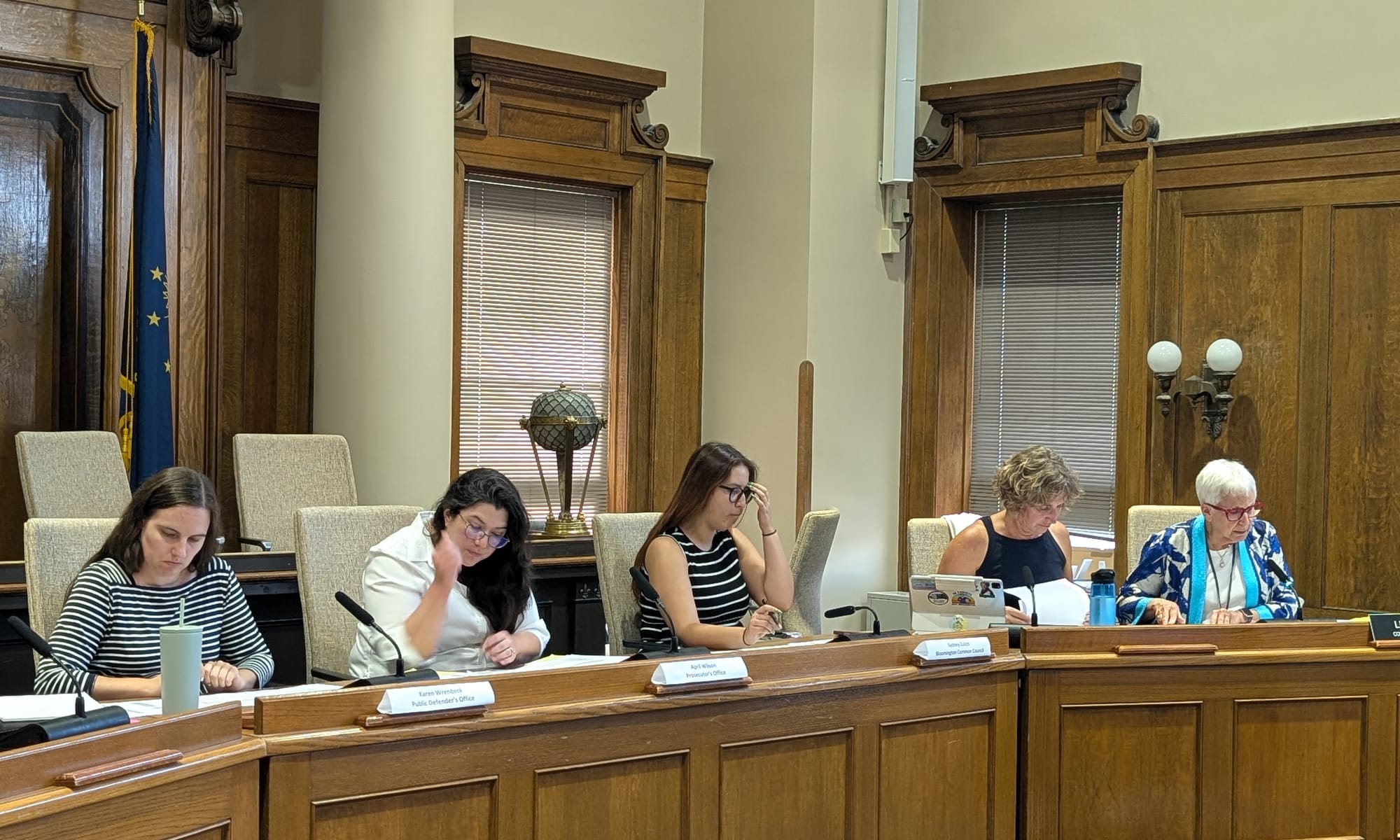
On Monday (July 6), the Collaborative Justice Project Working Subcommittee trimmed down to five a list of properties inside Bloomington under consideration for a new Monroe County jail site.
During their scheduled meeting, the group continued to work on the evaluation metrics that are being used as selection criteria, and requested county and city staff to provide information needed to conduct further site evaluations and arrive at a recommendation after its next two meetings.
The committee is looking to make a recommendation for a new jail site inside the city of Bloomington by the end of its July 13 meeting. The work is being done against a backdrop of expected new litigation over the conditions of the current jail.
The group started the meeting with a partially-filled-in evaluation matrix for 16 locations, each with its own column, with each row corresponding to one of the criteria. County attorney Molly-Turner King and city council attorney Larry Allen had done much of the work to fill in the cells with information.
At the beginning of Monday’s meeting, Bloomington mayor Kerry Thomson asked for suggestions from committee members on properties that any of them thought weren’s feasible for the project and could be excluded from the evaluations.
First to be struck off the list was the Bloomington Transit garage. City councilmember Sydney Zulich explained the reasoning, “It looks like the owner is not willing to sell the property, so that would pretty much take it off the table.” The land is owned by Indiana University, while the building is owned by Bloomington Transit.
City council attorney Larry Allen informed the subcommittee that the Fell Iron and Bender Lumber properties that are included in the matrix are also unlikely to be for sale. He pointed to the site plan approval by Bloomington’s plan commission in April for a 360-unit apartment complex there.
“In April of 2026, so just recently, at least the Fell Iron property went through the planning approval process, and it’s been approved for apartment building construction, so it’s very unlikely that that’s for sale,” Allen said.
Hopewell West and East, which are also on the subcommittee’s list, are owned by the Redevelopment Commission (RDC), Thomson noted.
“These are RDC-owned properties, and so an official decision would need to come from the RDC. I have done some checking though, and there is a full plat complete as well as a park installed, etc. So there’s significant planning already executed for residential and public promise of residential there,” Thomson said. “Again, I won’t speak for RDC if you want to make an official ask, but I would say it’s unlikely.”
The mayor did suggest that if any of the Hopewell properties became one of the top contenders in the course of the subcommittee’s deliberation, a proposal could be put on the RDC agenda “despite knowing it’s unlikely”.
According to Allen, consideration of the former H-T Building on South Walnut was complicated by the fact that part of the site sits in a floodway and the property is in the due diligence phase of a potential sale by the current owner, Monroe County Community School Corporation.
As with Hopewell, the committee decided to leave the H-T Building out of consideration for the time being.
The property south of the post office on South College Avenue was then struck off consideration because it is in a floodway as well.
The city hall parking lot, which made its way onto the list as a suggestion through the public feedback process by city councilmember Matt Flaherty, was also struck off the list as the mayor suggested a lack of viable solutions for city parking.
“If we were to get rid of that, it’s not a short-term resolution to come up with that, and so I would say, for the purpose of this group, it’s not really a viable discussion at this point,” she said. The property, at 1.3 acres, was also considered not big enough for the potential jail site.
The convention center parking lot west of the B-Line Trail was also considered unsuitable for the jail site because of its small size.
Deputy prosecutor April Wilson supported the decision not to further consider the parking lot, because it’s not just used for convention center parking. “It’s also overflow for county employees parking because the county parking garage is smaller than needed at times,” she said.
The subcommittee also has two more private properties on its list of considerations, and city attorney Allen told the members that more information on those will be presented during an executive session on Thursday (July 9).
The group then discussed the Curry Building, which is located next to the current justice building at 7th Street and College Avenue.
County attorney Molly Turner-King told the committee that the option to use the Curry Building by itself—as opposed to renovating the current justice center facilities in combination with the Curry Building—would not provide enough square footage.
“I think the only viable option would probably be [in combination] with the use of the current justice building,” she said.
After Monday’s discussion, the list of options targeted for additional focus by the committee for the new jail site comes down to five: renovating the current facilities in combination with the Curry Building; property north of Tapp Road next to the I-69 on Wapehani Road and Weimer Road; property south of Tapp Road on the I-69 and W Tapp Road; the Thomson property at 1620 S. Rogers Street; and the Fullerton Pike property at SR 37.
The North Park site, which was rejected by the county council, has a column in the spreadsheet as a reference point.
Also at Monday’s meeting, the committee revisited the evaluation metrics and the missing information for each. Bloomington mayor Kerry Thomson suggested coming up with a critical path of questions that need to be answered before the next meeting, and designating who answers those questions.
The members discussed whether one of the criteria is actually appropriate: Is the property adequate for 448 beds? “I don’t think it’s our charge to decide what the bed count should be. If we’re going to talk about size, let’s do square footage. Don’t want to get us into a situation where we have more beds than we need,” said Bloomington city councilmember Sydney Zulich.
Following a brief back and forth, committee members decided to base their operational adequacy metric on the square footage proposed in an August 29, 2025 design for the North Park site.
During the committee’s July 1 meeting, county attorney Jeff Cockerill said that according to that design, the area needed for the sheriff and jail space was 123,455 square feet.
The members also decided to use the square footage metric to answer the question of whether a site meets the requirements of constitutional care.
“If you use the square footage from the August 29, 2025 meeting, that blueprint was based on a design that remedies these constitutional conditions, and so in essence, if you’re using that square footage, then it would meet constitutional care,” said Turner-King in support of the notion.
The subcommittee also determined that it needs answers to questions about the availability of utilities at the potential sites and whether or not geotechnical and environmental studies have been completed. They also addressed the caveat that the information may be unknown for some of the sites.
For the committee’s next meeting on Thursday, Thomson suggested how the deliberations could unfold.
“I would suggest that we all come prepared with some comments about the properties. I would value hearing from this subcommittee what their main concerns and priorities are with each of the properties, and considering those over next weekend, along with the public comment that we’re going to hear, and I think that could advance our process for getting to a vote in the in the final meeting,” Thomson said.
The remaining meetings of the Collaborative Justice Project Working Subcommittee will held on Thursday, July 9 at 6 p.m. and Monday, July 13 at noon. The Thursday meeting will be preceded by an executive session at 5:30 p.m.


Comments ()