
New signal timing gives pedestrians head start at downtown Bloomington intersections
Bloomington is installing pedestrian-first signal timing at downtown intersections, funded by a state safety program. The change builds on a city-council-initiated 2021 no-turn-on-red ordinance and later council actions. LPI timing gives peds a head start before vehicles get a green light.
A news release from Bloomington’s office of the mayor on Wednesday announced that the city is completing the first phase of traffic signal retiming project with money from the the state of Indiana’s Highway Safety Improvement program.
The specific kind of newly implemented signal timing mentioned in the news release is called a leading pedestrian interval (LPI). An LPI addresses intersections where no-turn-on-red signs are posted.
The specific scenario is one where a pedestrian is waiting for a walk signal to cross a street, and a car is waiting to turn right, across the crosswalk. Instead of simultaneously giving the driver a green light and the pedestrian the walk sign, the traffic signal first gives the pedestrian the walk signal, and then a couple of seconds later gives the driver a green light. The idea is to give the pedestrian time to establish themselves visually in the crosswalk so that the driver can yield.
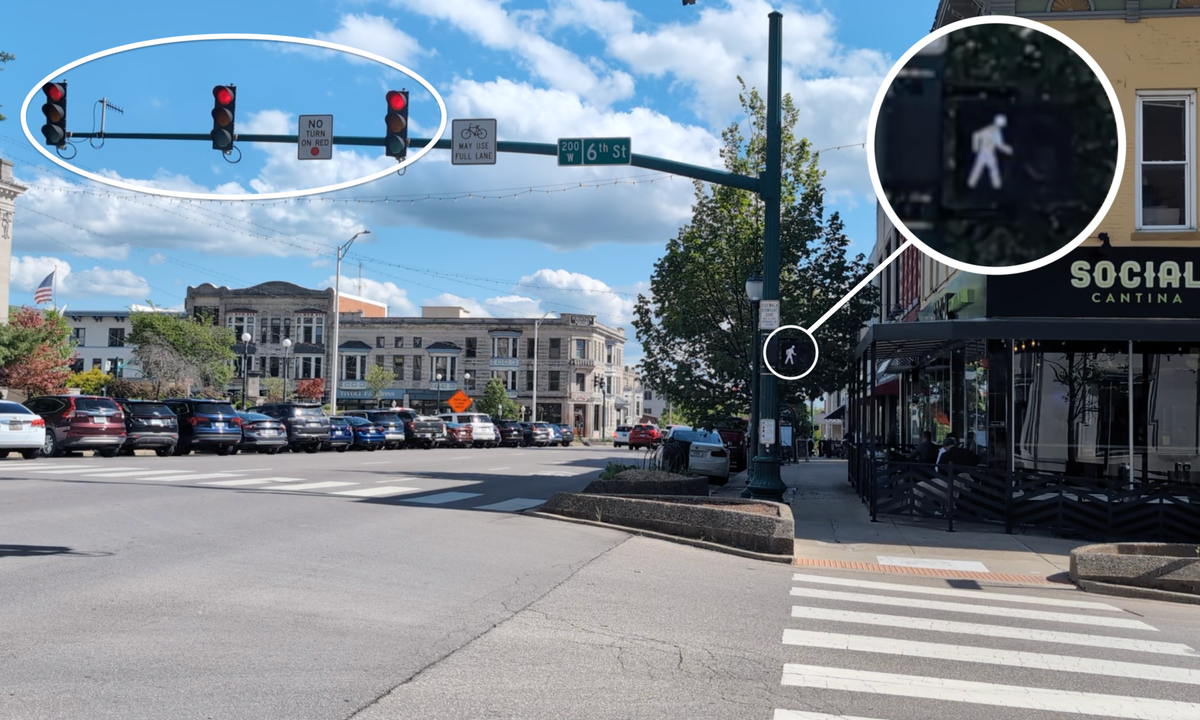
This week The B Square documented several signals in the College Avenue and Walnut Street corridor where LPIs are implemented. Here’s an example, southbound on College Avenue at 6th Street. (In the video, stare at the red figure indicating “Don’t Walk.” When it turns to a walk sign, look at the traffic signal—it will still be red.)
Pedestrian Leading Interval: Walnut Street & 6th Street
The basic environment for implementation of LPIs is one where turning on red is prohibited. That’s because if it’s legal to turn right on red, then a car driver has a right to turn (after stopping) without waiting for green, and an LPI would have little impact.
It was an ordinance initiated and adopted by the city council five years ago, that added about 80 spots in the downtown area to the list of downtown intersections where no-turn-on-red signs are mandated, including the one for southbound College Avenue at 6th Street.
Two years later, the no-turn-on-red ordinance was followed by a city council resolution [Res 23-17] directing a revision to the transportation plan, which is a part of the city’s comprehensive plan, to include LPIs in city policy. The resolution also called for as well as inclusion of walk signals in every signal cycle without requiring a pedestrian to hit the “beg button.” That kind of automatic inclusion of walk signals is known as “pedestrian re-call” in traffic engineering terms.
City council records don’t seem to include a resolution adopting changes to the transportation plan explicitly in response to Res 23-17. But in late 2024, the council did adopt the Safe Streets for All plan, which included LPIs as a targeted policy option.

Comments ()