
Monroe County sheriff wins narrow injunction against Indiana ICE-detainer law
A Monroe County special judge blocked AG Todd Rokita from enforcing SEA 76’s ICE-detainer compliance mandate against sheriff Ruben Marté, finding a likely Fourth Amendment conflict. The narrow preliminary injunction applies only to Marté while the state case continues.

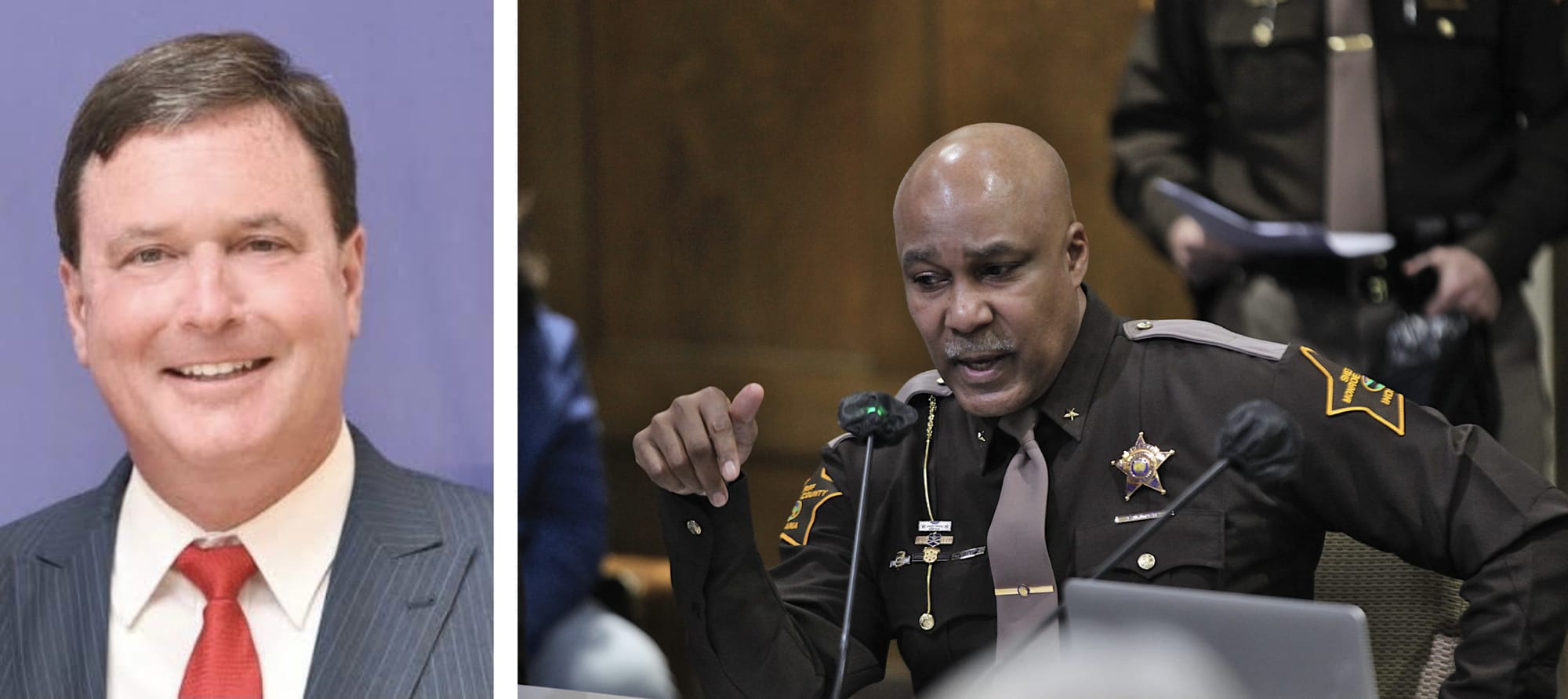
A local judge has blocked the state of Indiana from enforcing a key part of its new ICE-detainer law against Monroe County sheriff Ruben Marté, one day before the law was set to take effect.
In an order issued on Tuesday (June 30), Monroe County circuit court special judge Luke Rudisill granted Marté a preliminary injunction against enforcement of Indiana Code 5-2-18.2-9(a)(3), which was put into effect by SEA 76. That’s a provision, set to take effect on July 1, which requires a local agency with custody of a person named in an immigration detainer request to “comply with all requests made in the immigration detainer request.”
The injunction issued Tuesday applies only to Marté and the Monroe County sheriff’s office—not to other sheriffs around the state. The judge tailored his ruling narrowly just to Marté, because other sheriffs could have also asked the court for relief, but have not. As judge Rudisill puts it: “It is not this Court’s objective to pursue relief on behalf of professional individuals who are presumed to have knowledge of the law and the means to seek relief from it.”
The ruling is also narrowly tailored, because Marté filed suit based on the harm he faces from being compelled by the state law to violate his oath and the United States Constitution and the related liability—not on the harm to detainees whose rights may be violated. As judge Rudisill put it: “If the harm were based upon the constitutional rights violation of class of individuals who lack such presumed knowledge and resources, then perhaps this Court would be persuaded to broaden the scope of this injunction.”
[Added at 10:57 p.m. June 30, 2026. In a statement released Tuesday night, Marté said, “Today’s ruling reinforces an enduring principle of our system of government—that constitutional questions deserve careful judicial review, and that no public official should be placed in the impossible position of choosing between violating constitutional rights and violating state law.” ]
The ruling is not a final decision that the law is unconstitutional. A preliminary injunction is a temporary order entered while a case continues. But Rudisill found that Marté had shown a reasonable likelihood of success on his claim that mandatory compliance with ICE detainer requests would put the sheriff in conflict with the Fourth Amendment’s protection against unreasonable seizures.
An ICE detainer is a request from federal immigration authorities asking a jail to hold someone for up to 48 hours after the person would otherwise be released, so ICE can take custody.
Marté’s legal position has been that once a person is entitled to release from jail, continuing to hold that person solely on an administrative immigration detainer—without a judicial warrant or probable cause that a crime has been committed—amounts to a new seizure under the Fourth Amendment.
The action in circuit court was initiated in 2024 by Indiana attorney general Todd Rokita against Marté, about the sheriff’s policy on immigration status of prisoners. SEA 76, enacted by the legislature this year, put the already existing conflict between Rokita and Marté into sharper relief.
After the legislature passed SEA 76 this year, Marté mounted a federal challenge to the law based on the Fourth Amendment theory.
Rudisill’s order on Tuesday accepts, at least for now, the merit of Marté’s argument. In support of that argument, Rudisill’s order says that ICE’s probable-cause determination is made by an ICE officer, not by a neutral judge. Further, Rudisill writes that the probable-cause determination made by an ICE officer involves removability under civil immigration law, not probable cause that the person has committed a crime. The order also notes that unauthorized presence in the United States is a civil violation, not by itself a crime.
The distinction between civil violations and criminal violations is central to the case. Local jails routinely hold people on criminal charges, court orders, warrants and sentences. Marté’s argument is about what happens after the local legal basis for custody has ended. In Rudisill’s framing, the question is whether Indiana can require a sheriff to continue to detain someone anew, based only on an ICE detainer request.
The state, represented by attorney general Todd Rokita, argued that Indiana has a substantial interest in immigration enforcement and that local cooperation with federal immigration authorities has historical and statutory support. Rudisill acknowledges that interest, but says it does not override constitutional limits. “All Hoosiers should be wary of dispensing with constitutional requirements in the name of ‘safety’ and ‘public interest,’” the order says.
The practical effect is limited but still significant for Marté. The attorney general is not allowed to try to penalize Marté for refusing to comply with the detainer-compliance mandate in Section 9(a)(3).
SEA 76 allows civil penalties of up to $10,000 for knowing or intentional violations. But Rudisill emphasized that the injunction does not wipe out the rest of the law. Marté and other Indiana sheriffs remain subject to provisions requiring communication and information-sharing with federal officials, as long as those actions do not violate federal or state law.
The state-court ruling comes less than two weeks after a federal judge declined to block the same law before its July 1 effective date. That federal ruling did not turn on the merit of the arguments about whether the ICE-detainer mandate violates the Fourth Amendment. Instead, the federal court relied on the political subdivision doctrine, which can prevent a local governmental unit from suing the state in federal court over an intra-governmental dispute.
The twin tracks of separate litigation on the same issue unfolded starting two years ago. Rokita first sued Marté in Monroe County circuit court in July 2024 over the sheriff’s immigration-enforcement policy, known as MCSO-012. That policy says sheriff’s employees will not hold a person past the person’s scheduled release date based solely on an ICE detainer, unless there is a judicial warrant.
After Gov. Mike Braun signed SEA 76 into law on March 5 this year, Marté filed the federal lawsuit seeking to block the new detainer-compliance provision before it took effect. Rudisill had paused the older state-court case while the federal case proceeded.
The June 30 order brings the constitutional question back to the state court, at least as far as Marté is concerned. Rudisill found that the sheriff had shown irreparable harm because the law placed him in what the order called an impossible position: He had to either comply with ICE detainer requests and risk violating constitutional rights, or refuse to comply and risk state penalties.
The broader legal question, about whether Indiana can require local law enforcement agencies to honor ICE detainers without a judicial warrant, has not yet been addressed. But the case will continue with some temporary protection in place for Marté.



Comments ()