
Bloomington council approves 2027 budget 6–1, with president as lone dissenter
Bloomington’s city council adopted the 2027 budget on a 6–1 vote, with Isak Asare dissenting over whether city spending delivers clear, measurable benefits to residents. The council withheld millions for housing and parking projects. Matt Flaherty and Kate Rosenbarger were absent.
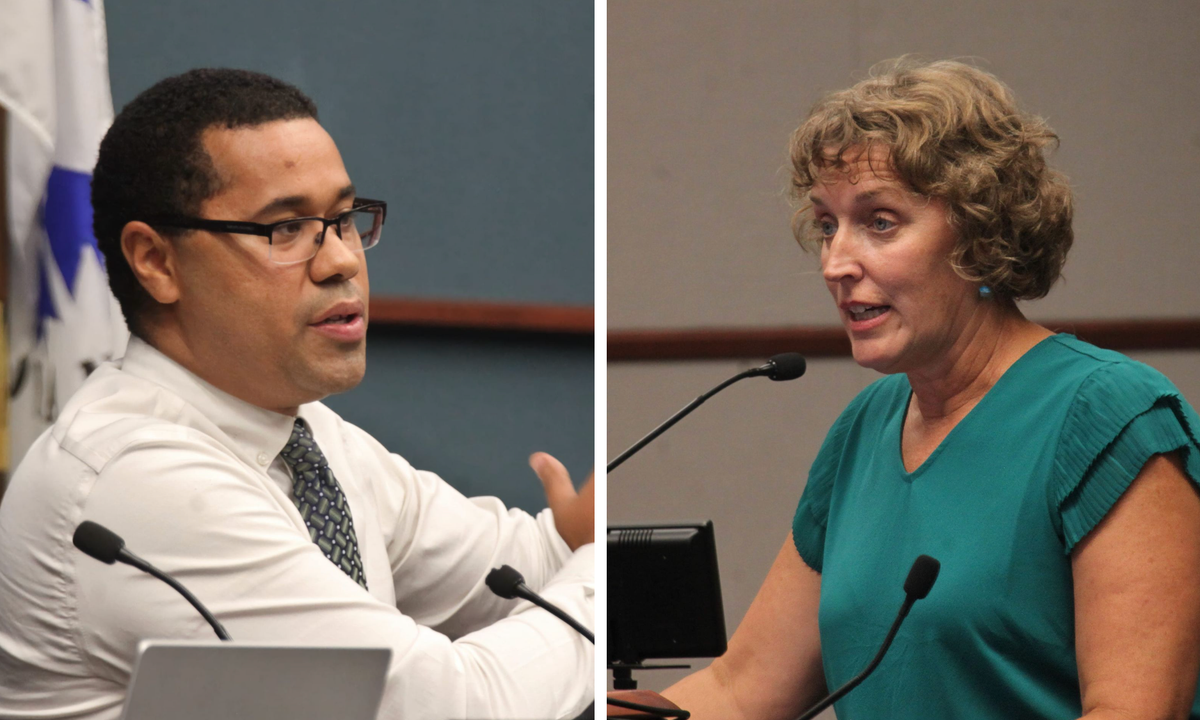
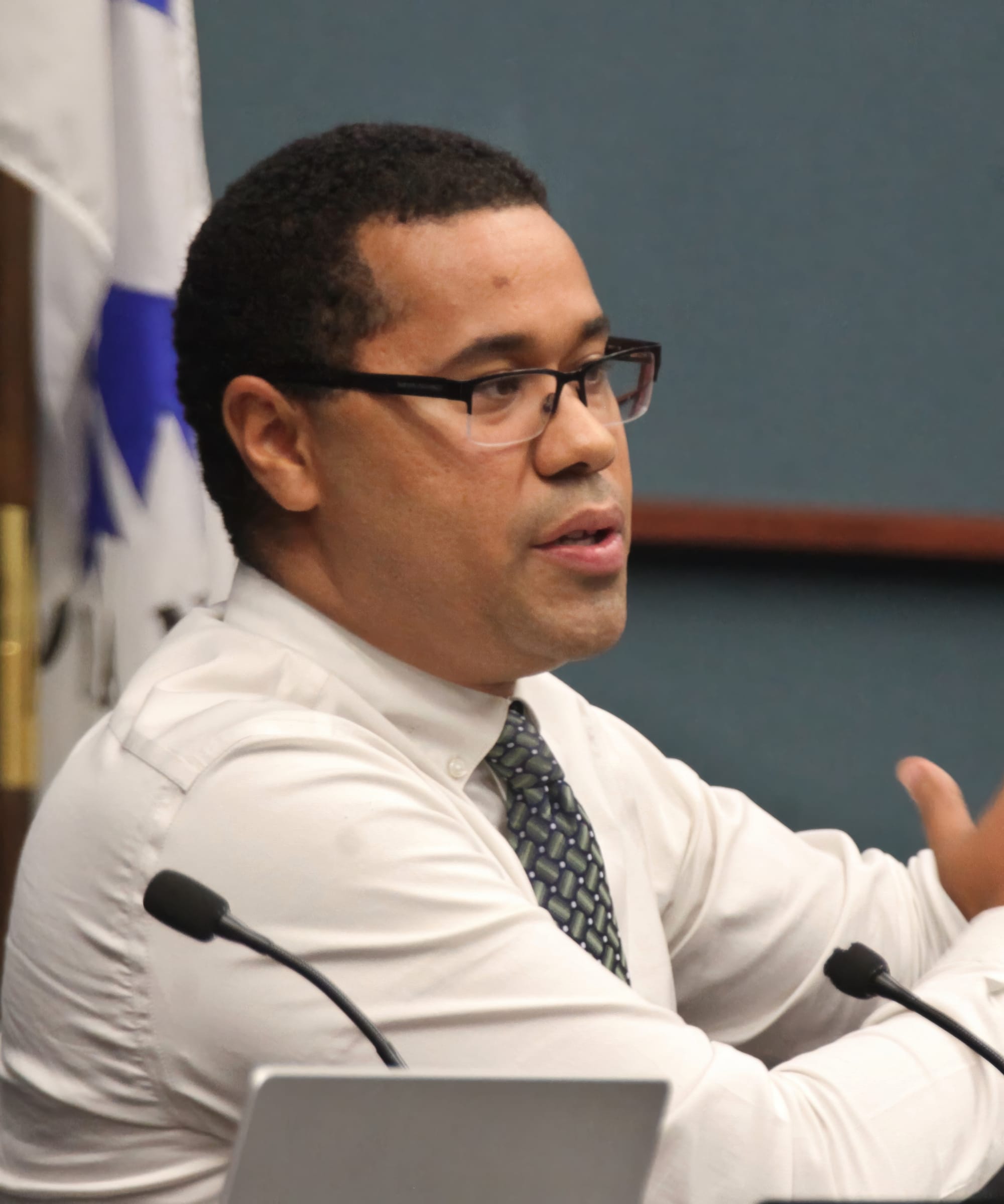
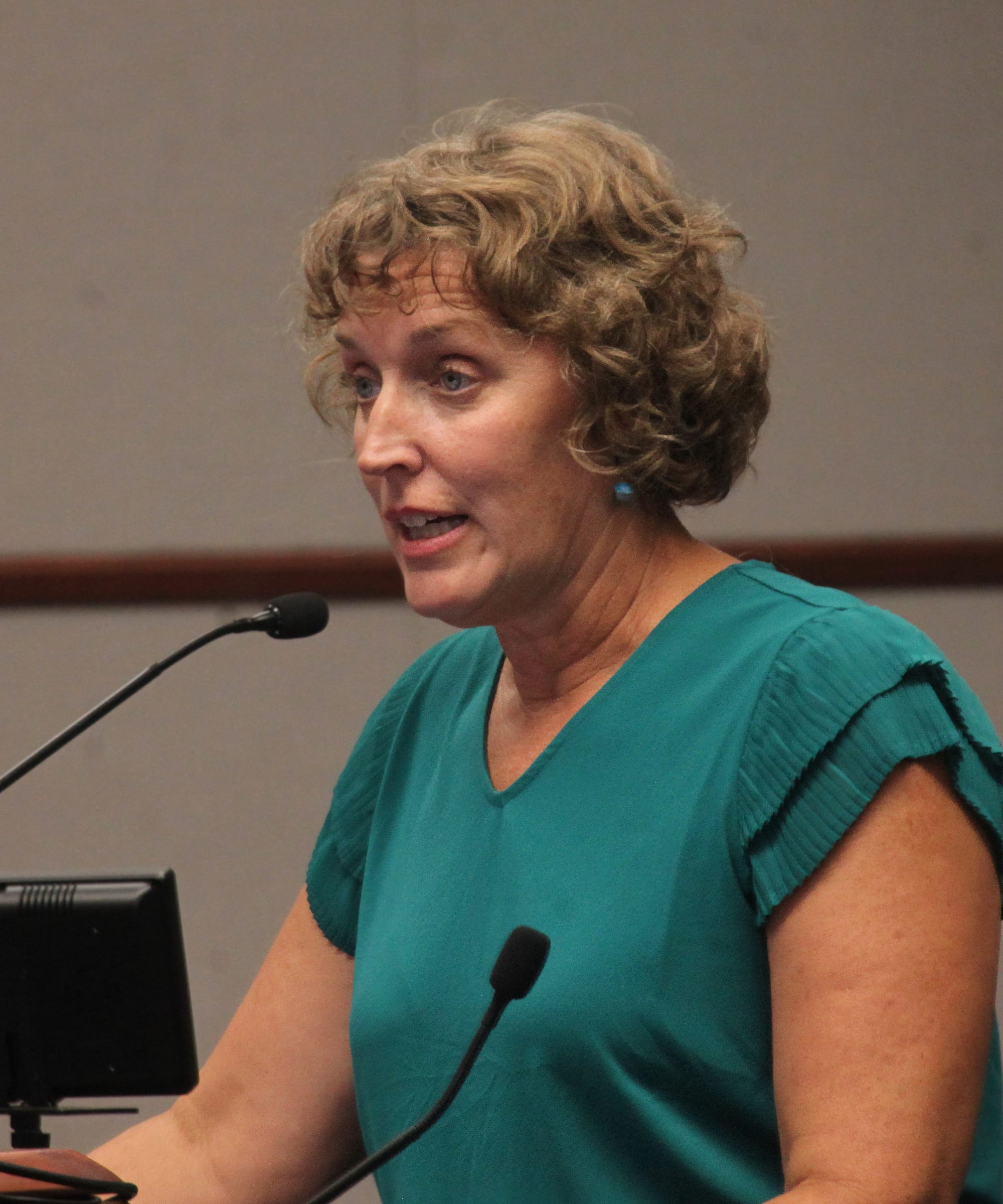
Left: Bloomington city council president Isak Asare Right: Bloomington mayor Kerry Thomson (Dave Askins, Oct. 14, 2026)
Bloomington’s city council voted 6–1 on Wednesday (Oct. 14) to adopt the city’s 2027 budget, with council president Isak Asare casting the lone dissenting vote.
Councilmembers Matt Flaherty and Kate Rosenbarger were absent. Flaherty had previously announced that he would vote against the budget if were able to attend.
The vote came after a week of deliberations when the council rejected a broad $2.5 million general fund spending cut, but withheld millions of dollars in spending authority for housing development and parking improvements.
The original budget proposal totaled about $171.4 million across all city funds, excluding Bloomington Transit (BT) and city of Bloomington utilities (CBU). Of that amount, about $63.7 million was in the general fund, which supports much of the city’s day-to-day operations.
The six amendments approved by the council a week ago, on Oct. 7, reduced proposed appropriations by about $6.5 million, leaving an amended budget of roughly $164.9 million, based on the original proposed total and the adopted reductions.
The original proposal called for general fund spending of about $6 million more than projected revenues, with the difference covered by cash reserves.
The final vote came late in a meeting dominated by long public comment and council debate on a separate ordinance, which prohibited the city’s use of automatic license plate readers (ALPRs) and restricted certain video surveillance technology. That legislation passed unanimously, 7–0.
The council altered the order of the agenda in the middle of the meeting in order to hear the ALPR item ahead of the budget approval. The meeting lasted until midnight, with the vote on the 2027 budget coming around 11:15 p.m., after a 6:30 p.m. start.
Why Asare voted no
Asare did not explain his dissent from the dais before the final budget vote. But in an interview with The B Square immediately after the meeting, he said his opposition reflected disappointment with the direction of the budget.
“Our budget, first and foremost, is a value statement,” Asare said.
He said the Thomson administration has repeatedly told councilmembers over the past several years that financial constraints make it impossible to undertake new initiatives or invest in programs that councilmembers want to pursue.
But the city then presented a proposed budget that Asare described as roughly $8 million higher than the previous year’s, while claiming that the spending plan was balanced and sustainable. “I don’t think that that is true,” Asare said.
At the same time, Asare acknowledged that Bloomington is in a strong fiscal position. His objection, he said, is to how the city is using that position to improve the lives of residents. He put it like this: “I don't think that we’re leaning in to that strong fiscal position correctly, and so I wanted to be clear about that.”
Asare rejected the suggestion that his proposal for a $2.5 million reduction was simply an effort to cut spending for the sake of cutting. He said the purpose was to compel a conversation about spending priorities and measurable results. That’s a conversation he believes the council, as the city’s fiscal body, should be leading.
“Everything that we do needs to have clear, demonstrable benefits to the residents of Bloomington,” Asare said. Asare said that his questions during the budget process had failed to produce satisfactory explanations of how the proposed spending would achieve specific outcomes for residents.
His criticism was not that the city necessarily should spend less on everything, but that it should be more deliberate about what it is trying to accomplish with its spending. “I fundamentally think that there’s so much more we can be doing with the budget to improve the lives of people in Bloomington,” Asare said.
He said city officials and elected representatives appear to have accepted the notion that “the city that we have is the best we can afford.”
For Asare, that acceptance represents a failure of ambition as much as a question of fiscal sustainability.
What the council changed
At its Oct. 7 special meeting, the council rejected Asare’s proposal to reduce the general fund budget by $2.5 million, or about 4%. The amendment failed 2–5, with only Asare and Flaherty supporting it.
Asare had proposed setting a lower overall appropriation target and leaving the administration to identify specific reductions, rather than having the council choose individual positions or services to eliminate.
Controller Geoff McKim and other administration officials opposed that approach, saying that reductions of that size could not responsibly be identified and implemented on the short timetable remaining before adoption.
Instead, the council approved six targeted amendments, including withholding $3 million in housing development fund appropriations, and $2.5 million for parking system improvements. Withholding those appropriations is not the same as permanently eliminating the spending. The administration can return to the council in 2027 with more specific proposals and request new appropriations.
The council also eliminated $272,000 for technology to monitor city-owned vehicles, $10,000 for the mayor’s branding initiative and funding for a vacant transportation demand manager position. It reduced a planned subsidy for sanitation operations by $600,000, anticipating that higher household trash-cart fees would make up the difference. The fee increase would require separate council approval.
At Wednesday’s meeting, councilmember Hopi Stosberg asked McKim, who joined the meeting remotely, about changes she had identified in the revised budget figures.
McKim confirmed that a $143,894 reduction in the economic development local income tax fund reflected removal of both salary and benefits for the vacant transportation demand manager position.
Deputy mayor Gretchen Knapp, who initially spoke for the administration, said the approved amendments had been incorporated into the budget and the revised state form had been generated.
McKim participated remotely because he was serving on federal jury duty in Indianapolis.
The final budget vote itself was brief. No members of the public spoke on the appropriation ordinance. Before the vote, councilmember Isabel Piedmont-Smith thanked McKim for his work on the budget and his willingness to explain the city’s internal budget calculations to the council’s fiscal committee.
Mayor Kerry Thomson did not speak during the final budget discussion. In her report to the council earlier in the meeting, she addressed other city business, including plans for a possible new police headquarters at 714 S. Rogers St. and the future use and costs of the Showers West building.
Flaherty’s three objections
Flaherty, who was absent Wednesday, had said at the Oct. 7 meeting that he would vote against the overall budget if present. His objections centered on three disagreements with the Thomson administration, rather than the budget’s bottom-line figures.
Flaherty thinks the Thomson administration is breaking local law, because it has continued using temporary traffic regulations imposed by the city engineer, beyond the 180-day period that Bloomington city code allows.
He also objects to what he considers inadequate enforcement of the city’s sidewalk snow-removal requirements, including on city-owned property.
His third objection concerns the administration’s decision not to proceed with previously discussed Indiana Avenue safety improvements following opposition from Indiana University representatives, even though the project had been part of an earlier budget negotiation, and without returning to the council.
Flaherty has characterized the budget vote as one of the few means available to councilmembers to hold the administration accountable over such disputes.
Looking ahead to 2028
Despite his no vote, Asare identified to The B Square some positive results from the budget process, particularly the council’s decision to withhold housing and parking appropriations pending further scrutiny and public input.
He said his next steps will include constituent meetings to discuss how residents want the city to invest its money, as well as conversations with the mayor and controller about a proposed plan for investing city reserves.
Asare also wants to use future council legislation, potentially including resolutions, to establish clearer expectations for the outcomes city programs should achieve. He cited accessibility as one area in which the city could define specific improvements and measure whether residents are receiving tangible benefits from their tax dollars.
Another, he said, is the city’s stated goal of attracting and retaining young professionals and families. He wants the city to develop a clearer plan for what investments would advance that goal.
The city has also been pursuing new budgeting software intended to better identify spending outcomes. Asare said he was skeptical about whether the technology would produce meaningful change, but welcomed the possibility.
Separately, Thomson’s administration has committed to bringing the council a proposal by June 1, 2027, for possible departmental reorganization and staffing reductions. That review comes against a backdrop of changes in Indiana’s property tax system and local income tax rules, including changes scheduled to take effect in 2029.
Asare contends that the council should not wait until the next budget, for 2028, is presented, to start deciding what the city should accomplish with its resources.
The council also voted unanimously Wednesday to approve a separate $65.27 million budget for city of Bloomington utilities, including $28.87 million for water operations and $36.4 million for wastewater operations, which also include stormwater. The 2027 Bloomington Transit budget had already been approved at the Oct. 7 meeting.


Comments ()