
Ellettsville merger would erase Monroe County’s share of municipal income tax
Ellettsville’s merger with Richland Township could reshape a proposed countywide income tax. Monroe County government’s projected $3.93 million share would disappear, Ellettsville would gain $4.55 million, and Bloomington would lose about $613,000, according to The B Square’s calculations.
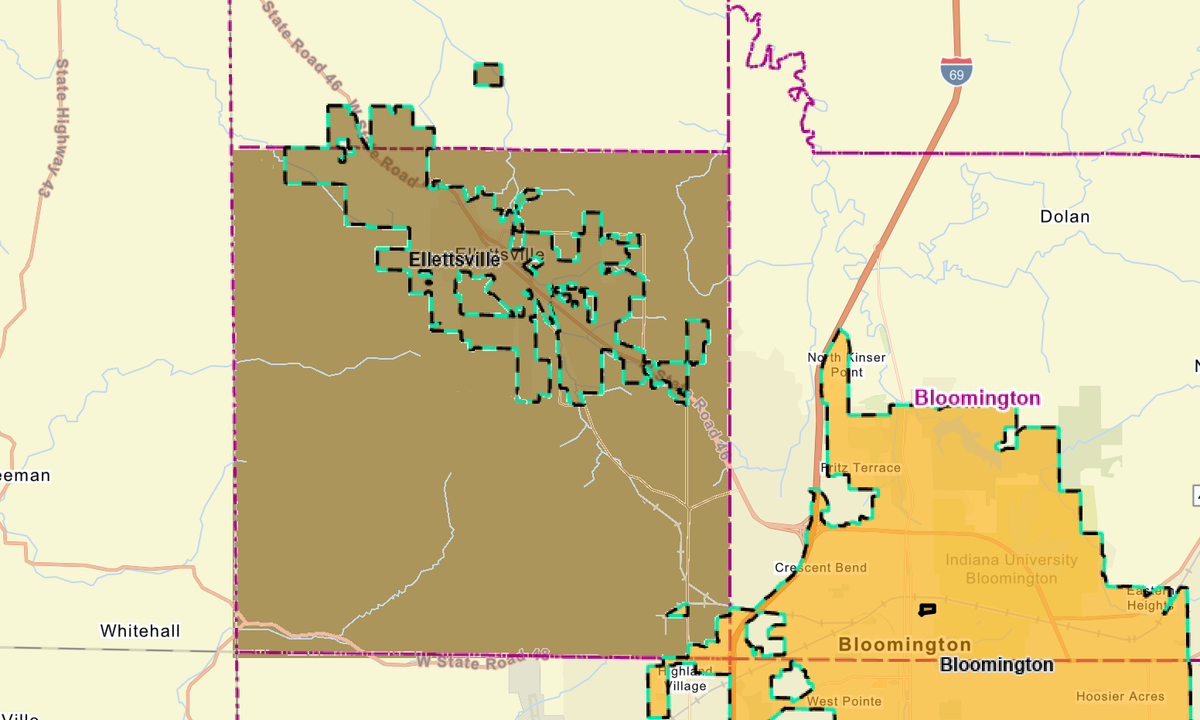
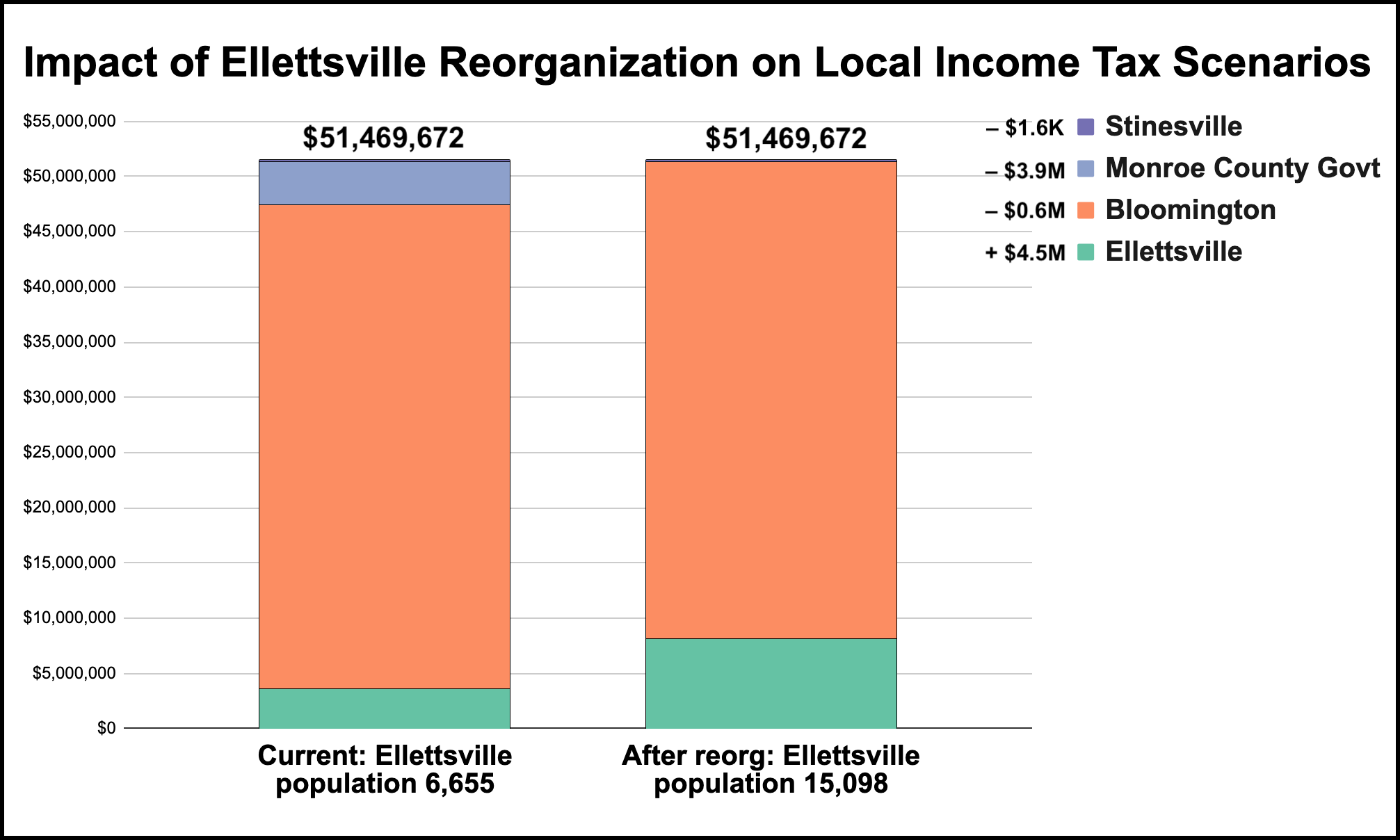
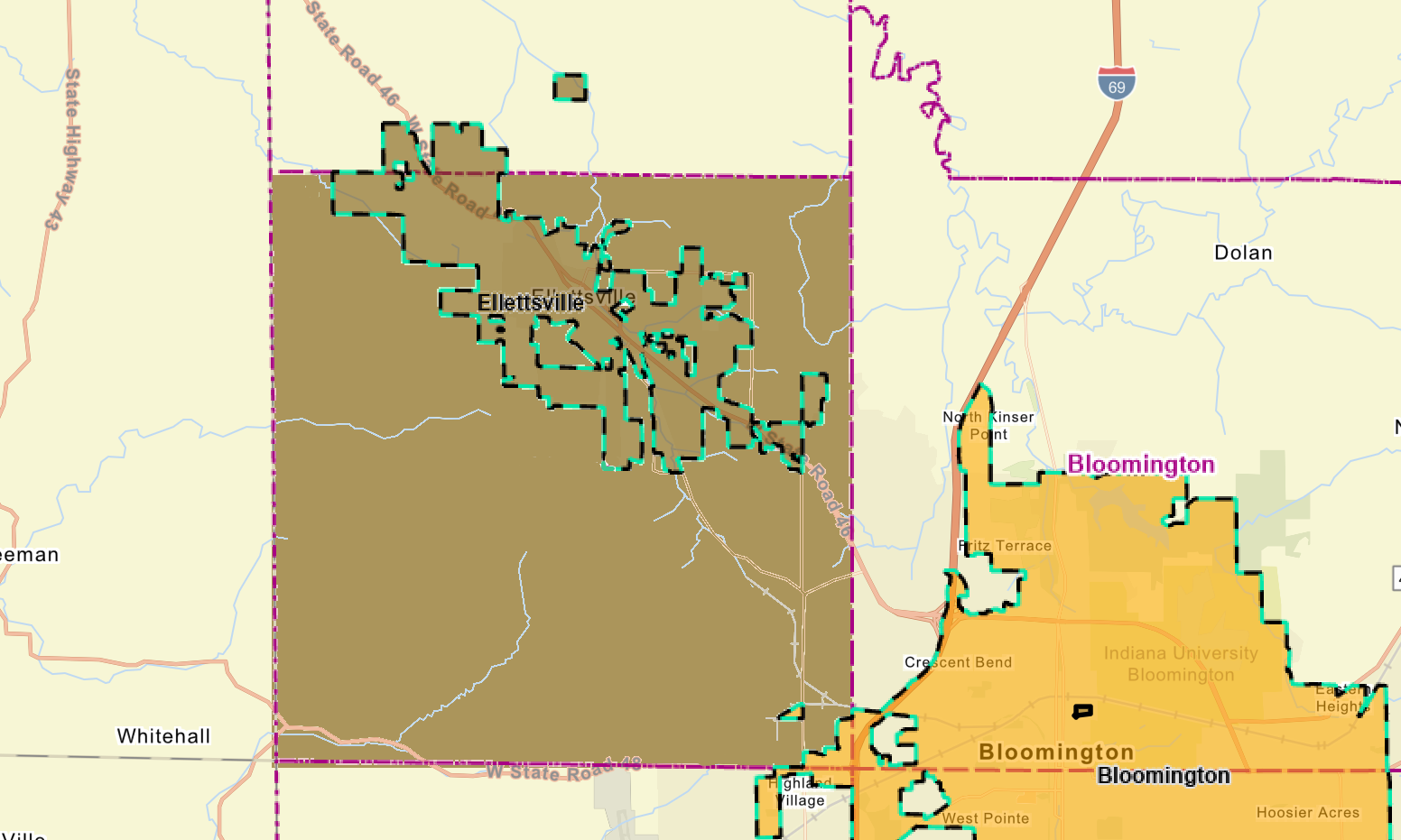
Left: B Square calculations of the impact of the Ellettsville-Richland reorganization on local income tax distributions. Right: A modified screenshot from Beacon, which is the platform Monroe County government uses for GIS mapping and parcel information. The modification was to extend the shading of Ellettsville to all of Richland Township.
Ellettsville’s successful reorganization referendum could have a big effect on other local government units.
The city of Bloomington could see more than a half-million-dollar negative impact. But the biggest financial downside to Ellettsville’s successful reorganization referendum would be felt by Monroe County’s government.
The reorganization merges the town of Ellettsville with Richland Township to form a new town of Ellettsville, effective in 2027.
Under a financial model presented to Monroe County officials in September, county government would receive about $3.93 million annually from a proposed countywide municipal-services local income tax (LIT). That’s a model that would set a municipal LIT rate at 1.049% for all residents of Monroe County, with the proceeds divided among the county’s municipalities (Bloomington, Ellettsville, and Stinesville) and the county government.
That’s in addition to a 1.2% countywide rate that the county council could set for county government alone.
But if the population of the newly reorganized town of Ellettsville is substituted into the state’s distribution formula, the county’s share would fall to zero, or $3.93 million less. Ellettsville would collect about $4.55 million more than the original model anticipated, while Bloomington would lose about $613,000.
Monroe County government would still have its full 1.2% rate available for generating revenue for county government.
But the change would remove a significant financial incentive for the Monroe County council to adopt a shared municipal-services tax rate in the first place.
The calculations are based on a model prepared by Financial Solutions Group (FSG), the county’s financial consultant. It was presented at the Sept. 18 meeting of Monroe County’s Municipal Unit Strategic Taskforce (MUST). FSG’s original model did not account for changes in municipal boundaries.
Indiana state legislature’s tax philosophy
The potential redistribution of income tax revenue is a consequence of a broader change in how Indiana lawmakers want local governments to be financed.
The shift began with Senate Enrolled Act 1 (SEA 1), adopted in 2025 as part of Gov. Mike Braun’s push to reduce property taxes. The legislation increased deductions and credits intended to lower property tax bills, especially for homeowners. The resulting reductions in property tax revenue have left cities, counties, townships, schools and other local units facing financial challenges.
But the legislation also restructured and simplified local income taxes, creating the possibility for local governments to replace at least some property tax revenue through taxes on incomes.
The basic philosophy is a shift in the burden of financing local government, away from taxes assessed on the value of real estate and toward taxes on income. It is not a complete replacement of property taxes, but it makes income taxes more important for sustaining local government services.
The overall general local income tax rate is limited to 2.9%, with additional restrictions on the individual components.
Under SEA 1, cities and larger towns got the option to impose their own municipal income tax of up to 1.2%, just on their own residents, separate from taxes for county services. The legislation also reorganized county income taxes into categories for county services, municipal services, fire and emergency medical services, and other local taxing units.
In 2026, the legislature passed House Enrolled Act 1210, which delayed implementation of the new income tax structure from 2028 to 2029. The bill also expanded the option for municipalities to participate in a shared countywide municipal-services tax, instead of imposing their own rates.
The either-or options are: the maximum 1.2% municipal services rate, which can be imposed by the county council on all county residents; and the maximum 1.2% rate that a city or town can impose on its own residents.
That difference between taxing all county residents to support cities and towns in the county and taxing only a city’s residents is important for Bloomington. That’s because the income tax base inside the Bloomington city limits is not large enough to preserve the city’s past revenues, even at the statutory maximum of 1.2%.
The legislature’s interest in moving away from property taxes might not be finished. In September, Republican legislative leaders discussed a proposal to use local income taxes to offset the entire property tax bill on owner-occupied homes. That proposal could see some action in the 2027 session of the state legislature.
How the money would be divided
The county’s financial consultant, Financial Services Group (FSG), has modeled a countywide municipal-services income tax rate of 1.049%, which would generate about $51.47 million annually. It was based on the idea that the cities and towns would be “made whole” by that rate, when their revenues from income taxes and property taxes under SEA 1 are compared to their past revenues.
Under the model, Bloomington, Ellettsville and Stinesville would all participate in the shared tax instead of imposing separate municipal income tax rates on just their own residents.
The distribution formula in state law gives participating municipalities collectively 1.5 times their share of the county’s population, up to 100% of the available revenue. The county gets what is left over.
In FSG’s original model, Monroe County government would collect about $3.93 million, or 7.6% of the municipal-services tax revenue.
But the Nov. 3 referendum that approved the reorganization of Ellettsville and Richland Township, significantly expanded the town’s boundaries and population. The town’s 2020 census population was 6,655. Richland Township’s population was 15,098.
Substituting Richland Township’s population for the original town’s population means the total municipal population for Monroe County is around 94,469. Multiplying that number by 1.5 yields 141,703, which is more than the 2020 census figure for Monroe County’s population of 139,718. That means there’s nothing left over for Monroe County government, and the total amount is split between the municipalities:
The second column in the table is The B Square’s calculation, not a revised FSG estimate.
What produces the dramatic result is a cap in the distribution formula. With the larger Ellettsville population, the combined municipal allocation would exceed 100% of the available revenue. The formula caps that allocation at 100%, with the three municipalities dividing the entire amount according to their relative populations.
That leaves nothing for the county government from the municipal-services tax. The $3.93 million loss does not mean Monroe County government would lose all its local income tax revenue. FSG separately modeled about $46.12 million for county services at a rate of 0.940%, which would be well under the county’s 1.2% maximum. That is a different component of the income tax system, unaffected by the population substitution for the distribution of the municipal services rate.
Why it matters politically
The financial implications go beyond the distribution of $51 million.
There was always a political hurdle to adopting a shared countywide municipal-services tax. Residents outside Bloomington and Ellettsville would pay the tax, even though they live outside those municipalities and receive relatively few direct municipal services.
Under FSG’s original model, at least a portion of their tax payments would come back to the county government, which provides services in the unincorporated areas.
With the reorganized Ellettsville population substituted into the formula, even that justification disappears. Residents outside the municipalities would pay the tax, but the county government would receive no direct allocation from it. That does not mean those residents could derive no indirect benefit from Bloomington or Ellettsville services. But the county government would receive no municipal-services tax revenue to spend on its own operations.
The county council would still have the legal authority to adopt such a rate. And county council members represent Bloomington residents, who would benefit substantially from the shared approach.
But from the standpoint of county government finances, the $3.93 million incentive to support the shared tax would be gone.
Does the shared rate make Ellettsville ‘more than whole’?
An important feature of FSG’s model is that the proposed 1.049% rate was calculated to meet Bloomington’s revenue target, including replacement of property tax revenue projected to be lost under SEA 1.
FSG estimated that Bloomington would need $43.74 million in municipal-services revenue to preserve its existing income tax funding and replace about $2.43 million in projected property tax losses. Under the shared-rate model, and the old population of Ellettsville, Bloomington would receive $43.75 million, almost exactly the target.
For the existing town of Ellettsville, FSG calculated a revenue target of $3.44 million, including about $256,000 in projected lost property tax revenue.
But at the 1.049% shared countwide rate, Ellettsville would receive $3.68 million, which is about $236,000 more than its target. So a tax rate chosen to make Bloomington whole would more than make the existing town of Ellettsville whole.
The disparity becomes more striking after reorganization. With the larger population substituted into the model, Ellettsville would receive about $8.23 million.
FSG did not prepare a revenue target for the newly reorganized town. But it did estimate a separate $675,027 revenue target for Richland Township under the existing governmental arrangement. Adding that amount to the existing Ellettsville target of $3.44 million produces a combined target of about $4.12 million. The projected $8.23 million municipal-services distribution for the expanded Ellettsville would be more than twice that combined figure.
Of course, that’s not a substitute for a financial plan for the reorganized town. The expanded municipality would take on responsibilities and expenses that the original town did not have, and the FSG targets measure revenue replacement, not the total cost of providing services.
Still, the comparison indicates that a shared municipal-services rate calibrated to keep Bloomington’s revenue intact would be more than sufficient to replace the income tax revenue and projected property tax losses due to SEA 1, for the existing Ellettsville and Richland Township governments.
But there’s a big new wrinkle for Bloomington caused by the passed referendum. At the original 1.049% shared municipal-services rate, Bloomington’s revised distribution, with an expanded Ellettsville, would fall about $611,000 short of the $43.74 million revenue target calculated by FSG.
To restore Bloomington to that target would require raising the shared countwide rate to roughly 1.064%, assuming the same countywide income tax base and population-based distribution formula.
At 1.064%, the countywide tax would generate about $52.21 million, compared with $51.47 million at 1.049%. Under the revised population distribution, Bloomington would receive 83.8% of that revenue, or about $43,749,984.
That would increase Ellettsville’s projected distribution to about $8.34 million.
What if Ellettsville goes it alone?
Ellettsville has another option: It could impose its own municipal income tax, at a rate of up to 1.2%, paid only by residents of the reorganized town.
How much revenue would that generate? For the existing town of Ellettsville, FSG estimated a taxable adjusted gross income base of $382.92 million, using household counts and median household income from the census, not actual taxable income data. FSG calculated that a rate of about 0.8986% would be sufficient to meet the existing town’s modeled revenue target of $3.44 million.
The expanded town would have a substantially larger population, including residents who previously lived in unincorporated Richland Township. Their taxable income would be added to Ellettsville’s municipal income tax base if the town chose to impose its own rate.
But without reliable adjusted gross income figures for the new municipal boundaries, it is not possible to calculate the revenue from a town-only tax with comparable confidence.
The question that Ellettsville leaders will be looking to answer is: Is it possible that the new town of Ellettsville could preserve existing revenue to its whole geographic area, by taxing incomes of only the new town’s residents? And if so, could it be done at a rate that is lower than the municipal services rate needed to keep Bloomington’s revenue intact?
Remaining uncertainties
The figures in FSG’s report describe a 2029 revenue scenario. That’s because collections under the new income tax structure begin in 2029, with the first distributions beginning in 2030.
But legislators could change the law in their 2027 session before any of those distributions occur.
Those uncertainties help explain why Monroe County’s MUST declined to recommend specific rates when it met on Oct. 23.
The four-member panel, which includes representatives of Bloomington, Ellettsville, Stinesville and Monroe County, unanimously adopted a statement requesting greater flexibility from the state legislature. The statement specifically asked for clearer rules governing government reorganizations and annexations, as well as adjusted gross income data for all taxing units.
The task force concluded that it did not have enough information to recommend rates for 2029.
That conclusion reflects a significant challenge that local governments across the state will face, given the legislature’s approach. Cutting property taxes, and shifting greater responsibility for financing local government to income taxes, just creates a new set of choices. Those choices affect which residents pay what tax, which governments collect it, and who benefits from the resulting revenue.


Comments ()