
MCCSC moves toward redistricting talks, board president calls change ‘inevitable’
MCCSC will schedule a work session to set parameters for possible redrawing of attendance boundaries, reorganization or restructuring. Board president Erin Cooperman called some kind of change “inevitable,” citing declining enrollment, unused building space and financial pressures.
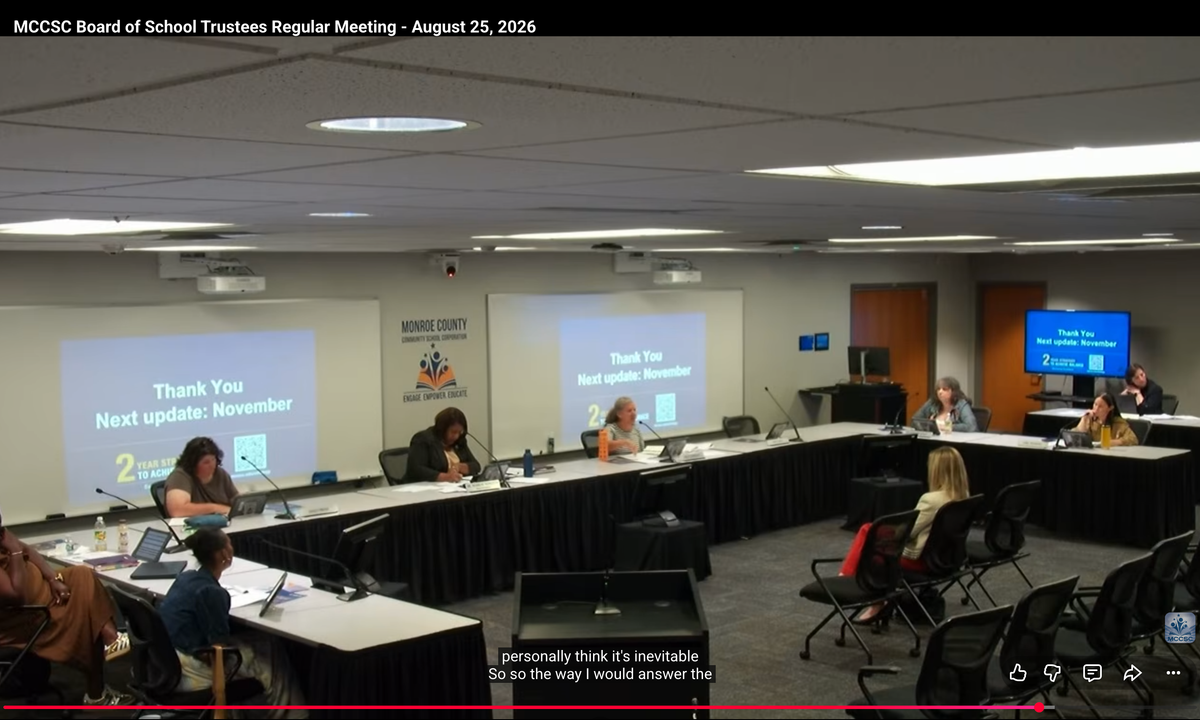
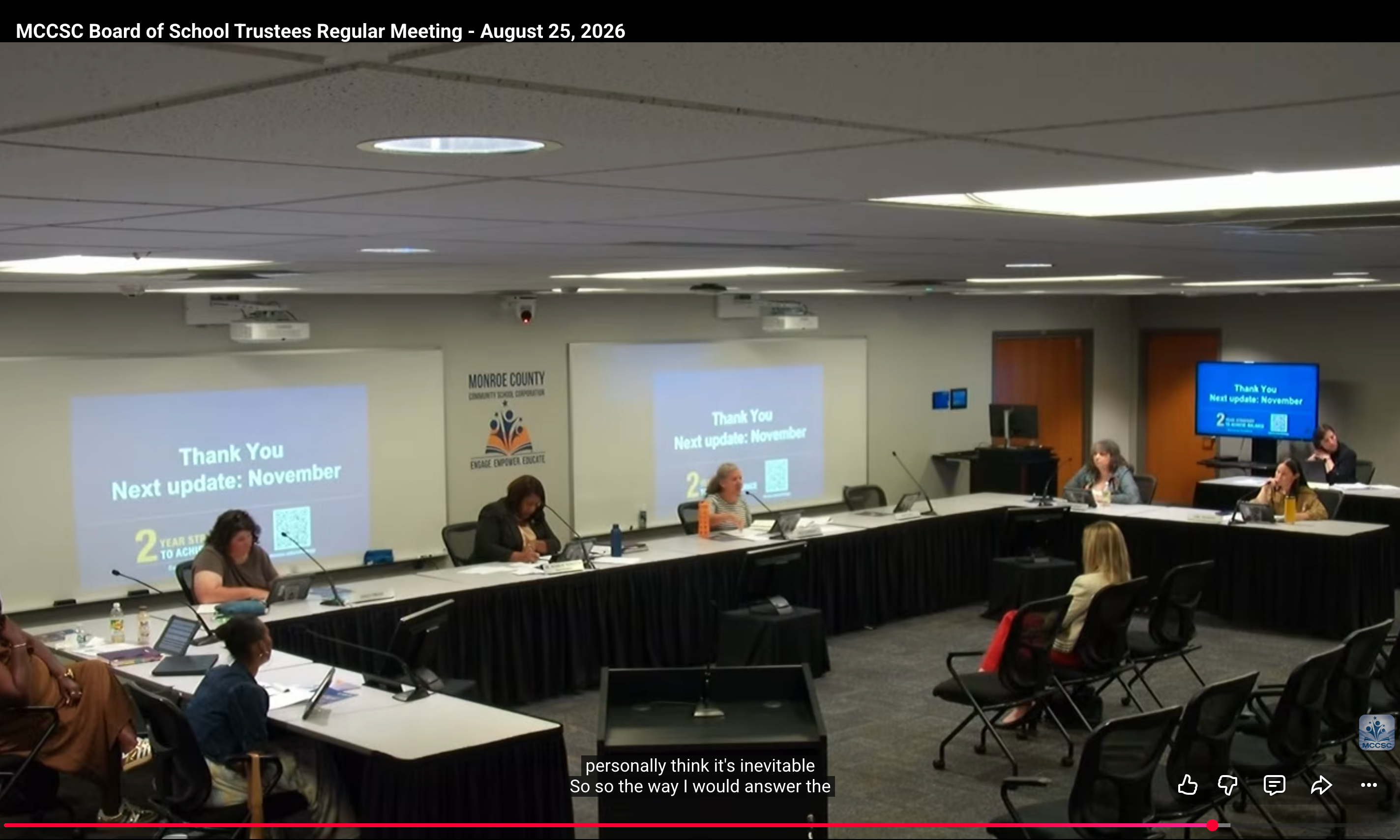
The Monroe County Community School Corporation (MCCSC) board will schedule a work session devoted to setting the parameters it would use to evaluate a possible redrawing of attendance boundaries, school reorganization or other restructuring.
The work session will give the seven-member board a chance to decide what would count as an acceptable outcome for such factors as socioeconomic balance, building utilization, cost savings, transportation, the number of students reassigned, and preservation of neighborhood schools.
No date for the work session was set at Tuesday’s (Aug. 25) regular board meeting. The board did not choose a redistricting map or direct the administration to develop one.
But the discussion ended with broad agreement among the board members who were present that the district should keep moving toward possible changes.
Board president Erin Cooperman went further, saying some kind of change is unavoidable. “My position is that some kind of redistricting, reorganization, or restructuring is inevitable,” Cooperman said. Even if socioeconomic balance were taken out of the equation and cost effectiveness were the only criterion, she said, declining enrollment and the amount of unused space in MCCSC buildings would still force the issue.
Cooperman said the district’s current building utilization rate is 69%, compared with an 85% industry standard used in the district’s redistricting study.
“Even if we were only talking about redistricting, reorganization and restructuring to adjust for declining enrollment and financial realities, I personally think it’s inevitable,” Cooperman said.
The 85% figure comes from the 28-page final report of MCCSC’s Redistricting Study Commission. For purposes of the study, a building’s capacity was calculated from the number of usable classrooms, with reserved spaces for activities like art and music. A rate of 85% utilization was identified as the target.
The demographic picture underlying the discussion also points toward fewer students. The redistricting report summarizes a demographic and enrollment study that MCCSC commissioned by Business Information Services in 2024. It projects district enrollment will decline by 3% to 5% over the next decade. Among the factors cited are a 24% decline in local birth rates since 2008, an aging population, fewer young families and increased enrollment in private and charter schools.
Parameters before maps
Tuesday’s discussion was the first extended conversation by the board about the findings of the 92-member Redistricting Study Commission, which met nine times from April through December 2025 and examined about 50 possible attendance-zone scenarios.
None of those scenarios was recommended to the board. Instead, the commission tried to determine what could and could not be accomplished through redistricting and the tradeoffs that would come with it.
One of the commission’s main conclusions was that MCCSC had not yet established clear enough targets to judge whether a particular map is successful.
The commission found that redistricting could improve socioeconomic balance among elementary schools. But it could not say how much improvement would be enough, because the board had never set a maximum acceptable gap among schools.
The commission reached essentially the same conclusion about cost effectiveness: It could not determine whether a scenario saved enough money without first knowing how much savings the board would consider meaningful.
So the final report’s recommendations gave the board some future work, which includes establishing the rationale for redistricting, defining “parameters and non-negotiables,” and deciding on desired outcomes. The report gives as examples a maximum socioeconomic-status gap among elementary schools, a fiscal-savings target, rules for drawing new attendance zones, and a maximum percentage of students who would be reassigned.
Those recommendations became the practical focus of Tuesday’s discussion.
Board member April Hennessey said there was not much the administration could do next until the board makes those choices. “I think … there’s not a lot that we can task the administration with until we begin to define those parameters,” Hennessey said.
One possible parameter, she said, would be how large a socioeconomic gap the board would tolerate between the district’s elementary schools. Current free-and-reduced-price meal figures show a 47-percentage-point spread between the schools with the highest and lowest rates, she said.
Hennessey cautioned that those meal figures do not tell the whole story about socioeconomic status. Other board members likewise asked the administration for more demographic information before the next phase of the work.
Cooperman said she had tried on her own to turn the broad considerations in the commission report into measurable criteria. Her draft list of criteria includes transportation time, cost savings and building utilization. “I do think that we have enough to start setting those parameters and metrics as a board now,” she said.
Cooperman also suggested extending the discussion beyond the term “redistricting.” That would let the board consider structural changes that the commission did not study, including school mergers or moving sixth grade from elementary schools to middle schools.
The commission did study scenarios involving closure of one or more elementary schools. Its report found that such scenarios could improve socioeconomic balance while keeping the remaining schools at or below the 85% utilization benchmark.
Board members point to tradeoffs
Hennessey said the district’s current attendance boundaries should not be treated as a neutral default simply because changing them would be controversial. “It is not a neutral position to say we’re just not going to redistrict,” she said.
Hennessey said socioeconomic balance remains important, but the district’s financial position and the utilization of its buildings now also have to be part of the discussion. “I think the facilities master plan is going to be immensely important to these conversations,” she said.
Board member Aja Jester said she wants the board to pay particular attention to unintended consequences for students who depend on school transportation. Moving a student to a different school could affect not just the bus trip to and from school, she said, but access to tutoring and before- and after-school activities.
Jester said she wants to see “some very specific maps” along with details about their impacts, including effects the board might not yet be considering.
Board member Erin Wyatt likewise said the district needs to be cautious about transportation, after-school supports and other consequences of moving students farther from their current schools. But Wyatt said the demographic outlook means the district will have to confront the boundary question in some form. “No matter what the reason, we’re going to have to look at redistricting,” Wyatt said.
The challenge for the board, Wyatt said, is that it has “yet to define clear parameters and what our non-negotiables are.”
Board member Tiana Iruoje said she had gone back and forth on redistricting. She described herself as a supporter of neighborhood schools, but said the research she has read and the discussion she has heard have moved her toward supporting redistricting. “I’m more for redistricting than I was before,” Iruoje said. “I think it’s more benefit than not.”
Iruoje also said the parameters need to account for what happens after boundaries are changed. She pointed to the possibility that families could use the district’s transfer system to avoid new assignments, undermining whatever objective the redistricting was intended to achieve.
Board member Ashley Pirani said the board should also look beyond free-and-reduced-price meal percentages to the racial demographics of each school, students receiving special services, special programs that draw students from outside a school’s attendance zone, and transfer patterns. Superintendent Markay Winston said the administration would work providing the additional data.
Pirani also said Bloomington’s history of racial housing restrictions and redlining needs to be considered if the district begins drawing new maps. Current residential patterns cannot be separated from that history, she said.
Facilities plan intersects with redistricting
The redistricting discussion came later in the same meeting where trustees approved separate agreements with CSO Architects and The Skillman Corporation for work on a new 10-year facilities master plan.
Winston said that plan will examine building condition, capacity and utilization along with enrollment and demographic trends. She said those factors will help determine what MCCSC’s physical footprint should look like in the future.
“It is certainly important to note that a facilities master plan process can be very instrumental in helping to inform good decision making as it relates to redistricting,” Winston said.
That relationship is also spelled out in MCCSC’s request for proposals for the facilities work. The document calls for a 10-year plan aligned with enrollment and budget constraints, including “redistricting modeling support (if needed)” and standardized studies of building capacity and utilization.
Winston told the board that the district has been monitoring declining kindergarten enrollment and low local birth rates and will need to use those trends in deciding what facilities MCCSC needs one, five and 10 years from now.
Next up: Work session
The board had originally intended to begin its substantive discussion of the commission report in July. In June, Cooperman said she wanted trustees to discuss the report in enough detail to give some direction to the leadership team at the end of that meeting.
That discussion was postponed because Wyatt and Iruoje were absent from the July meeting. Cooperman told The B Square at the time that she wanted all board members to have a chance to participate.
Tuesday’s discussion did not produce the parameters themselves. Instead, Hennessey suggested a dedicated work session with the whole board. “I’m less interested in a resolution at this moment and more interested in just getting together to sort of hammer out some of those things to see where we land,” she said.
Cooperman asked whether any board member objected to having Winston organize the session. Hearing none, she asked the superintendent to schedule it.
Winston then summarized the assignment: “You would like me to organize a work session to establish parameters that would allow us to examine redistricting, reorganization, and/or restructuring.”
From the public mic earlier in the meeting, Linnea Emigh, Cynthia Port and Amy Jackson took turns reading aloud a statement from former MCCSC board member Jacinda Townsend. In the statement Townsend urged MCCSC to pursue socioeconomic integration as it considers redistricting. She wrote that school assignment policies can themselves help shape residential segregation and urged the board not to treat existing patterns as a reason to avoid action.
“As someone who was the only Black kid in her school for two years, I’m going to tell you that I don’t remember at this point whose birthday party I went to. What I remember is that I got the same good education as other children,” Townsend wrote.


Comments ()