
Two hotel-and-apartment proposals submitted for Bloomington’s College Square
Two development teams have proposed hotel-and-housing projects for Bloomington’s College Square property. One calls for a roughly 160-room hotel with below-market-rate housing; the other includes a 135-room boutique hotel and about 100 apartments. No purchase prices were disclosed by the RDC Monday.

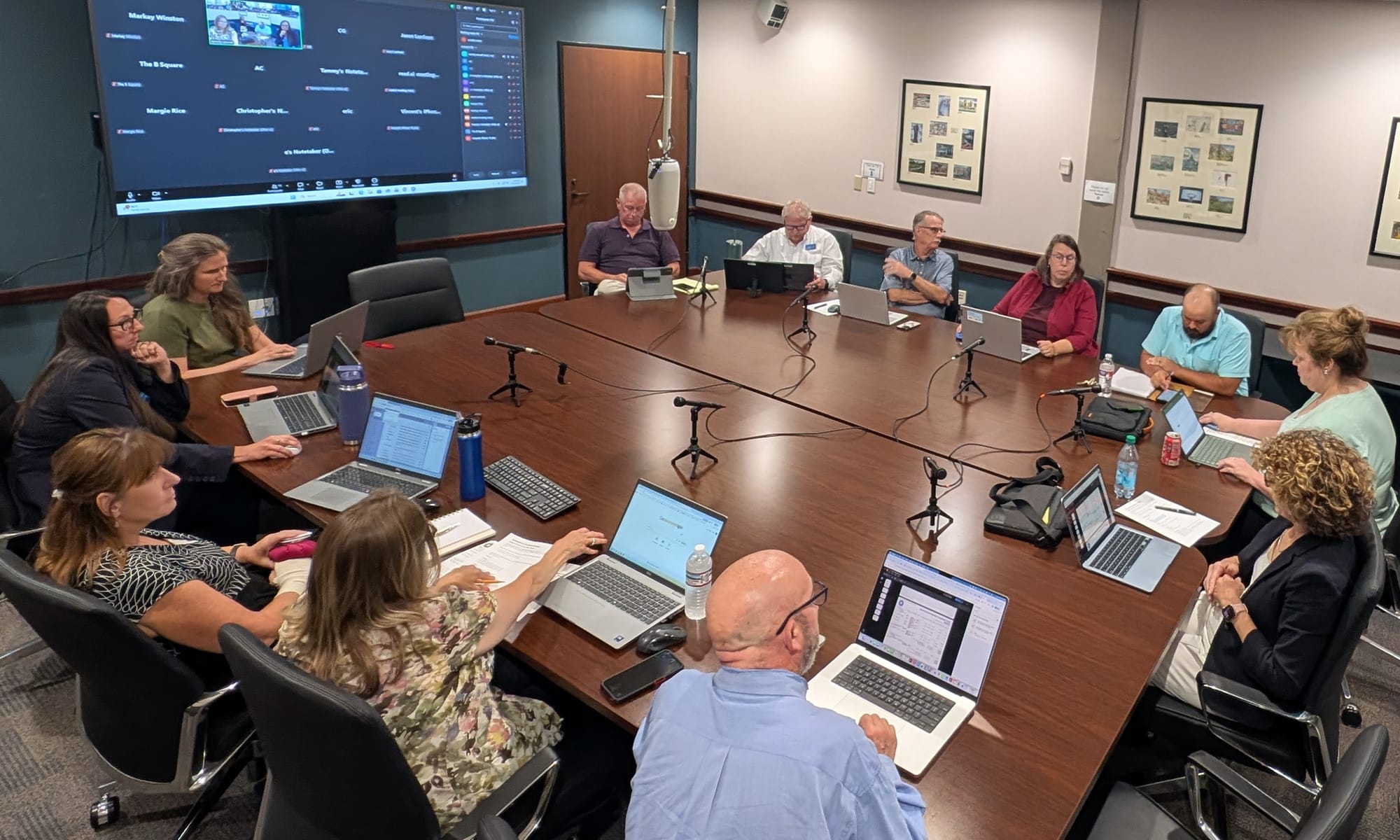
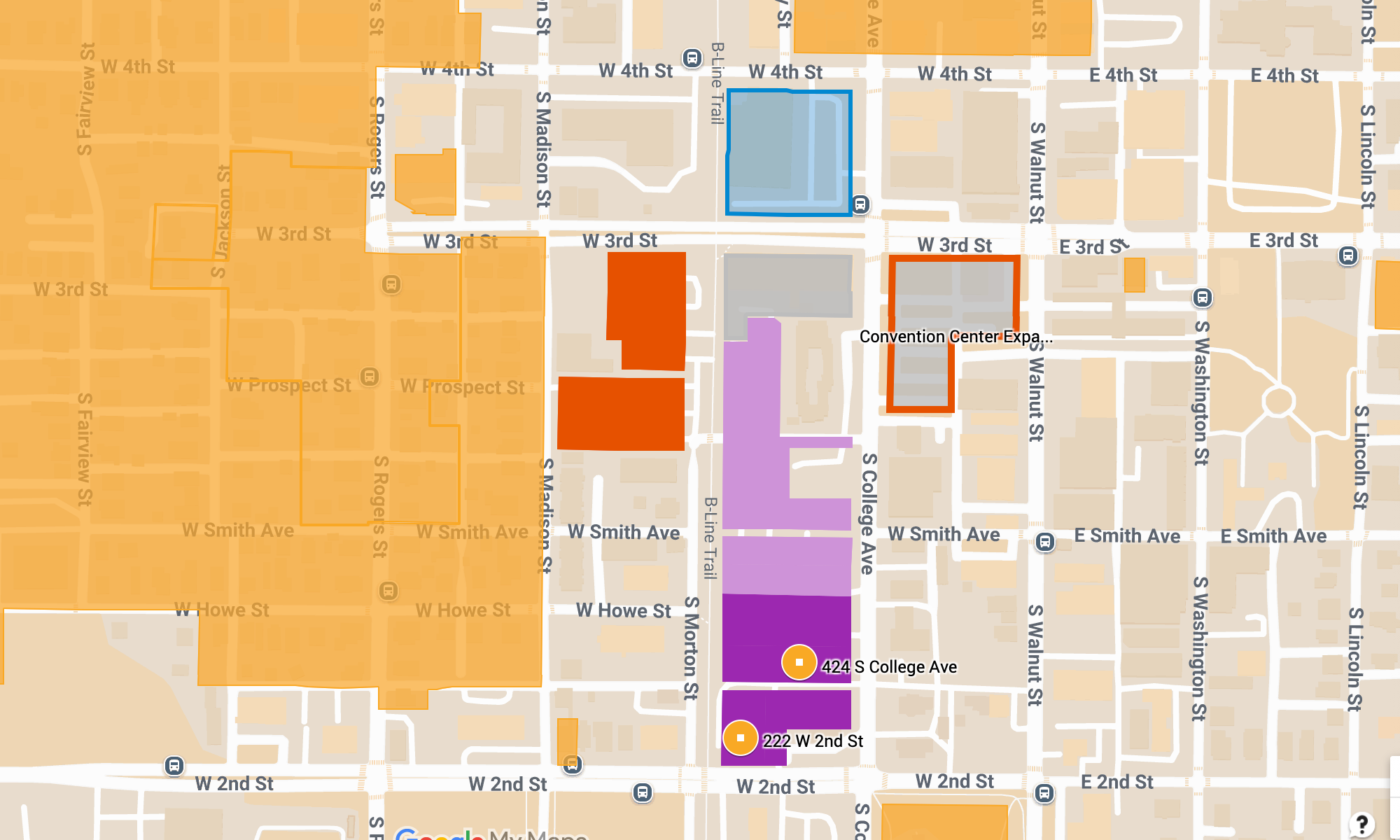
Left: The Bloomington RDC meets in the McCloskey Room in city hall. From the far corner clockwise: RDC member Randy Cassady; assistant city attorney Dana Kerr; and RDC members John West, Deborah Myerson, Sam Fleener (non-voting), Sue Sgambelluri, and Laurie McRobbie. Others at the table are city staff. Right: Land shaded with purple was transferred by either the city or the county government to the Monroe County capital improvement board (CIB) to support the convention center expansion project. The gray area bordered in orange is the site of the convention center expansion. It’s the dark purple area that the CIB had once targeted for a possible land swap for the blue square to the north, which is the College Square property, formerly owned by Bunger & Robertson. The dark yellow areas are historic districts. The 424 S. College and 222 W 2nd St addresses, indicated with placemarks inside the dark purple area, are listed as "contributing" in the city’s 2018 survey. Map by the B Square [dynamic map]
Two development teams have submitted competing proposals to buy and redevelop Bloomington’s downtown College Square property, with each envisioning a combination of a hotel and apartments.
One group proposed a roughly 160-room, full-service hotel paired with housing that would include below-market-rate units. That’s a proposal from a four-member team, made up of Concord Hospitality, TWG Development, RATIO Design, and Shiel Sexton.
The other group proposed a 135-room boutique hotel, about 100 market-rate apartments and a landscaped pedestrian passage through the block. That’s a proposal from Dora Hospitality and The Louderback Group.
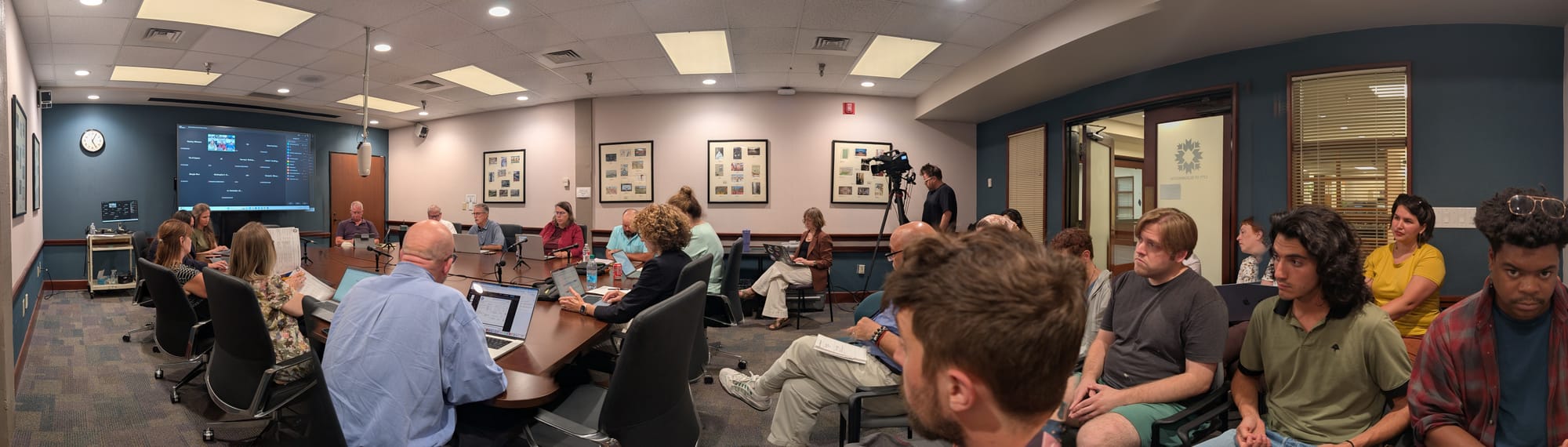
The submissions for the RDC’s public offering were opened Monday (July 20) at the regular meeting of Bloomington’s redevelopment commission (RDC).
The names involved for both proposals will be familiar. The Dora and Louderback group was selected last week as the Monroe County capital improvement board’s (CIB’s) preferred developer for construction of a host hotel on property south of the existing convention center. The added host hotel capacity is part of the plan for the convention center expansion, which is currently well underway.
Concord Hospitality made one of the four other responses to the CIB’s request for proposals, besides Dora/Louderback, to develop a host hotel on property south of the existing convention center. Another point of familiarity comes from the architectural firm that is a part of Concord’s team: RATIO Design now includes Adam Thies, who is a former member of the CIB.
RDC executive director Anna Killion-Hanson started the bid-opening proceedings at 5:16 p.m. during the RDC regular meeting on Monday (July 20). She worked from her laptop computer to open the digital folders, not from physical bid envelopes.
Killion-Hanson said, “We haven’t analyzed these. I don’t have any other details. Those are the summaries.”
No purchase-price figure was announced for either proposal. That left unanswered a key question: Does either offer meet the RDC’s minimum price of $7.59 million?
Killion-Hanson told The B Square after Monday’s meeting that she hopes the details and analysis of the proposals can be presented at the next regular meeting of the RDC on Aug. 3.
Concord, TWG team: 160-room hotel and housing
The first proposal came from a four-member team consisting of Concord Hospitality, TWG Development, RATIO Design and Shiel Sexton.
The proposal describes a two-part development strategy, according to the summary that Killion-Hanson read aloud. One component would be a hotel of approximately 160 rooms, with full-service amenities and features intended to meet the needs described in the RDC’s offering document and to support convention center activity.
The other component would be a complementary residential development intended to add activity to the property outside the periods when conventions and other events are taking place.
As Killion-Hanson read the summary, it referred to replacing affordable, below-market-rate housing units. The brief description did not say what existing units would be replaced, how many total apartments would be built, how many, if any, would have income-restricted rents or what income levels would qualify for those units.
The summary also did not include a hotel brand, proposed building heights, parking arrangements, construction schedule, financing structure or purchase price.
The team brings together companies with different specialties. Raleigh, North Carolina-based Concord Hospitality develops, owns and operates hotels, including full-service and upscale properties. Indianapolis-based TWG develops and manages market-rate, affordable and senior housing. RATIO is an Indianapolis-based architecture and urban-design firm, and Shiel Sexton is an Indianapolis commercial construction company.
The summary did not say whether the proposed 160-room hotel was intended to become the convention center’s official host hotel. Under the College Square offering, any proposal that includes the convention center host hotel must separately receive approval from the Monroe County CIB.
Dora proposal: Boutique hotel, market-rate apartments
The second submission came from Dora Hospitality and The Louderback Group.
Their proposal divides the College Square block into two basic developments. A 135-room “boutique upscale” hotel would be constructed on the southern portion of the property along 3rd Street. An apartment development with about 100 market-rate units would be constructed on the northern part of the property along 4th Street.
A landscaped promenade would run through the interior of the block, connecting the two developments. The promenade would serve as a shared gathering space in the center of the site and draw pedestrians from College Avenue west toward the B-Line Trail, according to the summary.
As with the first proposal, the description read aloud by Killion-Hanson on Monday did not identify a hotel brand, building heights, parking plan, construction schedule, financing terms or proposed purchase price.
Dora Hospitality is a third-generation Indiana company that develops, owns and manages hotels. The Louderback Group is a hotel-development and consulting firm founded by Russell Louderback. Dora says Louderback has been involved in the development of more than 140 hotels, including convention headquarters hotels and mixed-use projects.
The College Square submission is separate from the convention center host-hotel project for which the CIB selected Dora and Louderback five days earlier. The CIB’s July 15 decision calls for the team to negotiate an agreement for an approximately 200-room hotel on property south of the convention center. That southern hotel is expected to include a restaurant, rooftop bar, meeting space, parking and other amenities.
Louderback confirmed to The B Square after Monday’s RDC meeting that the intent is to develop both hotels—a host hotel on the property south of the existing convention center, and a boutique hotel north of it. The two hotels would complement each other, Louderback indicated.
No prices disclosed
The College Square public offering established a minimum purchase price of $7.59 million—the average of two independent appraisals commissioned by the RDC.
Killion-Hanson did not announce a dollar offer from either team. So it not clear from Monday’s bid opening whether both proposals included offers of at least $7.59 million, and whether their financial terms relied partly on other property or incentives.
Indiana state law requires a redevelopment commission to obtain two appraisals before publicly offering real estate. The initial offering price cannot be lower than the average of those appraisals.
The law also says that, for 30 days after written offers are opened, the commission cannot sell the property for less than the amount shown on the offering sheet. After those 30 days, the RDC is allowed to adjust the offering price if it determines that doing so would advance the city’s redevelopment plan.
That provision is not a requirement that the RDC accept one of the proposals within 30 days. It is a 30-day restriction against selling for less than the original offering price.
The same law allows the commission to reject all bids or select the “highest and best” proposal. In determining what constitutes the best proposal, the RDC is allowed to consider the nature and size of the proposed improvements, the developer’s ability to proceed promptly, proposed rents or sale prices and broader effects on the community’s economic and human welfare.
The College Square offering adds criteria including design quality, financial feasibility, developer experience, economic impact, workforce strategy and the proposed uses of the property. Price is one factor, but is not the sole basis for a selection.
State law also requires the submitted offers to be accessible to the public: “All offers received shall be opened at public meetings of the commission, and shall be kept open for public inspection.” The B Square has made a formal records request for copies of the proposals that were opened on Monday. [Added July 21, 2026 at 3:15 p.m link to Concord et al proposal] [Added July 21, 2026 at 5:14 p.m. link to Dora Hospitality proposal]
After Killion-Hanson finished reading the summaries, the commission proceeded directly to the next item on its agenda.
Several housing advocates who attended Monday’s meeting expressed disappointment that the RDC did not allow public comment on the two proposals. Some of the RDC members individually spoke with advocates after the meeting.
Two years of hotel and land negotiations
Monday’s opening came against the backdrop of a two-year effort to pair the Bloomington Convention Center expansion with a full-service host hotel. That effort eventually became entangled with the future of two pieces of downtown real estate: College Square, north of the convention center, and Seminary Pointe, to the south.
Construction is well underway on the roughly 60,000-square-foot convention center expansion, part of an overall project budgeted at about $70.7 million. It is planned for completion around the start of 2027, with renovations to the existing convention facility to follow. The host hotel is being pursued as a separate development.
College Square is the roughly two-acre former Bunger & Robertson property along College Avenue between Third and Fourth streets. The RDC acquired the property in two transactions totaling about $7 million. It includes a vacant office building and surface parking, with the B-Line Trail running along its western edge.
Its proximity to the convention center and courthouse square long made College Square a leading candidate for the host hotel.
In October 2024, the CIB selected Dora Hospitality over two competitors as its preferred hotel developer.
Dora then began negotiating with the RDC on acquiring College Square. But more than a year of talks failed to produce an agreement over the land and the public subsidy Dora said was needed to make the hotel financially feasible.
In February 2026, the CIB ended that first effort after concluding that it did not control the real estate needed for Dora’s alternative proposal south of the convention center.
The CIB then obtained control of city- and county-owned properties south of the convention center, including Seminary Pointe. The county had purchased Seminary Pointe in 2010 with about $3.2 million in innkeeper’s-tax revenue. In CIB issued a new request for hotel proposals centered on those southern properties.
Before issuing that RFP, the CIB proposed exchanging Seminary Pointe for College Square. Under that scenario, the CIB would use College Square for the host hotel, while Seminary Pointe could be transferred to a mission-oriented owner and preserved for affordable housing and commercial uses.
Seminary Pointe includes 29 low-rent apartments and businesses including Friendly Beasts Cidery, My Sister’s Closet, Blue Tip Billiards and Jeff’s Warehouse. Housing advocates proposed eventual ownership by Avalon Community Land Trust, with the property operated under a cooperative model.
The RDC declined the CIB’s request to pause the College Square offering for 30 days while the two bodies negotiated. On April 20, the RDC approved the public offering with its $7.59 million minimum and set July 20 as the submission deadline.
The offering sought what the RDC called a “transformative, mixed-use” development. It allowed the commission to consider design, economic impact, financing, developer capacity and proposed uses, rather than automatically choosing the highest monetary offer. Proposals centered on undergraduate student housing, particularly bedroom-by-bedroom rental projects, would not be considered.
Support for a land exchange increased while the offering was open. On June 3, Bloomington’s city council voted 8–0 to support an exchange even if the two properties were not equal in monetary value, reasoning that preserving affordable housing and community-oriented businesses would provide a public benefit.
At least 60 people rallied at city hall on July 6 to urge the RDC and CIB to negotiate.
An appraisal obtained by the CIB valued its four Seminary Pointe parcels at $7 million—close to the College Square minimum. Five city councilmembers cited that appraisal in a July 10 letter urging an exchange.
But the schedules of the CIB and RDC did not align. On July 8, the CIB heard competing proposals from Dora and MHG Hotels for a host hotel of at least 200 rooms on the southern land.
Mayor Kerry Thomson asked the CIB on July 14 to delay its selection for six days, until after the College Square offering closed.
The CIB did not wait. On July 15, it unanimously selected Dora to negotiate a definitive agreement for the hotel south of the convention center. CIB members said Dora’s preference for the southern location removed their practical need to acquire College Square through a land exchange.
That left Monday’s RDC meeting as the moment when the commission learned what the market had produced for College Square: Two proposals, both for a hotel-and-housing combination.
Comments ()