
Dora, MHG pitch host hotel plans for Bloomington convention center, land-swap question lingers
Dora Hospitality and MHG Hotels pitched competing plans Wednesday for a convention center host hotel, differing sharply on parking and financing. The CIB is expected to weigh the proposals July 15 as a possible land swap for the preferred College Square site remains unresolved.
Monroe County’s capital improvement board (CIB) on Wednesday (July 8) heard two competing proposals to build the convention center host hotel.
They both checked the basic boxes laid out in the CIB’s request for proposals: at least 200 rooms; a nationally recognized hotel brand; integrated meeting space to support the expanded convention center; and a schedule that gets the hotel open as soon as possible.
Both hoteliers, MHG Hotels and Dora Hospitality, gave sometime in 2029 as a projected opening date.
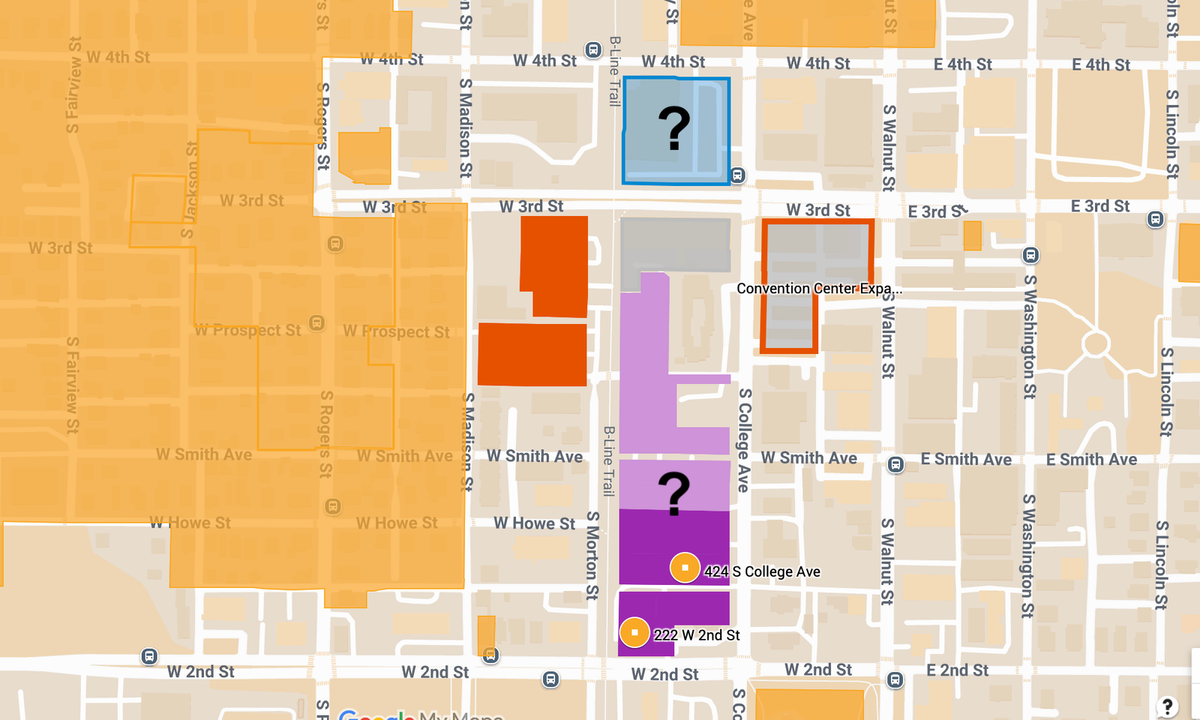
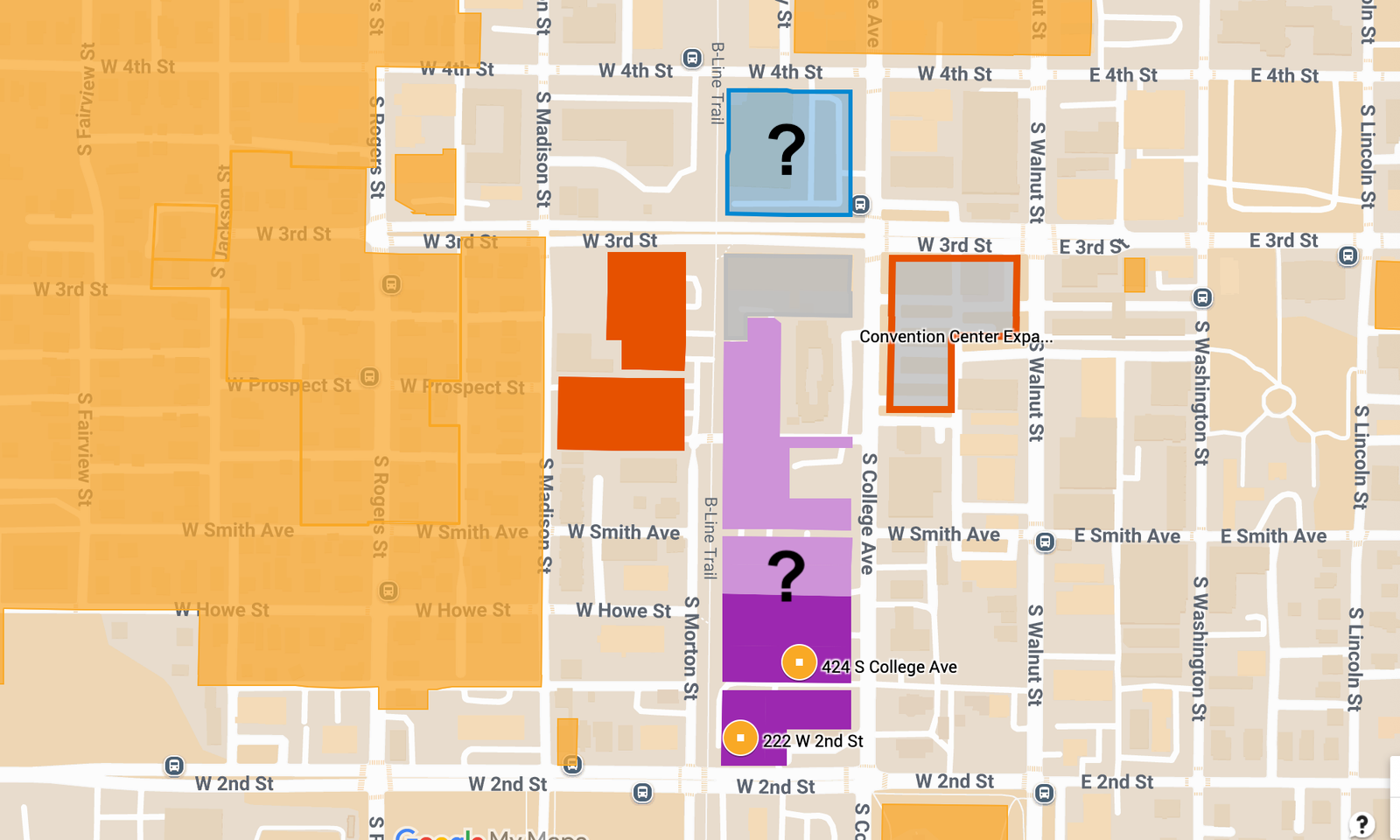
Where the proposals differ significantly is in how they handle parking and how they plan to finance construction. The proposals centered on CIB‑controlled land south of the convention center along College Avenue, which includes the Seminary Pointe block.
The presentations were given against the backdrop of the possibility of a land-swap deal between the CIB and Bloomington’s redevelopment commission (RDC) that would trade the Seminary Pointe block for the College Square lot at the southwest corner of 4th Street and College Avenue, just north of the existing convention center. The College Square lot is a vacant building and parking lot, which is by wide consensus a better location for a host hotel than Seminary Pointe.
A rally by housing advocates on Monday (July 6) in support of the land swap was preceded by a press release from Bloomington mayor Kerry Thomson that essentially called on the CIB to submit a proposal to the Bloomington RDC in the context of the RDC’s public offering for the College Square lot, which closes July 20. Offers are due to be opened at the RDC regular meeting set for that day.
Behind the scenes on Monday, city of Bloomington lawyers had urged the CIB in an email message to submit a land swap proposal through the RDC’s public offering. The emailed reply from the CIB’s attorney pointed to July 15 as the next regular meeting of the CIB, when any formal response could be expected. But it also included an update on the CIB’s progress to date on preparing the Seminary Pointe block for a hotel development.
That update from the CIB relayed what could be considered the news of the day: One of the appraisals the CIB had received for the real estate came it at $7 million, which is within about a half-million dollars of the minimum price the RDC had put in its public offering, which was $7.59 million.
The second of the two appraisals is not mentioned. But the $7 million figure is substantially more than what many observers assumed to be the value of the real estate. The perceived mismatch between the value of the two parcels had been one obstacle to a land swap.
Dora Hospitality
Dora Hospitality proposed a single, soft‑brand, full‑service hotel, possibly under a Marriott Tribute or Hilton Tapestry flag. The entrance would be on College Avenue, with a second public face on the B‑Line Trail.
Architect David Rausch, with Luminaut, showed a detailed massing that steps down toward Smith Avenue, he described as picking up the rhythm of the convention center’s College façade, and lines the B-Line with meeting rooms, wellness space, and a pool to activate the trail. The building program includes about 200 rooms, a full‑service restaurant on the ground floor, a rooftop bar oriented toward the convention center, and around 6,000 square feet of meeting space.
Parking is a key part of Dora’s pitch and a major cost driver. The concept relies on roughly 200 spaces built into the site. About 175 of the spaces would be built in a single level of below‑grade parking plus additional stalls at grade on the south side, using the site’s natural slope to reduce excavation of solid rock. Rausch and partner Russ Lauterbach told the CIB the current parking stall count is partly a zoning placeholder, but said they are not eager to reduce it by a lot, pointing out that a drive‑to convention market needs close, dedicated parking to keep group business and repeat guests.
On financing, principal Vince Dora described a private joint‑venture structure in which he and Lauterbach recruit equity partners they already work with, including Bloomington‑connected investors. The project is expected to cost on the order of $70–75 million, or roughly $375,000 per room. Dora said both he and Lauterbach are already in conversations with national lenders, but that term sheets will only materialize once the CIB selects a developer and settles on the site.
Dora framed the design as deliberately efficient as a way to make the numbers work. Dora also acknowledged what he sees as the main structural drawback: Guests will still have to walk outdoors between the hotel and convention center, a sales challenge in winter that they would have to manage in how they package convention business.
MHG Hotels
The proposal from MHG Hotels was for an Embassy Suites‑style Hilton or similar Marriott flag, with around 200 to 250 rooms and roughly 15,000 square feet of meeting space, plus a full‑service restaurant, lobby bar, and rooftop bar. Where Dora arrived with a sketched-out site plan, MHG’s approach was mostly descriptive.
On parking, MHG leaned harder into cost and feasibility concerns. Managing director Hunter Carmichael called parking “probably the largest challenge” for a 200‑room hotel with significant meeting space. Carmichael pointed to the already stressed 4th Street garage as evidence that large events cannot simply be dumped into existing structures.
Owner Neil Patel cited current costs of roughly $15,000 per stall, and warned that a 200‑plus‑space garage adds “millions and millions of dollars” to the project. MHG’s preference, they said, is to avoid building a full garage on the hotel footprint and instead use or acquire nearby surface parking, with valet or self‑park operations. They gave a hotel in Fort Lauderdale, with seven levels of structured parking, as evidence they can deliver integrated structured parking, if required.
Dora vs. MHG
The sharpest contrast between the two proposals was in the financing and ownership. Sanjay Patel told the CIB that MHG Hotels will not seek outside investors and that the company is “100% owned” by him, with typical projects in the $55–60 million range financed with 20–30% equity and the balance from Indiana‑based lenders MHG already uses. He promised proof of funds and bank contacts, if selected. Patel cast that single‑owner model against “pie in the sky” RFP responses that depend on assembling dozens of investors after they win a bid .
Both teams promised a true full‑service operation tailored to convention center business, but they framed “full service” differently. Dora leaned on the flexibility of a soft brand and access to a major loyalty and reservation system without a rigid prototype. They also stressed a design that physically and visually ties the hotel to the convention center and the B‑Line.
MHG leaned on the Embassy‑style model and its existing Bloomington portfolio, arguing that suites, branded breakfast and evening offerings, and an integrated cluster of three local hotels give them a built‑in base of institutional and IU‑related customers to feed the convention center.
Vice president of MHG’s operations, Kattie Killion said that the company knows how to deliver the kind of stay in Bloomington that results in repeat business. MHG’s two Bloomington properties are Home2 Suites by Hilton and Homewood Suites by Hilton. Killion described MHG’s current properties in Bloomington: “We have alumni and guests that come back and stay there and prefer that hotel over the Graduate or the Hilton Garden Inn or any other hotel. And that’s because we know how to operate a hotel.”
The CIB’s evaluation group is expected to sort through those contrasts between the two proposals before making a recommendation to the full board on July 15.
The evaluation group includes: CIB members Jay Baer, Doug Bruce and John Whikehart; Mike Campbell of the Convention and Visitors Commission; and Mike McAfee of Visit Bloomington. Supporting the group are: CIB attorney Jim Whitlatch; CIB controller Jeff Underwood; Jason Larrison and Mary Krupinski of JS Held, which is the CIB owner’s representative, and subcontractor to JS Held, Adam Gelter, a hotel expert.
What happens on July 15 at the CIB meeting might not be a final selection of a hotelier by the CIB.
The July 6 email from the city attorneys for the RDC on Monday urged the CIB to hold a decision in abeyance until July 20, when the RDC’s public offering closes.
That scenario is described like this: “CIB evaluates their offers on July 15th and determines that none of the bids are better than College Square. They keep the bids under consideration, let the world know that College Square remains their first choice, and pause.”
Historical background
The two companies who pitched proposals on Wednesday are familiar to the CIB. Dora and MHG were two of the three hotel developers that sought the job in the first round of competition nearly two years ago.
In September 2024, the CIB heard presentations from Dora, MHG and Garfield Public/Private. The request for proposals back then called for an upscale hotel with at least 200 rooms, at least 10,000 square feet of meeting space and amenities that included a restaurant, lounge and fitness center. The developer was also expected to work with the convention center on room blocks and convention bookings.
Of the three companies, Dora was the only one that presented a concept tied to a specific piece of real estate. Its preferred location was the former Bunger & Robertson property at Fourth Street and College Avenue, north of the existing convention center. The property, now known as College Square, is owned by Bloomington’s redevelopment commission (RDC).
In October 2024, the CIB chose Dora over MHG and Garfield as its preferred hotel developer. The selection set in motion negotiations between Dora and the RDC over College Square, which the city’s RDC had acquired in two transactions for a total of about $7 million.
The hotel project began to fall well behind the convention center expansion itself. By October 2025, with no College Square deal in place, the CIB gave Dora and the RDC 60 days to show concrete progress. By then, construction of the convention center expansion was well underway, while a hotel was still expected to take another two and a half to three years to design and build.
The December deadline produced no College Square agreement. Dora instead turned its attention to city-owned land immediately south of the existing convention center. In January, the company presented a letter of intent for a five-story, 200-room hotel there. Dora asked for the land to be contributed to the project but said it was not seeking additional public subsidy.
That effort ended Feb. 5. The CIB concluded that it could not accept Dora’s proposal because it did not control the city-owned land required for the project. The city was saying that it wanted to negotiate a price for the south parcels, when the CIB had expected they would be donated to the project, based on a letter from Bloomington corporation counsel Margie Rice dated May 6, 2024.
The CIB formally ended the original hotel selection process and turned toward a new request for proposals, after first trying to establish exactly what land it could offer a developer.
Less than two weeks later, the city’s position shifted. Mayor Kerry Thomson and CIB president John Whikehart issued a joint letter saying the administration supported the public processes needed to make city-owned land south of the convention center available to the CIB at no cost, subject to approval by the appropriate boards and commissions.
A general awareness that a host hotel for a convention center is generally assumed to require a subsidy is something that many Bloomington decision makers confronted for the first time in mid-December of 2025. But a 2019 study done by Hunden Strategic Partners (HSP) for a steering committee, which was working on Bloomington’s convention center expansion project at the time, indicated that a significant public subsidy would be needed to support a host hotel. That’s a hotel that works under contract with a convention center, typically by committing blocks of rooms for convention attendees at reduced rates and coordinating bookings and services with the center.
By February and March, Monroe County officials were also starting to consider transfers of county-owned property in the area to the CIB.
Those county properties included Seminary Pointe, a block of comparatively very-low-rent apartments and commercial space stretching south toward Second Street. In April, after approvals from the Bloomington RDC for part of the real estate, and and the county commissioners and county council for other parts, the CIB accepted transfers of the Seminary Pointe property and other nearby parcels.
The newly acquired land gave the board a site it could offer to a hotel developer—but also created the possibility of a different deal.
The CIB proposed trading Seminary Pointe to the RDC in exchange for College Square. Under that scenario, the hotel could be built on the north site that the CIB had long regarded as the better location, while Seminary Pointe could be preserved for housing and commercial uses. The property included about 29 residential units, with rents reported at roughly $400 to $700 a month. The CIB approved a request to the RDC on April 15 to open land-swap negotiations.
The RDC did not agree to the CIB’s request for a 30-day pause to negotiate a swap. Instead, it moved ahead with a public offering of College Square, setting a minimum price of $7.59 million and a July 20 deadline for responses.
Four days later, on April 24, the CIB approved a new request for proposals for a host hotel using about six acres south of the convention center, including Seminary Pointe. Proposals were due June 30, with interviews anticipated in early July. The board also authorized appraisals and environmental work on the property.
By June 17, the CIB had laid out the schedule that led directly to Wednesday’s presentations: proposals due June 30, an initial review July 1, interviews July 8 and final consideration of a preferred hotel developer targeted for July 15.
The CIB continued moving toward redevelopment of Seminary Pointe as a host hotel while housing advocates pressed for the land swap. That pressure included a public presentation of a plan to renovate some of the buildings. Bloomington Homes for All also held a rally on Monday, a two days ahead of the CIB’s hotelier interviews.
Residential leases and three commercial leases were extended through Aug. 31, and demolition notices posted in June triggered the city’s historic-preservation review process. On June 25, the historic preservation commission released demolition delays on two contributing structures, clearing an obstacle to demolition as early as Oct. 1.
Five proposals arrived in response to the CIB’s RFP. Only Dora and MHG were found to have met the submission requirements and were advanced to the interview stage.
The CIB’s July 1 meeting slide deck listed all five responses, with reasons why three were excluded, and recommending interviews with Dora and MHG. That is the recommendation that was adopted by the CIB.
That put two companies that had competed for the project in 2024 back before the CIB on Wednesday, this time with a different piece of land on the table.


Comments ()