
Bloomington’s $165.7M draft budget for 2027 faces first public scrutiny by city council on Monday
On Monday, Bloomington’s city council begins four nights of departmental budget presentations covering mayor Kerry Thomson’s $165.7-million proposal for 2027. Written questions already target a $5.47-million general fund gap, vacant positions, and evidence that spending produces measurable results
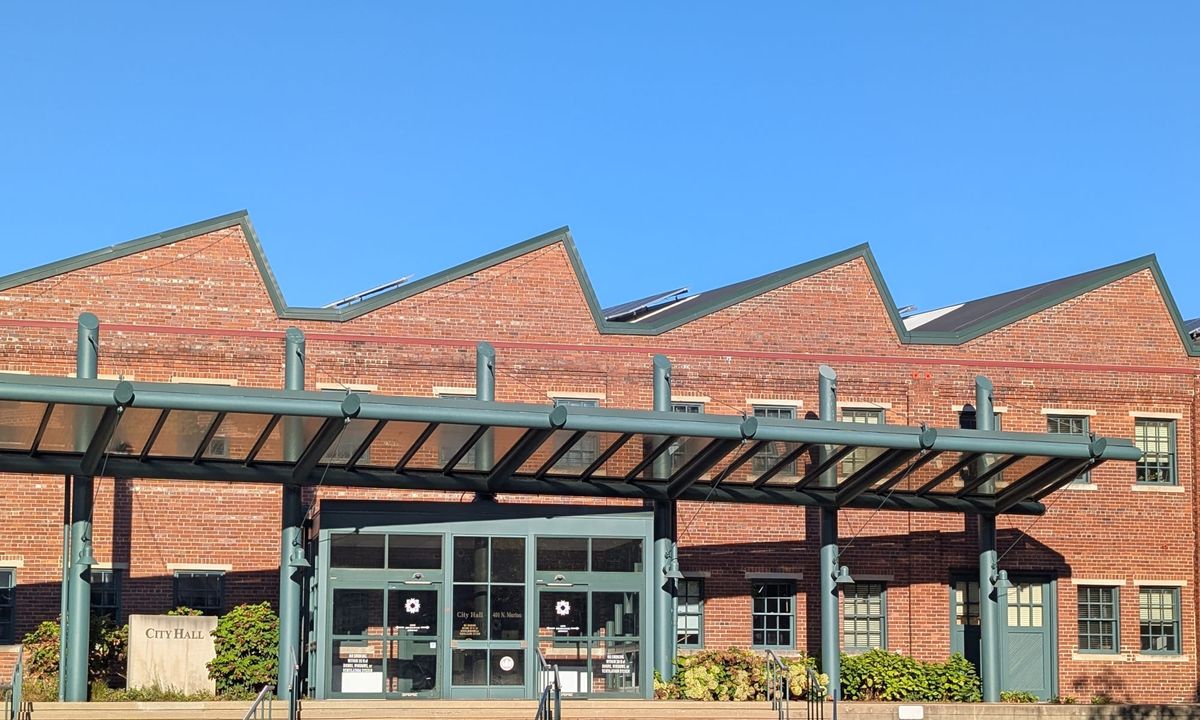
On Monday (Aug. 17), Bloomington residents will get a first look at how mayor Kerry Thomson’s administration and the city council interact publicly over the mayor’s proposed 2027 budget. That’s when councilmembers begin four nights of departmental budget presentations.
The budget review comes on the heels of pointed council critique of the administration’s $37,900 community survey. At the council’s Aug. 5 meeting, councilmembers sharply criticized a methodology that deliberately de-emphasized Indiana University students. Thomson was not in the room for that Aug. 5 presentation.
Councilmembers questioned whether the survey could reliably guide policy or spending, with Hopi Stosberg calling its treatment of students “pretty appalling” and Sydney Zulich calling one explanation from the consultant “a stunningly insulting answer.”
That discussion also pointed directly to the budget. Council president Isak Asare asked what the survey’s findings should actually mean for the city: “What’s the ‘So what?’ for council and the city?” He continued: “What are the things that we’re claiming that should inform our behaviors, actions, decisions, especially as we’re going into budget [review season] here?”
On Monday, councilmembers could begin putting those kinds of questions directly to the mayor.
The 5:30 p.m. meeting will start with citywide overviews from the mayor’s office and city controller Geoff McKim. Those will be followed by departmental presentations from the fire department, police and central dispatch, community and family resources, and housing and neighborhood development (HAND).
The proposed budget was released two working weeks ago, on Aug. 3. It calls for $165.7 million in spending across the city’s tax-supported and special-purpose funds, apart from a separate $65.3-million city of Bloomington utilities (CBU) proposal and general-obligation debt-service funds.
The general fund proposal shows $63.7 million in spending against $58.3 million in estimated revenue, a $5.47-million gap that would be covered from reserves, if the shortfall actually materializes.
Monday’s mayor and controller presentations are not about the budgets for those two offices. Their presentations are essentially citywide introductions applicable across departments. It’s not until the following week when budget presentations for the office of the mayor and office of the controller are scheduled. Those Aug. 26 presentations are set for 10 minutes each.
Thomson’s introductory memo describes the proposal as a “conservative approach” prompted partly by coming revenue pressure from property- and income-tax legislation (SEA 1) approved by the state legislature in 2025.
Her administration says spending decisions are concentrated this year on core municipal services, protecting existing assets and addressing housing, homelessness, public safety and wage growth. The administration is also asking councilmembers who want additional spending to identify an equal amount that could be cut elsewhere.
McKim’s memo gives Monday’s discussion a nuts-and-bolts financial frame. He describes employee compensation as the primary expenditure-side challenge. The proposal adds no full-time positions, but includes a 2.7% cost-of-living adjustment for non-union employees, 3% for union employees, step increases for eligible workers, and higher health-insurance costs.
There’s increase in the required police and fire pension contribution rate from 23.3% to 26.5%. Personnel expenses across the funds covered by McKim’s summary are proposed at $86.7 million, up from $82.2 million in the 2026 budget.
The compensation picture is also a recurring theme in the written questions councilmembers have submitted ahead of the presentations. As of noon Friday, the only councilmembers who had submitted questions were Asare and Isabel Piedmont-Smith. Asare’s questions were all submitted on Aug. 10; Piedmont-Smith submitted questions on Aug. 11, Aug. 13, and Aug. 14.
The city council has posted a link to the written budget questions and administration responses on its webpage.
Asare’s questions consistently ask the administration to connect budgeted payroll with the work defined by a job, and to explain why particular jobs are needed. He asks for a position-by-position accounting of salary, benefits and total cost.
Among the specific positions or groups of positions that Asare highlights for scrutiny are the mayor’s public engagement director (vacant), special assistant to the mayor, homelessness coordinator, executive office manager, communications director, communications coordinator, and legislative affairs specialist.
Also specifically mentioned by Asare are the fire department’s mobile integrated health program manager, vacant sworn police positions and vacant dispatch telecommunicator positions. Asare also has questions about the deputy city clerk positions and the council’s own proposed three-position staff structure.
Asare’s question about the homelessness coordinator position could be taken as representative of his approach:
Homelessness Coordinator caseload, interventions, and outcomes. The narrative states that the Coordinator responds to reports, connects people with support, hosts daily and weekly provider meetings, leads monthly City meetings, researches strategies, and coordinates cases (p. 215). Those activities are described, but the budget does not provide a caseload, service standard, baseline, target, or evidence that the coordination changed outcomes. Provide the 2025 and 2026 year-to-date number of reports received, unique people served, locations addressed, referrals made, referrals accepted, shelter placements, housing placements, repeat contacts, encampments resolved, average response time, cases closed, and cases remaining open. For each measure, provide the baseline, target, actual result, data source, and definition. Separate results produced by the Coordinator from results produced by Heading Home, service providers, Police, CFRD, HAND, or other partners. State the fully loaded 2027 cost, cost per case and successful placement, and the expected measurable change if the position were eliminated
Asare’s questions go beyond personnel. He asks McKim to define exactly what is and is not contained in the headline $165.7-million spending figure, reconcile conflicting 2026 totals in the budget book, distinguish recurring spending from one-time uses of reserves, and provide projected 2026 actual spending, rather than comparisons based only on the adopted budget.
For Monday’s individual departments, Asare asks fire officials to document the need for a $1-million replacement of self-contained breathing apparatus and a proposed $2.5-million aerial platform truck. He asks CFRD for program-by-program cost and outcome information. Aare asks HAND to report housing results such as units produced or preserved, households served and cost per unit, rather than primarily describing activities.
As of the document version available Friday (Aug. 14) around 2 p.m., most of the written questions have no written administration response. The few answers so far include responses about previously approved employee reclassifications, the mayor’s office communications structure, and why future discretionary purchases cannot yet be identified by vendor and amount.
Piedmont-Smith’s questions take up some of the same themes as Asare from a different angle. She asks the mayor to address the $5.47-million general fund gap and the roughly $28-million difference between revenue and expenditures across the funds in McKim’s summary. She also asks whether the administration is actually using an outcome-based approach when deciding what to fund, requests more information about grants and sponsorships, and asks whether a vacant position is reviewed for continued need or if the city automatically fills it.
In the council’s meeting materials, listed budget presentation time spans do not include councilmember questions or discussion.
In past years, the custom of some councilmembers has been to send written questions to department heads after the in-person presentation of the material. After Monday, the remaining departmental presentations are set for Aug. 19, Aug. 24 and Aug. 26.
The final budget is scheduled for its formal introduction on Sept. 23, with a final adoption vote scheduled for Oct. 7.
This year, a raw data file has been provided by the administration with line-by-line revenue and expense numbers proposed for 2027 and adopted for 2026. The figures have been pivoted out by The B Square by department in a shared Google Sheet. Highlighted in red are rows where the number proposed for 2027 is at least 15% more (or less) than the 2026 figure and involves a dollar amount that is more than $10,000.

Comments ()