
Second shots-fired report at Powerline Camp, Monroe County mulls moving up Sept. 1 deadline
A second report of gunfire near Monroe County’s Powerline Camp has renewed pressure to close the encampment before Sept. 1. For now, commissioners are keeping the deadline, while the sheriff’s office works on a plan to prevent the county-owned Thomson property from being reoccupied.
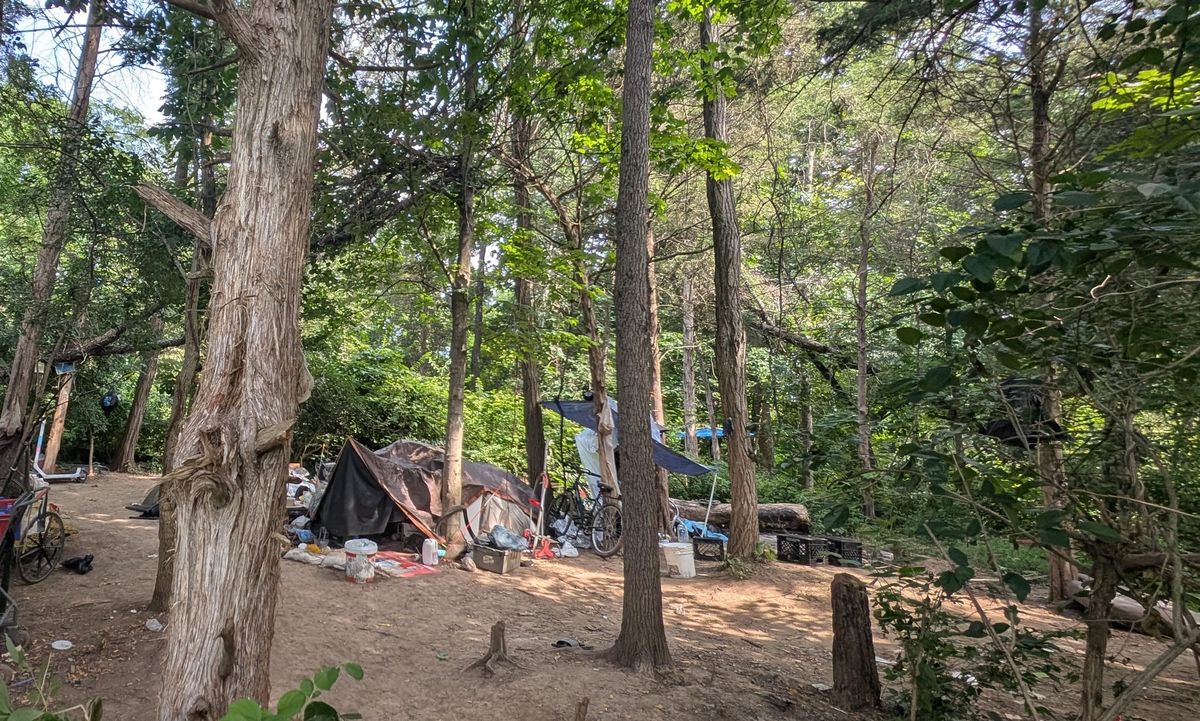
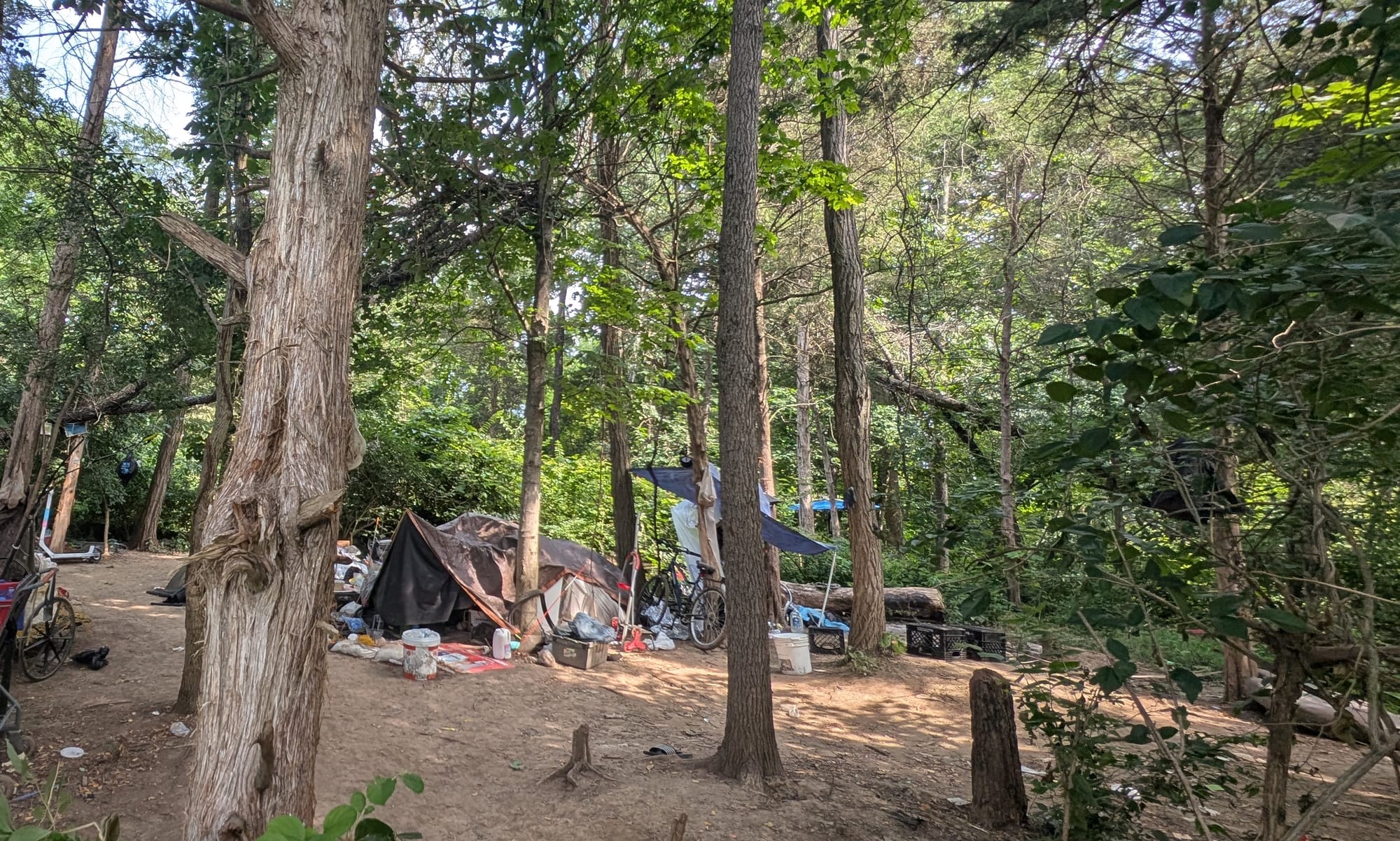
A second report in the span of a week about gunfire at Monroe County’s Thomson property off South Rogers Street has increased tensions around the homeless encampment there.
The encampment, on county-owned land inside Bloomington city limits, is located just north of Osage Place, a Habitat for Humanity neighborhood that is halfway to completed construction. The proximity to Duke Energy power lines gives the place its “Powerline Camp” moniker. Estimates vary for how many people are currently living there, but the figure seems to be around 40.
The recent increased activity in the woods north of the neighborhood has prompted county officials to discuss whether to move up a Sept. 1 deadline they had set for residents to leave.
They have decided to leave the Sept. 1 deadline in place. For now.
On Thursday (Aug. 13), the Monroe County sheriff’s office talked with the county commissioners office about accelerating the closure, according to chief deputy Phil Parker. But as of Thursday evening, the Sept. 1 date remains in place. Still, Parker stressed to The B Square that the decision is not “set in stone” and could change, if conditions change.
To implement an earlier closure, Parker said, it would be essential to have a post-encampment plan in place. That’s because simply clearing the encampment will not solve the problem, if people can return a few days or weeks later, Parker said.
According to Parker, a finalized post-encampment plan, which the sheriff’s office has been working on, is hoped to be ready for submission to county commissioners by Monday (Aug. 17).
Increased tension at Powerline Camp
Thursday’s discussion among county officials about accelerating the timeline for the encampment closure followed another report of shots fired in the area the previous day, on Wednesday (Aug. 12) around 5:36 p.m.
Parker told The B Square that a sheriff’s lieutenant responded with Bloomington police to the weapons call originating from RCA Park. In the vicinity of the “power line area,” 21 spent 9mm shell casings and one unspent 9mm round were found. Bloomington police used a drone to search the area, but officers did not locate anyone with a weapon or anyone who appeared to have been injured, Parker said.
That came just a week after an Aug. 5 incident, when four people fought over a backpack on Cherokee Drive, just south of the encampment. A witness told police he had heard what sounded like four gunshots from the direction of the encampment about 10 minutes before the fight. Sheriff’s deputies searched the camp that day, but found no physical evidence that allowed them to establish where the apparent shots had originated.
Deadline discussion
Late Thursday, the Greater Bloomington Chamber of Commerce made a call for quicker action. In a news release, the chamber called on the county and city to close the encampment before the originally planned date of Sept. 1.
The chamber also wants increased law-enforcement presence around the property and the nearby Osage Place neighborhood. The chamber also called for steps to prevent the property from being reoccupied after it is cleared.
[Added at 3:10 p.m. on Friday, Aug. 14, 2026. Bloomington mayor Kerry Thomson released a statement Friday (Aug. 14) afternoon that also calls for the closure of the encampment ahead of the Sept. 1 deadline. The mayor is quoted in the release saying: “I urge our County partners to move that timeline forward. The City stands ready to support an accelerated closure.” The name of the property is related to Thomson Consumer Electronics, the successor to RCA’s consumer-electronics operation in Bloomington, which is not connected to Bloomington’s mayor.]
Responding to the chamber’s release, county commissioner Julie Thomas indicated to The B Square that commissioners don’t currently intend to change the deadline. “We have provided the people at Thomson with a deadline to leave,” Thomas wrote. “Service providers are active in the area.”
But Thomas left open the possibility that the encampment could be closed earlier than Sept. 1. She indicated that law enforcement could act sooner if circumstances warrant it: “If there is an emergency, [sheriff’s deputies] will do so earlier.”
County commissioner Jody Madeira responded to a B Square question by writing that closing the Powerline Camp “is not as simple as ensuring that the campers are no longer on the property.” She continued, “It requires close coordination on several matters including working with several county departments and outside entities, and this depends on these entities’ schedules as well. All of that needs to be in place for a successful closure. ”
Madeira added, “Because of these logistics, there’s no immediate ability to close the encampment. But if there is an emergency situation our intent will be to find a way to align resources on a new schedule. ”
At the same time, the sheriff’s office is working to finalize what could become the more consequential part of the county’s approach to the encampment: How to keep the Thomson property from immediately becoming occupied again after the current one is cleared.
Parker said that having the post-encampment plan in place is essential to closing the encampment. So speeding up the timeline for closure would also mean speeding up the timeline for finalizing the post-encampment plan.
Parker said he and sheriff Ruben Marté expect to have a finalized post-encampment plan submitted to commissioners by Monday (Aug. 17).
That would put the sheriff’s office in a practical position to contemplate closure ahead of the Sept. 1 deadline. Parker told The B Square that once the post-encampment plan is in place, Marté is in support of discussions about moving up the deadline.
The proposal is expected to have a significant cost, which means the proposal will also need the backing of the fiscal body of the county, which is the county council. Part of the draft annual general obligation bond request from commissioners this year is a $150,000 purchase of drones and cameras, which would be used in part to monitor the Thomson property.
Background for Sept. 1 deadline
The current Sept. 1 deadline was posted Aug. 3. It grew out of a July 23 decision by commissioners Julie Thomas and Jody Madeira that authorized county attorney Jeff Cockerill to begin formal steps toward closing the camp after the sheriff’s office reported increasing public-safety concerns.
The process also reflects a significant change in county policy over the last eight months.
In December 2025, after an attempt to clear the Thomson camp during cold weather prompted substantial public opposition, commissioners adopted a policy requiring at least 30 days notice before a homeless encampment could be cleared.
But on June 4, commissioners removed that 30-day guarantee from the written policy as a new state “street camping” law was about to take effect. County attorney Cockerill said the minimum-notice requirement could conflict with the state law, which gives law enforcement separate authority to act against unauthorized camping on public property. That left the county with no formally guaranteed minimum notice period, although commissioners said 30 days would remain their goal when the county itself initiates a closure.
The new state law generally requires law enforcement to give a person a warning and information about available shelter or services before a street-camping charge can be brought. At least 48 hours must then pass, with the person remaining within 300 feet of the place where the warning was issued. The county’s Sept. 1 deadline is an exercise of the commissioners’ authority as the property owner and does not prevent the sheriff’s office from acting sooner under state law.
Cleanup contract
On Thursday morning, commissioners also voted 2–0 to approve a contract of up to $70,000 for the eventual cleanup of the Thomson property. Commissioner Lee Jones was absent.
The contract with Indianapolis Crime Scene Services LLC, doing business as Bio-One NW Indianapolis, sets a rate of $3,500 a day for up to 20 days.
Under the contract, Bio-One workers are to make a “reasonable effort” to separate trash from belongings that could have real or sentimental value. The county will provide dumpsters, storage containers and equipment for moving material, while Bio-One personnel will handle items in the encampment itself. Needles will be handled under sharps-disposal protocols, and any firearms or controlled drugs found will be turned over to the sheriff’s office.


Comments ()