
Monroe County commissioners unveil jail-site map, scoring grid as they push case for North Park
Monroe County commissioners say time and space will drive their jail-site decision—and both factors point to North Park. They also unveiled a site-evaluation grid and dynamic map, while warning of mounting legal, financial and human costs as a city-county panel nears a recommendation on July 13.
Monroe County commissioners used time at the end of their regular Thursday (July 9) meeting to talk about their priorities for selection of a new county jail site. The key takeaway: Time and space are the two factors they will rely on in their choice of a new jail location.
And those two factors point to North Park, a site that was twice rejected by the county council, most recently on May 26. The fact that North Park remains the first choice of commissioners is not news. But a new dynamic map and a grid with site evaluations count as new tools for absorbing the considerable information that is currently being disseminated.
Commentary from county commissioners Jody Madeira and Julie Thomas on Thursday morning came against the backdrop of a jail-site selection committee (called the Collaborative Justice Project Working Subcommittee) that has been meeting over the last few weeks and is expected to make a recommendation for a new jail site inside the city limits on July 13. Commissioner Lee Jones did not attend Thursday’s meeting.
The CJPWS on Monday narrowed a list of 16 properties to five options, including renovation of the current jail and justice center in combination with the nearby Curry Building. The group has been working through evaluation criteria and seeking additional information about the remaining sites. The committee’s work follows the county council’s May 26 rejection of an $11.375-million purchase of the North Park property, which left the county without a selected site after years of planning for a new jail. [Monroe County Jail Timeline]
At the same time, the county is emerging from nearly two decades of federal court oversight: A lawsuit over conditions at the downtown jail, filed in 2008, was dismissed June 8, but the dismissal left open the possibility of new litigation over jail conditions.
On Thursday morning, commissioner Jody Madeira stressed that under Indiana law it is the county executive’s duty to establish and maintain a county jail, and that means the board of commissioners. The CJPWS, now drafting its own recommendation, is “non‑binding,” she said, but still has value. Part of that value, Madeira said, is educational. The work of the CJPWS, which is open to the public, can help the public move “away from slogans and misunderstandings and toward concrete criteria like time and space, infrastructure and access, costs and legal risk,” Madeira said.
The commissioners have decided not to participate formally in the work of the CJPWS and have made clear they do not see it as a substitute for their own statutory role or that of the county council. Madeira has participated in the work of the CJPWS as a member of the public—by offering feedback on the selection criteria adopted by the CJPWS, and by providing background on the importance of single-story jail design.
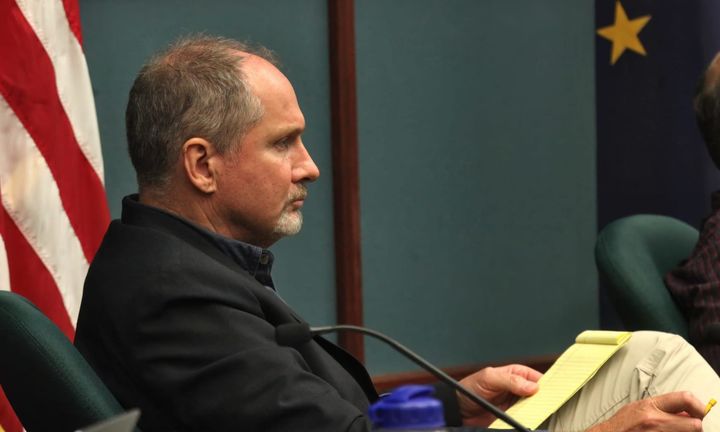
On Thursday morning, Julie Thomas boiled the problem down to two requirements: time and space. Thomas called time the most important factor, both because of construction inflation and because of “human costs” tied to continued operation of an aging and failing facility. Any site inside the city adds roughly a year to the process, she said, because of city planning and city council approvals: “Anything in the city will take an extra year—anything. That’s just the way it is.”
In the context of the assumptions used by the commissioners, adequate space means at least 25 acres. Madeira said that figure comes from work by DLZ, the sheriff, and other partners. That amount of space is meant not only to accommodate a 400‑bed jail with expansion capacity but also, eventually, courts, prosecutor, public defender, clerk and related justice offices.
Co‑location of those offices has existed in Monroe County for four decades and is “strongly preferred,” Madeira said. Failing to plan for colocation now would lock in higher operating costs stemming from more transports, more staff, and more vehicles. Not colocating those other offices would introduce ongoing security and liability risks, she added.
Thomas pointed to Vigo County as a cautionary example of under‑building. That county opened a new jail only to face continued capacity pressures that led to construction of another jail. She said local officials there told her their council had cut the design below what was needed and they were now trying to “figure out how to make this work.”
Madeira focused on the importance of a one-story design for a new jail . A single‑story jail, she said, is “empirically valid, evidence‑based,” citing peer‑reviewed criminological research on carceral design. One‑level, direct‑supervision layouts with true lines of sight, natural light and visible greenery are associated with fewer assaults, lower suicidality and better conditions for both inmates and staff, Madeira said. She said she wants “the least traumatic experience in a facility that we know is traumatic for everyone” and said she does not want to build “a prison that is more prison‑like than it has to be.”
Both commissioners also worked to show that the county’s own vetting has been extensive, independent of the CJPWS matrix.
Thomas unveiled a grid that she described as a “pretty comprehensive” list of every site the commissioners have studied over “many years,” from sub‑10‑acre parcels to larger tracts such as North Park and Tapp Road. [spreadsheet format for grid] For each site, the table identifies key barriers and decision points: size, ownership, legal and zoning constraints, sewer and utility access, slope and karst, flood issues, land and infrastructure costs, expected time to build, and an overall conclusion.
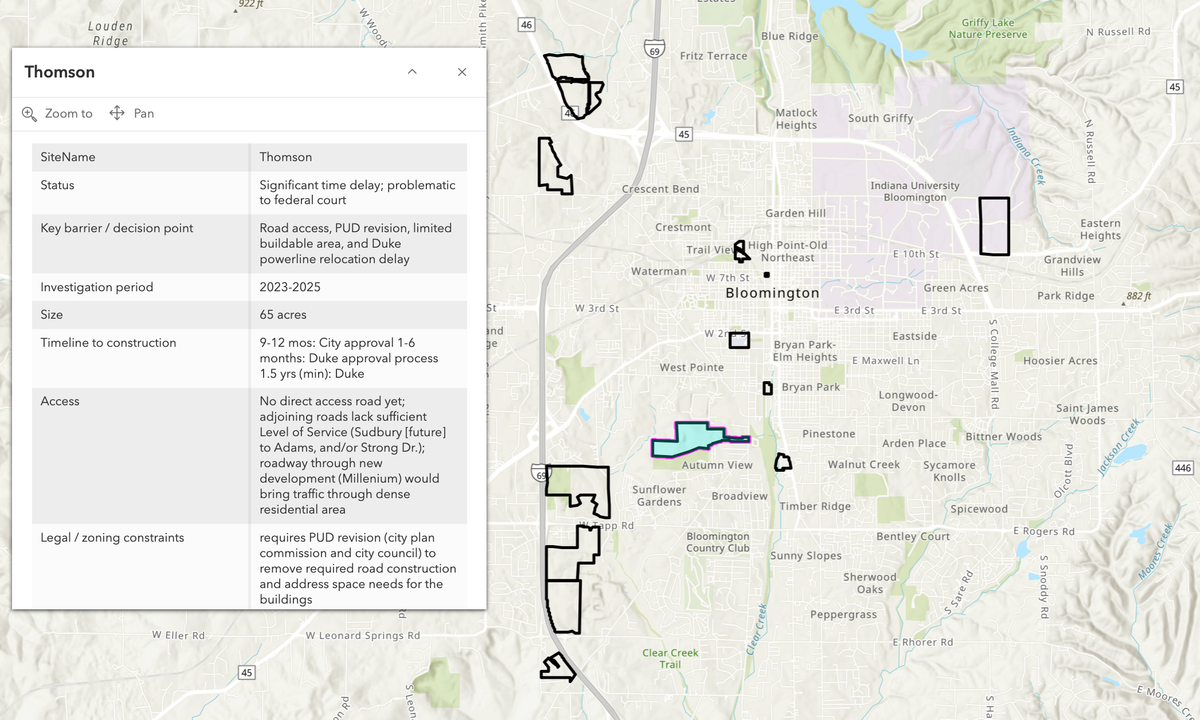
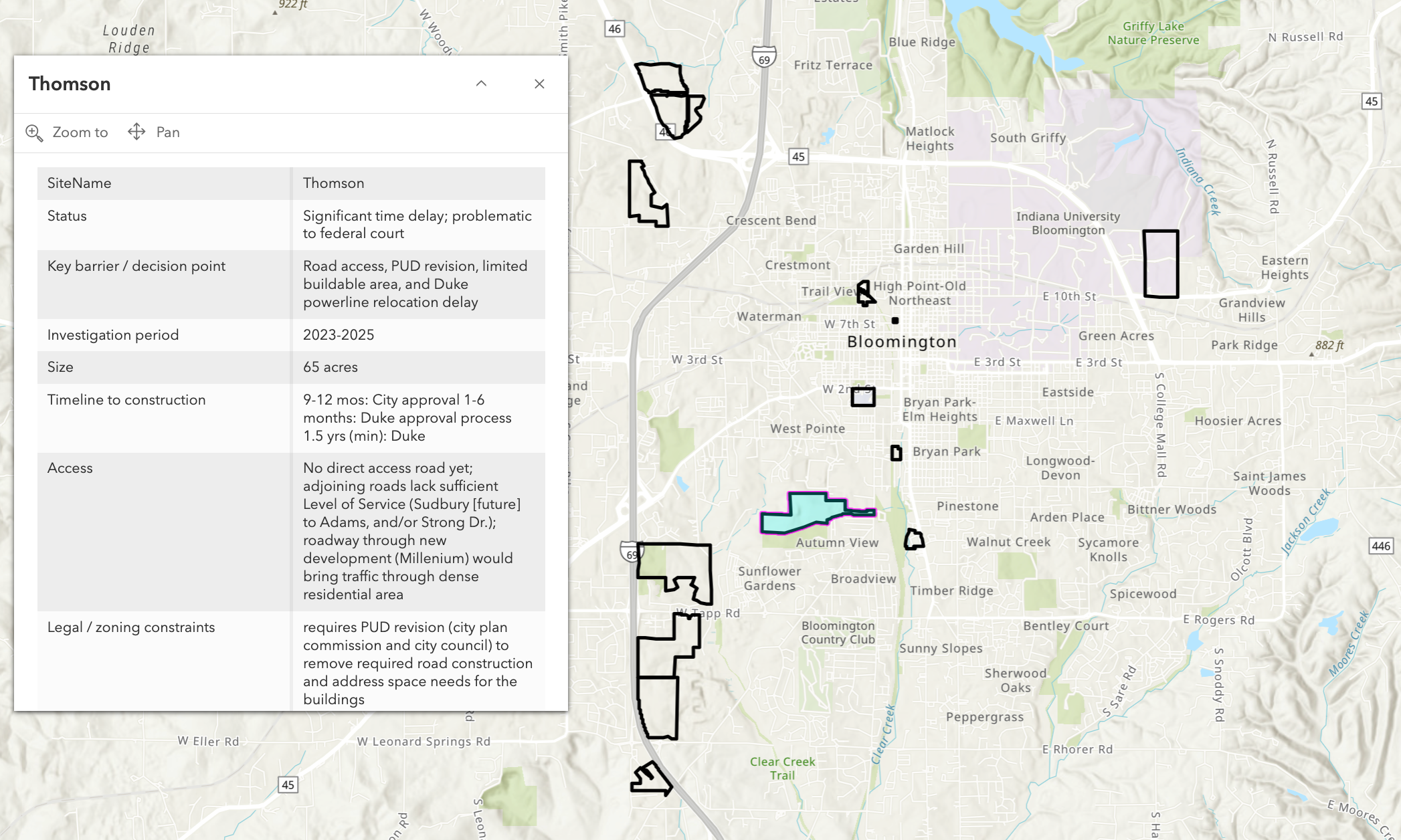
In parallel, the county’s GIS staff has produced a dynamic map that lets the public click on each potential location for a jail and see the same narrative assessment that appears in the chart. A slope layer can be switched on to visualize topographic problems. Thomas flagged the Tapp Road tracts as examples where steep grade changes and a planned city connector road could make much of the acreage unusable.
Within that framework, Thomas said, only North Park met all of the requirements, including the 25‑acre threshold, access and infrastructure feasibility, and lack of legal impediments. She criticized the assignment given to the CJPWS because it ruled out any site outside city limits at the outset. Thomas called that “a mistake” that removed a property “a stone’s throw from the city” from consideration (North Park).
Madeira wrapped up the issue of urgency by saying that every time the conversation circles back to “infeasible” locations is another “moment that we are exposed legally, financially, and morally.”
The next meeting of the Collaborative Justice Project Working Subcommittee is Thursday (July 9) at 6 p.m.


Comments ()